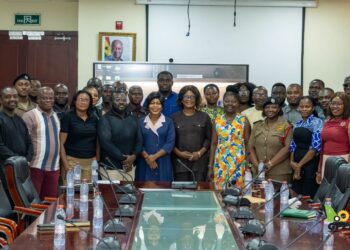

A high-powered delegation from the Importers and Exporters Association of Ghana (IEAG) recently arrived at the Ghana Standards Authority (GSA) Head Office to engage directly with the Director-General, Prof. George Agyei, and his senior executive team.
While the meeting was formally characterized as a courtesy call, the underlying agenda was far more substantive. It marked a deliberate effort to synchronize the regulatory rigor of the GSA with the commercial urgency of the private sector, specifically focusing on the optimization of Ghana’s maritime and land ports.
“The courtesy call focused on exploring avenues for collaboration between GSA and IEAG to strengthen port operations and to discuss ways to improve Ghana’s ports for the benefit of all industry players”
Ghana Standards Authority
For years, the relationship between trade regulators and the associations representing the boots on the ground has been one of professional tension – a natural byproduct of the friction between strict standard enforcement and the need for rapid cargo clearance. However, this engagement suggested a shift toward a consultative framework.
The GSA is the primary gatekeeper of national quality, tasked with ensuring that every item entering or leaving the country meets rigorous safety and performance benchmarks. The IEAG, conversely, represents the vital flow of goods that fuels the domestic market and drives foreign exchange.

Bringing these two entities to the same table was a calculated move to ensure that regulation facilitates trade rather than obstructing it. The primary focus of the dialogue was the exploration of new avenues for collaboration, as the port is a complex ecosystem of documentation, physical inspection, and digital validation.
Any delay in this ecosystem carries a direct financial penalty, which is ultimately passed down to the Ghanaian consumer. Sitting down with the Director-General, the IEAG leadership sought to move past reactionary grievances and toward a proactive system where standards are integrated into the workflow of importers and exporters.
Strengthening port operations requires a shared understanding of what constitutes “efficiency.” From the GSA’s perspective, this denotes the ability to identify and neutralize substandard goods before they enter the market. From the IEAG’s perspective, it is the ability to clear compliant goods with minimal stay time.
The meeting served as a diagnostic session for these competing priorities, with the goal being to establish a “seamless compliance” model where the IEAG’s members are better educated on GSA requirements before their containers ever reach the quay, thereby reducing the need for intrusive, time-consuming interventions at the port.
Competitive Advantage
One of the more nuanced themes of the discussion was the idea that high standards are not just a hurdle, but a competitive advantage for Ghanaian businesses.

For exporters within the IEAG, the GSA is the entity that provides the quality passport needed to enter lucrative European and North American markets. Without a robust and internationally recognized standards regime, “Made in Ghana” products would struggle to find a foothold abroad.
The IEAG’s move to call on the GSA Director-General highlights an awareness that a stronger regulator actually protects the legitimate trader. When the GSA is effective at weeding out counterfeit or substandard imports, it protects the honest importers of the IEAG from being undercut by cheap, dangerous alternatives.
The meeting was notable for its emphasis on the “industry-wide” impact of these discussions. The IEAG did not arrive with a list of narrow, firm-specific complaints. Instead, the focus remained on the broader health of the trade ecosystem. This macro-level approach is essential for long-term reform.
The benefits of the GSA and IEAG collaborating on improving port systems are expected to ripple out beyond their immediate memberships to include shipping lines, freight forwarders, and logistics providers. This engagement comes at a time when Ghana is under increasing pressure to improve its ease of doing business rankings, particularly in the category of Trading Across Borders.
The GSA’s role in this is pivotal. If the authority can successfully implement more digitalized, risk-based inspection protocols, the speed of port operations could increase significantly without compromising safety. The Director-General’s willingness to host the IEAG delegation underscored an openness to this kind of modernized, data-driven regulation.
The trade community is watching closely to see if this recent dialogue translates into tangible changes at the port gates. The expectation is that a joint task force or a regular consultative forum will emerge from this meeting, providing a dedicated space for solving technical trade barriers in real-time.
READ ALSO: Legendary Ghanaian Playwright Kwaw Ansah Brings Timeless Drama ‘Mother’s Tears’