
The Ghana-Korea economic corridor has breached the $380 million threshold, marking a definitive shift from routine diplomacy to a high-octane partnership of industrial and cultural fusion.
According to the Republic of Korea’s Ambassador to Ghana, H.E. Park Kyongsig, the 2025 trade volume represents a significant year-on-year surge, fueled by a unique cocktail of investor confidence, industrial synergy, and an aggressive deployment of soft power.
As Seoul looks to deepen its footprint in West Africa, Ghana has emerged not merely as a trading partner but as a sophisticated strategic base for Korean industrial expansion. This upward trajectory is a validation of Ghana’s ongoing investment reforms and a testament to the growing appetite for Korean technical expertise in the sub-region.
“Trade between our two countries is increasing year by year, and we are seeing more interest from Korean businesses looking to establish operations in Ghana. Ghana remains an attractive destination for Korean investors, with many using it as a strategic base to expand”
H.E. Park Kyongsig, Korea’s Ambassador to Ghana
Ambassador Park’s $380 million figure revelation, shared on the sidelines of a Korean cuisine cooking class in Accra, underscores a fundamental evolution in how the two nations interact. The gradual rise observed in previous years has transitioned into a robust growth phase, driven by a deliberate alignment between Korea’s technological prowess and Ghana’s industrial transformation agenda.
This relationship is increasingly defined by the transfer of high-level skills and the integration of Korean electronics and construction giants into the fabric of the Ghanaian economy. In a masterstroke of unconventional statecraft, Ambassador Park linked the success of multi-million dollar trade deals to the popularity of K-food, music, and film.
This culinary diplomacy is based on the premise that economic cooperation is most sustainable when it is built on a foundation of cultural affinity.
Hosting a cooking class to celebrate Korean cuisine, for example, effectively lowers the psychological barriers to trade. When Ghanaian consumers embrace Korean culture, they are more likely to trust Korean brands, creating a fertile ground for the 20 Korean companies currently operating within the country.
“Cultural exchange is very important because it forms the foundation for stronger economic cooperation and future development. Beyond economic indicators, people-to-people relations and cultural diplomacy play a critical role in strengthening trade partnerships”
H.E. Park Kyongsig, Korea’s Ambassador to Ghana
For the Ambassador, this people-to-people strategy creates favorable environments for long-term capital commitment. His optimism was rooted in the belief that cultural familiarity breeds investor security between both nations. As Korean films and music dominate global charts, the halo effect extends to Korean manufacturing and technology, and vice versa.
Culture has become the invisible infrastructure that allows for the frictionless flow of goods and services.
The West African Hub
Perhaps the most significant revelation from Ambassador Park is the strategic positioning of the 20 Korean companies currently on the ground. These firms are not viewing Ghana as an isolated market of 33 million people; they are viewing it as the gateway to the broader West African sub-region.
This leverages Ghana’s relative political stability and its central role in the African Continental Free Trade Area (AfCFTA) to serve as a manufacturing and logistics springboard for the continent. For Seoul, Ghana is the beachhead for a larger African economic offensive.
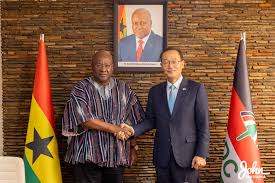
This geographic arbitrage is particularly evident in the construction, electronics, and manufacturing sectors, where Korean companies are not just selling products but are building capacity, establishing operations in Accra and Tema.
These firms are contributing to local job creation and skills development, ensuring that the $380 million in trade translates into tangible human capital gains for the Ghanaian workforce. This model of investment-led trade is far more resilient than traditional commodity-based exchange, as it creates a permanent industrial footprint that survives market volatility.
HE. Kyongsig noted that the partnership is moving rapidly into high-value technical domains. While traditional trade remains strong, the new focus is on industrialization, technology transfer, and infrastructure development, with Korea’s support for Ghana’s industrial transformation agenda becoming increasingly technical – involving capacity building and knowledge sharing through specialized initiatives.
This is a value-adding partnership that seeks to move Ghana up the global value chain by integrating Korean digital innovation and green technology into local production processes. The role of Korean electronics firms is particularly noteworthy.
As Ghana pushes for a more digitized economy, the presence of Korean tech giants provides the necessary hardware and software ecosystem to support local innovation. The synergy is extending to green technology too, where Korean expertise in renewable energy and sustainable manufacturing is being sought to secure Ghana’s industrial base.
For the Korean Ambassador, the continued growth of this $380 million partnership is contingent on the ease of doing business. He was clear in his assessment: Korean capital is watching Ghana’s investment regime reforms with intense interest.
Ongoing efforts to streamline bureaucracy and enhance transparency are the primary catalysts for attracting the next wave of Korean investment. The Ambassador’s optimistic outlook for sectors like construction and technology is tied directly to the government’s ability to maintain a predictable and favorable regulatory environment.
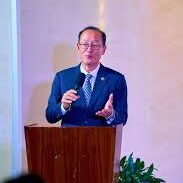
As both countries explore new avenues for cooperation – particularly in digital innovation – the $380 million figure is expected to become the new baseline rather than the ceiling. The success of the 2025 trade year proves that the Ghana-Korea fusion is working.
Through blending cultural diplomacy with hard-nosed industrial strategy, the two nations have created a resilient economic corridor that defies global trends. For the Ghanaian economy, the Korean partnership offers a rare opportunity to leapfrog traditional development stages through rapid technology transfer.
For Korea, Ghana offers a stable, high-growth environment to showcase its industrial maturity.
READ ALSO: Morgan Nero Crowned Unsung Artiste of the Year for 27th TGMA