
The Minister for Food and Agriculture, Hon. Eric Opoku, has forged a strategic alliance with the University of Cape Coast (UCC) to weaponize biotechnology and advanced research in the national drive for agricultural industrialization.
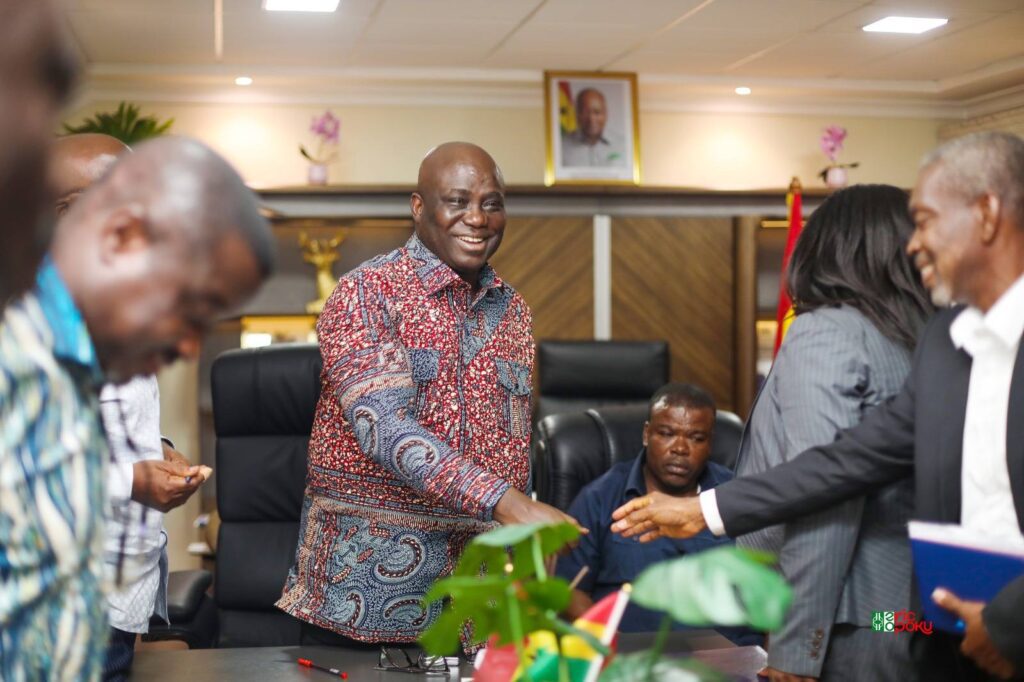
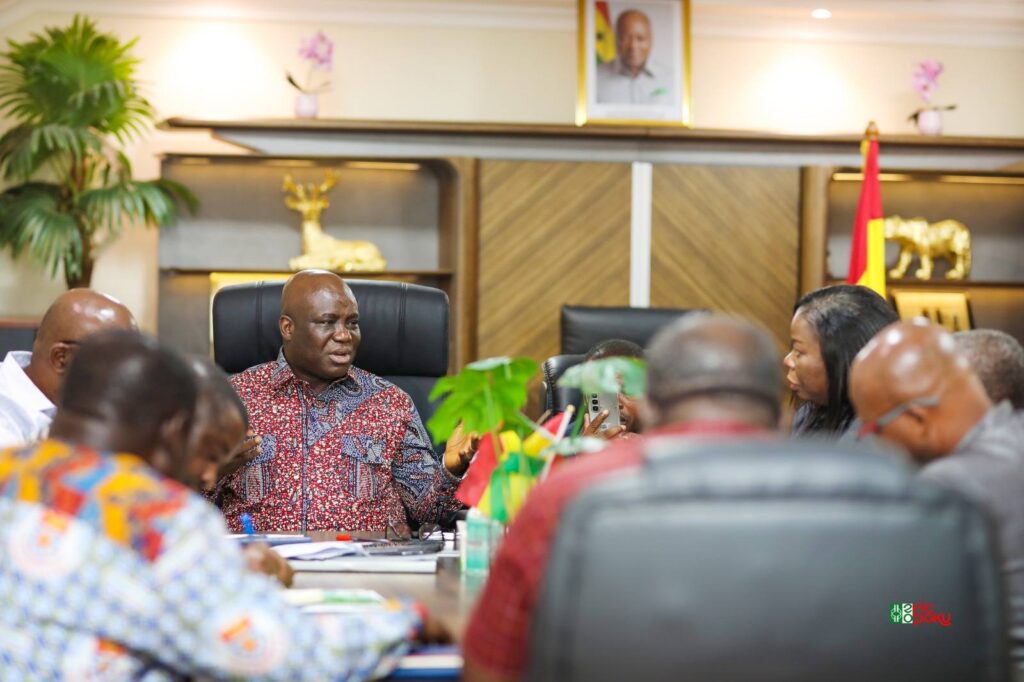
In a recently held high-level consultative meeting, Hon. Opoku received a delegation of academic heavyweights and administrative leaders to bridge the gap between laboratory research and field-level productivity, marking a departure from traditional farming rhetoric.
According to the Minister, the move is toward a “science-to-soil” framework, where the University’s intellectual capital is directly tethered to the government’s economic transformation agenda – prioritizing the operationalization of a national seed bank and the integration of molecular processing.
“I received an esteemed delegation of academics and administrative leaders from the University Of Cape Coast led by Prof. Rofela Combey, Provost, College of Agriculture and Natural Sciences together with Prof. Henry De-Graft Acquah- Dean, School of Agriculture, Eng. Prof. Ransford Obeng Darko- Associate Professor, Department of Agriculture Engineering… to deliberate on agricultural advancements”
Hon. Eric Opoku, Minister for Food and Agriculture
The Prof. Combey-led delegation from the University of Cape Coast presented a technical roadmap that shifts the focus from raw commodity exports to high-value industrial outputs, positioning science as the primary engine for President John Dramani Mahama’s agricultural reset.
The dialogue deliberated the mechanics of job creation and value-chain enhancement. For the Minister – recognizing that to make a primary economic engine, the sector must move beyond the hoe-and-cutlass era and embrace the precision of advanced science – the involvement of UCC’s School of Agriculture and Department of Agriculture Engineering is a necessity.
A central pillar of the discussion was the urgent requirement to operationalize a national seed bank, noting that in the current global agricultural landscape, seed sovereignty is a matter of national security.
The partnership aims to cultivate and distribute locally viable seeds characterized by specific varietal nomenclature – essentially ensuring that Ghanaian farmers have access to seeds that are scientifically optimized for the local climate, soil profile, and resistance to emerging pests.
Domesticating the seed production process through UCC’s research facilities is a step towards ending the country’s reliance on imported hybrids that often carry high costs and uncertain long-term viability.
The initiative is to operate within a closed-loop system where the University develops the genetic blueprints for high-performing crops, and the Ministry of Food and Agriculture (MoFA) provides the material support to scale their distribution across the country’s farming belts.
It was highlighted that the seeds are not just generic placeholders but are tailored for specific industrial uses – such as high-starch cassava for industrial adhesives or specific shea varieties optimized for the global cosmetics and pharmaceutical markets. This level of specificity is the hallmark of the new agricultural mandate under Hon. Eric Opoku.
Molecular Processing
The partnership is also set to revolutionize the processing of traditional Ghanaian staples, specifically cassava and shea butter. For decades, these commodities have been exported in their most basic forms, leaving the majority of the profit margins to be captured by foreign refineries.
The UCC delegation, including experts in advanced molecular processing, explored how biotechnology can be used to add value at the source, involving the use of advanced techniques to extract higher-purity derivatives from shea and transforming cassava into a versatile industrial raw material.
The Ministry hopes to effectively build an industrial buffer against fluctuating global commodity prices by integrating these molecular techniques into the local agribusiness framework. Hon. Opoku added that if successful, Ghana will no longer just be a supplier of raw nuts and tubers; it will become a regional hub for bio-processed agricultural derivatives.
This shift is expected to stimulate a new wave of high-skilled job creation, moving the youth into the technical and laboratory-driven side of the agricultural sector rather than just manual labor.
Representing the Government of Ghana and the strategic vision of President John Dramani Mahama, the Minister “unequivocally pledged comprehensive human and material support,” to turn these research objectives into field realities.
This pledge is a significant indicator of the government’s willingness to fund the science-to-soil pipeline. The University leadership has mirrored this commitment, offering its institutional support to provide the technical oversight and research data necessary to guide policy decisions.
This mutual commitment is expected to be codified in a formal Memorandum of Understanding (MOU) in the near future – an MOU that will act as the operational manual for the partnership, defining the specific benchmarks for the seed bank’s rollout and the timelines for the introduction of molecular processing units in key farming districts.
The collaboration between MoFA and UCC is the physical manifestation of a broader strategic shift, as the President’s vision requires agriculture to go beyond feeding the nation to powering the economy.

The partnership leverages the expertise of Eng. Prof. Ransford Obeng Darko and the broader academic team to ensure that the engineering and financial frameworks of the sector are as robust as the biological ones.
The inclusion of the College Registrar and Finance Officer in the delegation underscored the comprehensiveness of the institutional merger, focusing on the administrative and fiscal viability of the proposed projects.
READ ALSO: Family Sets Final Funeral Rites for Gospel Legend Yaw Sarpong