
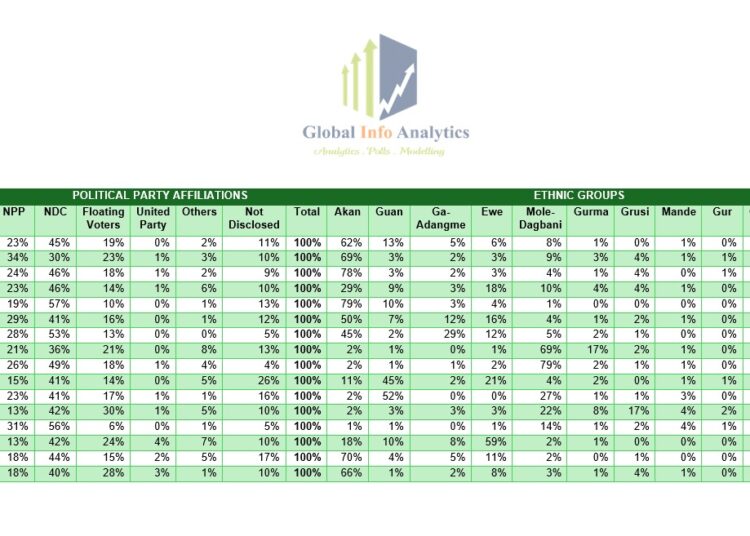
A new national tracking poll conducted by Global InfoAnalytics has revealed a significant decline in support for the opposition New Patriotic Party, with the governing National Democratic Congress now reportedly holding majority voter affiliation in fifteen out of Ghana’s sixteen regions.
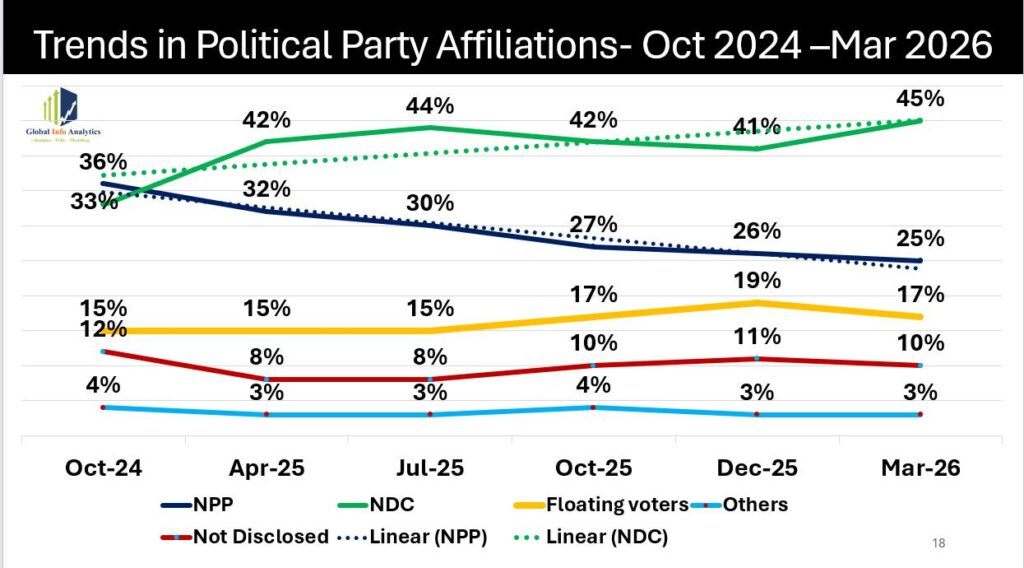
The findings, released by Executive Director Mussa Dankwa as part of the March 2026 tracking poll, show that 45 percent of voters nationwide currently identify with the NDC compared to 25 percent for the NPP.
According to the poll, 17 percent of respondents identified as floating voters, while 10 percent declined to disclose their political affiliation and 3 percent aligned with other political parties.
“The March 2026 poll shows 45 percent of all voters in Ghana are NDC, 25 percent NPP, 17 percent floating voters, 10 percent not disclosed and 3 percent other parties”.
Global InfoAnalytics Executive Director Mussa Dankwa
The poll further revealed that the NDC now holds majority affiliation in every region except the Ashanti Region, traditionally regarded as the NPP’s strongest political base.
According to Global InfoAnalytics, this marks the first time since the organization began national tracking polls in 2020 that one party has dominated voter affiliation across fifteen regions.
Ashanti Remains NPP’s Only Stronghold
Despite the broader decline in support, the Ashanti Region remains the only region where the NPP continues to maintain majority affiliation according to the poll findings.
However, the survey also suggests that support for the NPP within the Ashanti Region has weakened considerably since the 2024 general elections. Polling data cited by Global InfoAnalytics indicates that NPP affiliation in the region reportedly declined from 56 percent in November 2024 to between 34 and 37 percent by early 2025.
Political analysts say the trend reflects growing voter dissatisfaction within parts of the party’s traditional support base following the NPP’s defeat in the 2024 elections. The poll also identified major political shifts in the Eastern Region, another area historically associated with the NPP.
According to the findings, the NDC has now overtaken the NPP in the Eastern Region, securing 41 percent support compared to the NPP’s 29 percent. The changes in both the Ashanti and the Eastern regions could have significant implications for future electoral contests given their strategic political importance.
Decline Linked to Economic Frustration
Political analysts and pollsters have attributed the NPP’s declining support largely to public dissatisfaction with economic conditions and perceptions about governance during its previous administration.
According to Global InfoAnalytics, widespread frustration over living conditions, inflation, and economic management contributed heavily to voter discontent before and after the 2024 elections.
The poll also suggests that voter apathy among traditional NPP supporters played a major role in the party’s electoral decline. Estimates cited in the survey indicate that more than 2.1 million NPP supporters who participated in the 2020 elections did not vote in the 2024 elections.

Analysts believe the drop in turnout among the party’s own support base reflected disappointment and declining confidence among core voters. The report further pointed to ongoing internal divisions within the NPP as another factor contributing to the party’s current difficulties.
Although many party delegates reportedly remain optimistic about future grassroots unity, observers say unresolved leadership tensions continue to affect the party’s image and organizational strength.
Educated Voters Moving Away
The latest poll also suggests that the NPP has experienced declining support among highly educated voters. According to Global InfoAnalytics, only 27 percent of respondents with a tertiary education currently identify with the NPP.
This represents a major challenge for the party given its historical strength among sections of the educated middle class and professional communities. The survey also highlighted broader concerns regarding public confidence in government institutions over recent years.

According to the findings, trust in government institutions reportedly declined from 56 percent in 2018 to 31 percent by 2024. Analysts say falling institutional trust may have contributed to broader political dissatisfaction and shifting voter preferences across several regions.
The poll findings come amid continued debate within the NPP over responsibility for the party’s defeat in the 2024 general elections. According to a post election survey conducted by Global InfoAnalytics in April 2025, many voters attributed the party’s electoral loss to key figures within the previous administration.
Former President Nana Akufo-Addo was reportedly identified by 68 percent of respondents as one of the main figures responsible for the defeat. Former Finance Minister Ken Ofori-Atta was cited by 40 percent of respondents, while Mahamudu Bawumia was mentioned by 37 percent.
The findings reflect continuing internal reflection within the NPP as the party attempts to rebuild support ahead of future elections.
NDC Gains Political Momentum
The latest poll underscores growing momentum for the governing NDC following its victory in the 2024 elections. The governing party’s dominance across most regions is being interpreted by observers as a sign of strengthened grassroots support and improved national reach.
However, analysts also caution that voter affiliation trends can shift over time depending on economic conditions, governance performance, and political developments.
With several years remaining before the next general elections, both major political parties are expected to intensify efforts aimed at consolidating support and rebuilding voter confidence.
For the NPP, the latest findings are likely to increase pressure on party leadership to address internal divisions, reconnect with core supporters, and restore public confidence.
READ ALSO: IMF Predicts Tougher Economic Road Ahead