
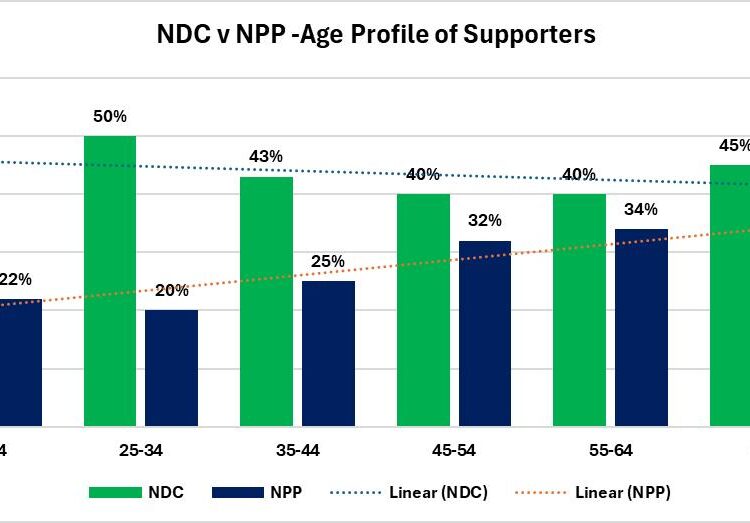
New data from Global InfoAnalytics suggests a significant shift in Ghana’s political dynamics, with the National Democratic Congress gaining stronger support among younger and more educated voters, while the New Patriotic Party faces declining affiliation.
A key finding of the poll is the growing influence of younger voters, who appear to be aligning more strongly with the ruling National Democratic Congress.
The data indicates that a higher proportion of younger voters now associate with the NDC compared to the NPP, suggesting a shift in political loyalty among the country’s youth.
The trend becomes more pronounced when viewed across age groups. While support for the NDC declines gradually among older voters, the NPP’s support shows the opposite pattern, increasing with age. This divergence points to a generational divide in political preferences.
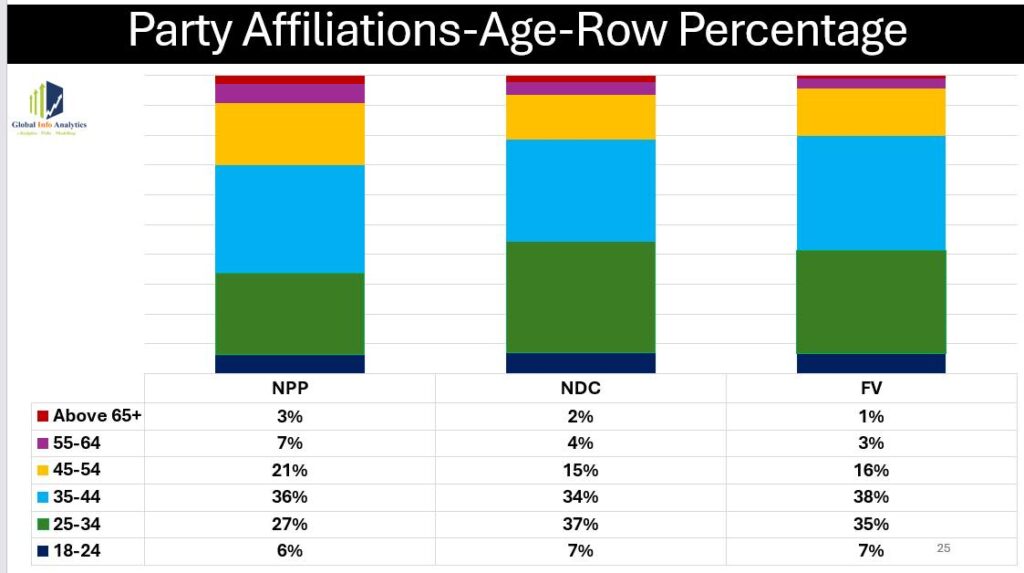
The data further reveals that 77 percent of all respondents in the poll are below the age of 44. Within this demographic, 79 percent of NDC supporters fall into this age bracket, compared to approximately 70 percent for the NPP.
This suggests that the NPP’s support base is less aligned with the broader voter population, which is predominantly youthful. Mr Dankwa emphasised the importance of demographic analysis in understanding political trends, noting that the data offers clear insights for those willing to examine it closely.
The renowned pollster indicated that shifting preferences among younger voters could have long-term implications for electoral competitiveness.
Education Gap Widens Between Parties
Beyond age demographics, the poll also highlights differences in party affiliation based on educational attainment. The National Democratic Congress appears to hold a significant advantage among voters with higher levels of education.
The data shows that the NDC’s largest margin over the NPP is among voters with university degrees and higher qualifications, where the party leads by a substantial 24 percentage points. This suggests that educated voters are increasingly gravitating toward the NDC.
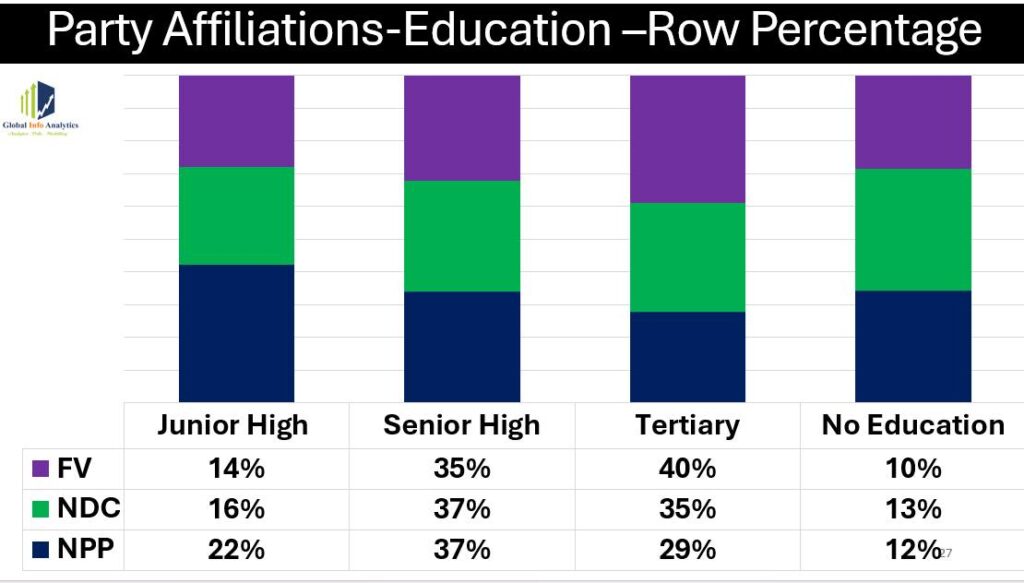
Overall, 72 percent of NDC supporters have at least senior high school or tertiary level education, compared to 66 percent among NPP supporters. While both parties draw support from educated voters, the NDC’s stronger performance in this category points to a growing gap.
Analysts suggest that this trend may reflect broader perceptions about policy direction, governance, and economic management, although the poll itself does not explore the underlying reasons for voter preferences.
Regional Dynamics and Electoral Risks
The findings also shed light on regional patterns that could influence future elections. The NPP’s support base remains heavily concentrated in two key regions, Ashanti and Greater Accra, which together account for 48 percent of its total support.
In contrast, the National Democratic Congress’s support is more geographically distributed across the country, with only 36 percent of its base concentrated in these regions.
Instead, the NDC appears to have a stronger presence in swing regions such as Greater Accra, Central, and Western, which collectively account for 44 percent of its support compared to 36 percent for the NPP.
This distribution presents a strategic challenge for the NPP, particularly in Greater Accra, which is widely regarded as a critical battleground in national elections. The data suggests that failure to secure victory in this region could significantly reduce the party’s chances of winning future elections.
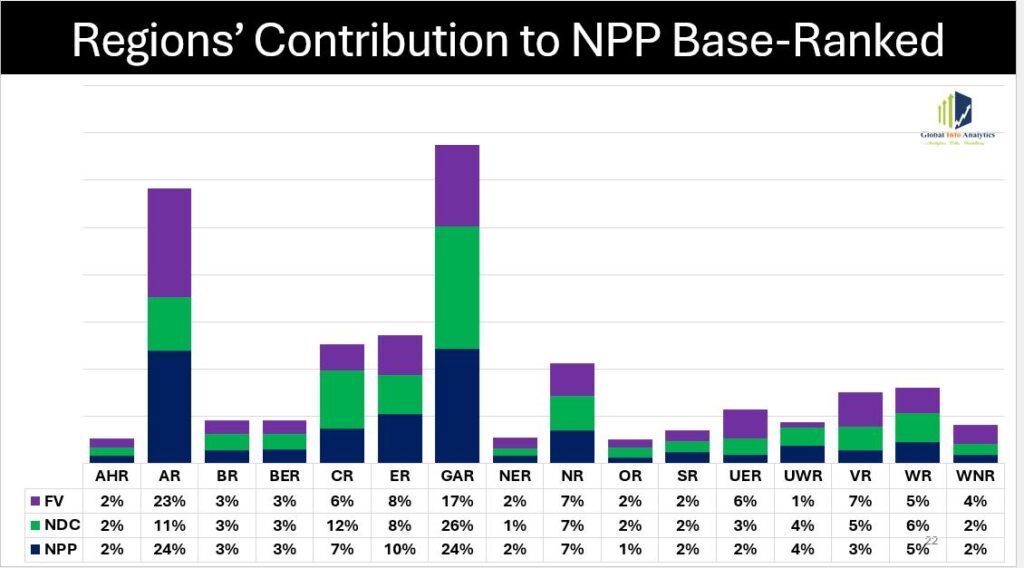
Mr Dankwa cautioned that relying heavily on a limited number of regions poses a considerable risk, especially in a competitive political environment where voter preferences are shifting.
The findings, drawn from an ongoing face-to-face tracking poll conducted in March 2026, point to evolving voter preferences that could shape future electoral outcomes.
According to Executive Director Mussa Dankwa, the latest figures reinforce earlier indications that the gap between the two major political parties is widening. The poll shows that only 25 percent of voters now identify with the New Patriotic Party, compared with 46 percent for the National Democratic Congress.
This marks a notable shift from the period before the 2024 general elections, when the New Patriotic Party held 37 percent affiliation, and the National Democratic Congress stood at 33 percent.
The emerging trend highlights a broader realignment in Ghana’s political landscape, with demographic factors playing an increasingly decisive role in shaping party support.
Implications for Ghana’s Political Future
The Global InfoAnalytics poll results underscore the importance of adapting to changing voter demographics and expectations. With a youthful population that is increasingly influential in shaping electoral outcomes, political parties may need to rethink their strategies to remain competitive.
The growing support for the NDC among younger and more educated voters suggests that these groups could play a decisive role in future elections. At the same time, the NPP’s stronger appeal among older voters indicates that generational differences will continue to shape political alignments.

The widening gap between the two parties also raises broader questions about voter sentiment and the direction of Ghana’s democratic process. As political competition intensifies, the ability of parties to connect with diverse demographic groups may prove critical.
While the data provides a snapshot of current trends, it also points to the dynamic nature of Ghana’s political landscape. As the country moves closer to future electoral cycles, shifts in voter behaviour will remain a key factor in determining outcomes.
READ ALSO: Ghana Lands ‘RR4’ in Major Fitch Review