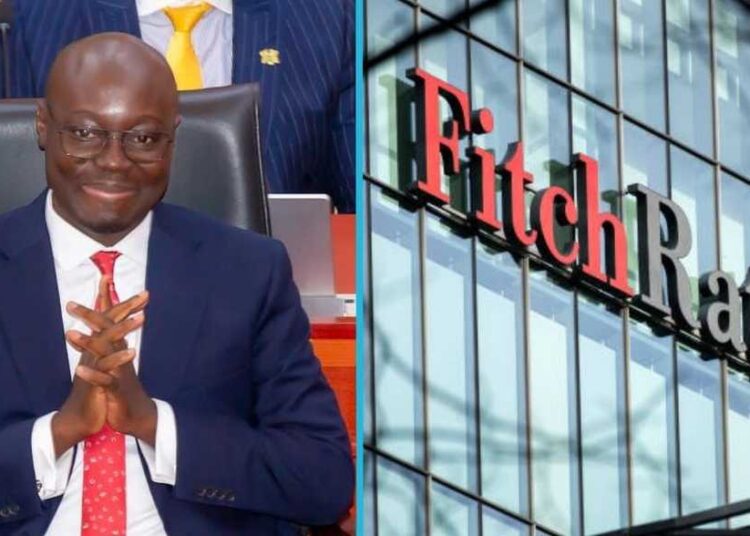
Ghana has secured a notable position in the latest sovereign credit assessment by Fitch Ratings, which affirmed the country’s Long-Term debt ratings at ‘B-’ and assigned a Recovery Rating of ‘RR4’.
The decision signals rating stability while introducing a deeper layer of analysis that places recovery prospects at the center of sovereign risk evaluation.
The rating action also saw Ghana removed from Under Criteria Observation following Fitch’s implementation of its updated Sovereign Rating Criteria introduced in September 2025. This development reflects a methodological shift rather than a sudden change in economic conditions, yet it carries important implications for how investors interpret the country’s debt risk profile.
By reaffirming the Long-Term Foreign- and Local-Currency Issuer Default Ratings at ‘B-’, Fitch underscored continuity in Ghana’s credit standing. The Stable Outlook attached to the rating suggests that near-term risks are viewed as broadly balanced, offering a measure of predictability to investors monitoring the country’s fiscal and macroeconomic trajectory.
Understanding the ‘RR4’ Recovery Rating
A key highlight of the review is the assignment of a ‘RR4’ Recovery Rating to Ghana’s senior unsecured Long-Term debt. This marks the first time Fitch has formally embedded recovery assumptions into its sovereign rating framework. The move aligns sovereign credit assessments more closely with corporate debt analysis, where recovery expectations have long shaped investor decision-making.
The ‘RR4’ classification indicates average recovery prospects in the event of a sovereign default. In practical terms, this means investors could expect moderate levels of capital recovery should debt restructuring occur. Fitch explained that the rating reflects the absence of clearly identifiable recovery drivers that would otherwise improve expected outcomes for creditors.
For market participants, recovery ratings add nuance to traditional credit scores. While the ‘B-’ rating captures the likelihood of default, the recovery rating provides insight into potential loss severity if a default materializes. Together, these measures offer a more rounded view of sovereign credit risk.
Alignment with Issuer Default Ratings
Fitch also aligned Ghana’s senior unsecured Long-Term debt ratings with its Issuer Default Ratings. This technical adjustment ensures consistency across Ghana’s sovereign credit instruments and strengthens the transparency of the rating framework.
The alignment means that changes to the country’s Issuer Default Ratings will directly influence instrument-level ratings. As a result, shifts in macroeconomic performance, fiscal consolidation efforts, or debt sustainability metrics could transmit more quickly across Ghana’s credit profile.
This linkage reinforces the central role of sovereign fundamentals in shaping investor confidence. Stronger economic management, credible fiscal reforms, and stable external balances will remain decisive factors in determining how Ghana’s debt is perceived in global markets.
Context from the June 2025 Upgrade
The reaffirmation builds on earlier positive momentum recorded in June 2025, when Fitch upgraded Ghana’s Long-Term Foreign- and Local-Currency Issuer Default Ratings to ‘B-’ with a Stable Outlook. That upgrade reflected improving macroeconomic and fiscal conditions at the time, including better revenue performance, tighter expenditure controls, and progress on debt restructuring efforts.
Although the current review does not represent a fresh upgrade, it confirms that the earlier gains have been sustained. Stability in ratings can be as significant as upgrades, particularly for economies emerging from periods of financial strain. It signals policy continuity and reinforces perceptions of a steadier economic path.
For Ghana, maintaining the rating level supports its re-engagement with international capital markets. Investors typically view rating stability as a sign that downside risks are contained, which can help reduce borrowing costs and widen access to funding.
Governance Metrics Strengthen the Assessment
Governance quality featured prominently in Fitch’s evaluation. The agency assigned Ghana an ESG Relevance Score of ‘5’ for Political Stability and Rights, and ‘5[+]’ for Rule of Law, Institutional and Regulatory Quality, and Control of Corruption.
These scores draw heavily from the World Bank Governance Indicators, which form a core component of Fitch’s proprietary Sovereign Rating Model. Ghana’s governance performance placed it in the 51st percentile globally, reflecting a mixed but credible institutional profile.
Fitch highlighted Ghana’s track record of peaceful political transitions and moderate political participation rights as positive factors. Established legal and institutional frameworks also contributed to the assessment. However, the agency noted that a moderate level of corruption continues to weigh on governance perceptions.
Strong governance structures are increasingly influential in credit analysis. Transparent institutions and predictable regulatory systems reduce uncertainty for investors and enhance policy effectiveness. Ghana’s positioning near the global median suggests room for improvement while demonstrating foundational institutional resilience.
Implications for Investors and Policymakers
The reaffirmed rating and recovery assessment carry practical implications for both investors and policymakers. For investors, the combination of a ‘B-’ rating and ‘RR4’ recovery outlook provides clearer risk pricing benchmarks. It helps portfolio managers evaluate expected returns relative to potential loss scenarios.
For policymakers, the review reinforces the importance of sustaining macroeconomic reforms and institutional strengthening. Continued fiscal discipline, debt management improvements, and governance reforms could support future rating upgrades and better recovery prospects.
The sensitivity of Ghana’s instrument-level ratings to changes in Issuer Default Ratings also heightens the stakes. Any deterioration in economic fundamentals could quickly influence the broader credit profile, while sustained improvements may translate into stronger market confidence.
In essence, Fitch’s latest action is both a validation of progress made and a reminder of the work ahead. Ghana’s credit story remains one of cautious recovery, institutional consolidation, and measured optimism within a challenging global financial landscape.
READ ALSO: Kofie: Sidelining Local Farmers Threatens AETA Goals