

The Ministry of Finance has launched a Public Financial Management Compliance League Table in a significant move to strengthen fiscal discipline and promote accountability across public institutions.
The initiative, described as a landmark transparency measure, delivers on a commitment outlined in the 2025 Budget Statement to provide an objective and evidence based assessment of how state institutions comply with existing financial management laws.
The League Table evaluates adherence to the Public Financial Management Act, 2016 and its accompanying regulations, offering a structured framework to measure how effectively public entities manage and utilize state resources.
By ranking institutions based on compliance levels, the Ministry aims to create a culture of responsibility and continuous improvement within the public sector.
The introduction of the League Table reflects a broader effort to enhance oversight and ensure that public funds are managed in line with established rules and procedures. It also provides a clear performance benchmark that can guide both policymakers and institutions in identifying areas that require attention.
Driving Transparency and Accountability
At the core of the initiative is the goal of deepening transparency in the management of public finances. The League Table is designed not only to highlight strong performers but also to expose compliance gaps that may undermine effective governance.

By publicly ranking institutions, the Ministry is creating an environment where performance is visible and measurable. This approach is expected to encourage institutions to improve their compliance systems while reinforcing the importance of accountability in public administration.
The League Table also serves as a diagnostic tool, offering insights into systemic weaknesses that may exist within certain institutions. These insights are expected to inform targeted interventions and policy adjustments aimed at strengthening financial management practices across the board.
According to the Ministry, the exercise is not intended to penalize institutions arbitrarily but to promote constructive engagement and reform. Institutions that fall short of compliance standards will be supported to identify deficiencies and implement corrective measures.
Top Performers Demonstrate Strong Compliance
The inaugural League Table highlights a number of institutions that have demonstrated high levels of compliance with public financial management requirements.
Among these are the Environmental Protection Authority, Tema Oil Refinery, Ministry of Energy and Green Transition, Ghana National Petroleum Corporation, Ministry of Finance, Ghana AIDS Commission, and the Petroleum Development Hub Corporation.
These institutions are recognized for adhering closely to financial regulations and maintaining strong internal systems for managing public resources. Their performance sets a benchmark for others and illustrates the potential benefits of disciplined financial governance.
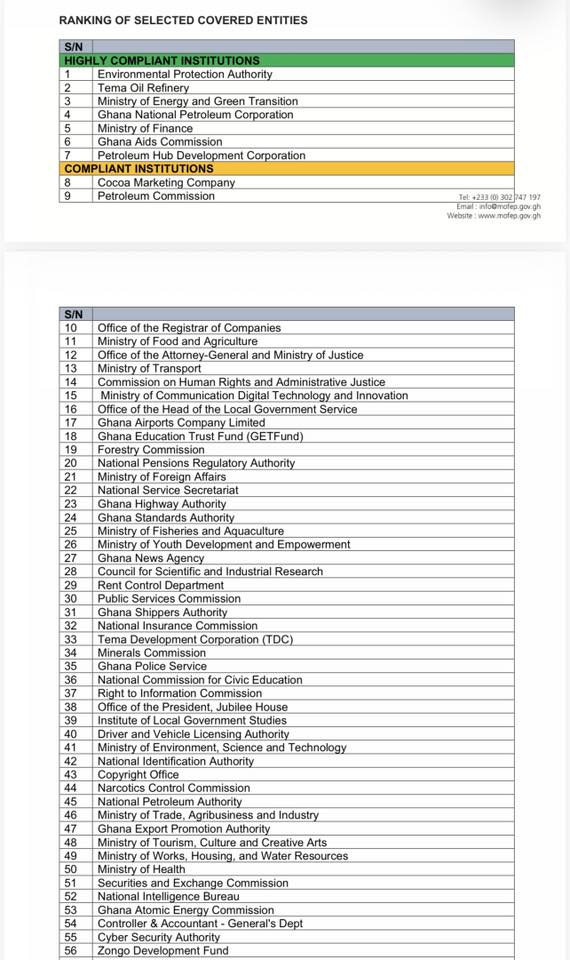
The high compliance levels often correlate with improved operational efficiency and better service delivery, reinforcing the importance of adhering to established financial management frameworks.
Compliance Gaps Raise Concerns
Despite the strong performance of some institutions, the League Table also reveals significant compliance challenges within parts of the public sector. A number of entities have been identified as having low compliance scores, raising concerns about the effectiveness of their financial management systems.
Institutions listed among the least compliant include the Office of the Legal Aid Commission, Mineral Income Investment Fund, Ghana Commodity Exchange, Venture Capital Trust Fund, National Peace Council, Financial Intelligence Centre, Korle Bu Teaching Hospital, University of Ghana, and Ghana Integrated Iron and Steel Development Corporation.
It also includes the National Council for Curriculum and Assessment, Ghana Revenue Authority, National Media Commission, National Food Buffer Stock Company, Office of the Head of the Civil Service, Ministry of Education Headquarters, Ghana National Fire Service, National Disaster Management Organisation, National Communications Authority, and the Ghana Infrastructure Fund for Electronic Communications.
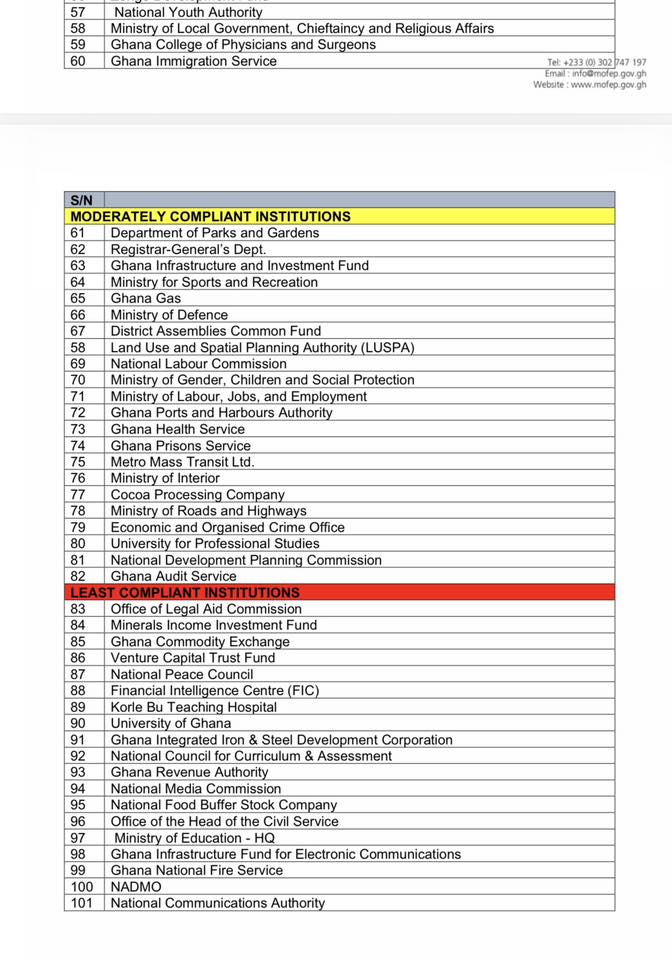
The identification of these institutions highlights areas where urgent reforms may be needed to ensure compliance with financial regulations. It also underscores the importance of strengthening internal controls and accountability mechanisms to prevent misuse of public funds.
Between the highly compliant and least compliant categories, the League Table also identifies institutions that fall within compliant and moderately compliant classifications, indicating varying levels of adherence across the public sector.
Sanctions and Corrective Measures Ahead
The Ministry of Finance has signaled a firm approach to addressing persistent non compliance, indicating that tougher enforcement measures will be implemented where necessary. Through its Public Financial Management Compliance Division, the Ministry plans to engage directly with institutions that have recorded low scores.
These engagements will focus on identifying specific gaps in compliance systems and providing guidance on how to address them. However, officials have made it clear that continued non compliance will attract sanctions, reflecting the government’s commitment to enforcing financial discipline.
The move toward stricter enforcement is expected to send a strong signal to public institutions that adherence to financial regulations is not optional. It also aligns with broader efforts to ensure that public resources are used efficiently and transparently.

The introduction of the PFM Compliance League Table marks a significant step in Ghana’s efforts to strengthen fiscal governance. By combining transparency, accountability, and enforcement, the initiative seeks to address longstanding challenges in public financial management.
Analysts suggest that the success of the League Table will depend on consistent implementation and the willingness of institutions to embrace reform. If effectively managed, the initiative could lead to improved financial discipline, reduced waste, and better outcomes in public service delivery.
As Ghana continues to pursue economic stability and sustainable development, the importance of sound financial management cannot be overstated. The League Table provides a practical tool for monitoring progress and ensuring that public institutions remain accountable to the citizens they serve.
READ ALSO: Ghana, Colombia Sign Deal to Boost Maritime Trade