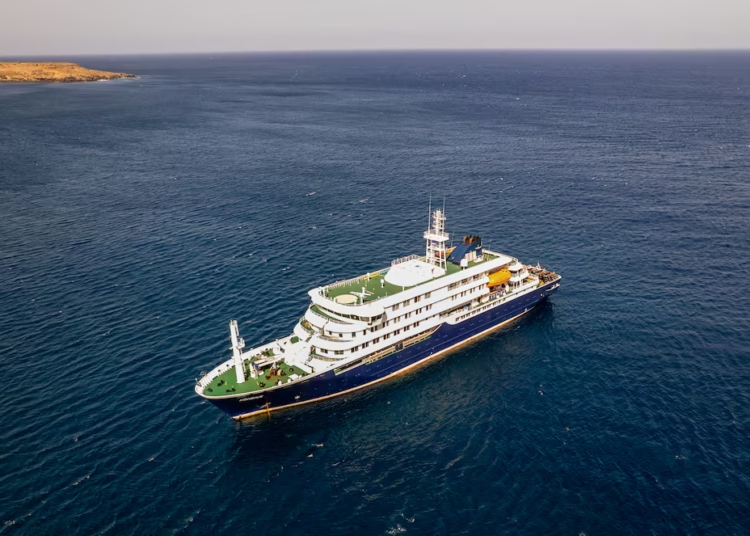
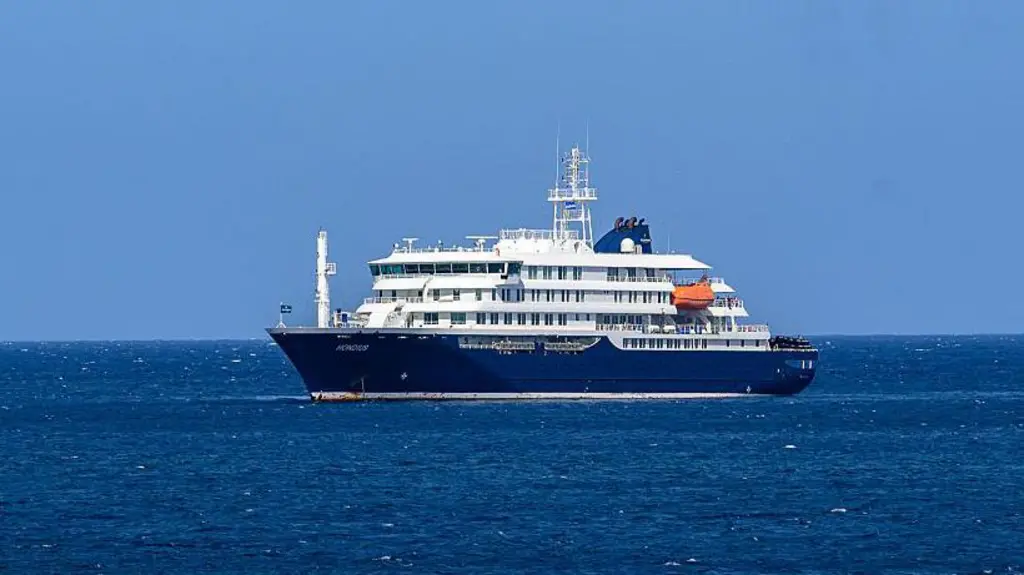
Spain has begun a carefully coordinated evacuation of passengers from the MV Hondius, the expedition cruise ship anchored off Tenerife after a deadly hantavirus outbreak.
The Dutch-flagged vessel arrived at the industrial port of Granadilla on Sunday, nearly a month after the first passenger died while the ship was sailing through the South Atlantic. As daylight broke, the ship remained anchored offshore within a one-nautical-mile security perimeter enforced by military police boats, while emergency teams on land prepared to transfer more than 100 passengers and crew to charter flights bound for their home countries.
Spanish Health Minister Mónica García noted that the operation was “proceeding normally” and confirmed that all passengers still on board were asymptomatic.

Earlier in the morning, medical teams boarded the vessel to carry out final health assessments. Through telephoto lenses, passengers were seen walking on deck and standing at cabin windows wearing white medical face masks, while some sat socially distanced in small evacuation boats, filming and taking photographs as they were ferried to shore, where officials dressed in white protective suits received them.
Per the report, passengers are being disembarked in phases according to nationality. Fourteen Spanish nationals were the first to leave the ship and will be flown to Madrid, where they will undergo quarantine at the Gómez Ulla military hospital. According to the Spanish officials, the operation is “unprecedented.”
Moreover, extensive precautions have been put in place to ensure there is no direct contact between passengers and the local population. Dozens of intensive care specialists are on standby at Tenerife’s Candelaria hospital, where a fully equipped isolation room with testing kits and a ventilator has been prepared in case any passenger becomes seriously ill during the transfer.
According to Chief Intensive Care Doctor, Mar Martin, large quantities of protective suits, masks and gloves have been stockpiled for medical staff, adding, “We are absolutely ready.”
“We’ve never seen hantavirus before – but it’s a virus, with some complications, just like we manage every day. We are fully trained for that.”
Mar Martin
The outbreak has been linked to a landfill site in southern Argentina, a popular destination for birdwatchers and home to rodents known to carry the Andes strain of hantavirus. Although the virus is rare and is typically transmitted from rodents to humans, limited person-to-person transmission has been documented in close-contact settings.
World Health Organization Director-General, Tedros Adhanom Ghebreyesus, has also arrived in Tenerife to oversee the disembarkation and has praised Spain’s response as “solid and effective.”

He added that “Your concern is legitimate, because of the experience of Covid: that trauma is still in our minds. However, he emphasised that the risk of wider contagion now was low “because of how the virus works, and because of how the Spanish government has prepared to avoid any problem.“
The ship’s arrival initially sparked protests among some residents and port workers concerned about safety. Tensions escalated when Canary Islands President Fernando Clavijo briefly threatened to block the vessel, warning that a rat carrying the virus might “get off the ship in the middle of the night and endanger the people of the Canary Islands.” But National health officials later dismissed the suggestion, insisting that such a scenario was “not a risk.”
Not all those on board will disembark in Tenerife. Around 30 crew members will remain on the vessel to sail the Hondius to the Netherlands. For most passengers, however, the operation marks the end of weeks of fear and uncertainty at sea, though an extended period of quarantine still lies ahead.
Global Airlift Mobilized as Nations Race to Repatriate Hantavirus Cruise Passengers
Meanwhile, countries across Europe, North America and Oceania have mobilized aircraft to evacuate their citizens from the MV Hondius, as authorities in Tenerife carry out a tightly controlled operation following a deadly hantavirus outbreak aboard the expedition vessel.
Belgium, France, Germany, Ireland, the United States, the United Kingdom and the Netherlands confirmed that they had dispatched planes for their passengers
The World Health Organization reported that eight people linked to the outbreak have fallen ill after leaving the ship, including three who died: a Dutch couple and a German national. Six infections have been laboratory confirmed, while two remain suspected cases.
According to Spanish authorities, passengers will remain on board until their designated evacuation flights are ready. The next group to disembark includes Dutch passengers, along with citizens of Germany, Belgium and Greece. They will be followed by travelers from Turkey, France, the United Kingdom and the United States.
“The final flight of the operation is departing from Australia. It is the most complex flight and is scheduled to arrive tomorrow afternoon.”
Mónica García
The final aircraft is expected to transport six passengers from Australia, New Zealand and other Asian countries, marking the last stage of one of the most complex repatriation efforts mounted during a modern public health emergency.
READ ALSO: TGMA 2026: A Night of Stellar Wins and Ghanaian Musical Brilliance