Chief Executive Officer of the Ghana Investment Promotion Centre (GIPC), Mr. Simon Madjie, has led a high-level strategic visit to Weatherford’s integrated operations facility in Houston, Texas, to establish a framework for advanced technical collaboration and investment in Ghana’s upstream petroleum sector.
This move serves as a pivotal step in Ghana’s broader agenda to strengthen ties with global oilfield service leaders, ensuring that the nation’s energy landscape benefits from cutting-edge technologies that drive efficiency.
By engaging directly with Weatherford, the GIPC aims to bridge the gap between local production needs and international technical expertise, specifically focusing on expanding drilling activity and deepening value creation within the Ghanaian economy.
“Discussions focused on Weatherford’s capabilities in drilling, production optimisation, intervention services, managed pressure drilling technologies, and real-time operational support, while also exploring opportunities for future collaboration in technology transfer, drilling support, and capacity building.”
Ghana Investment Promotion Centre (GIPC)
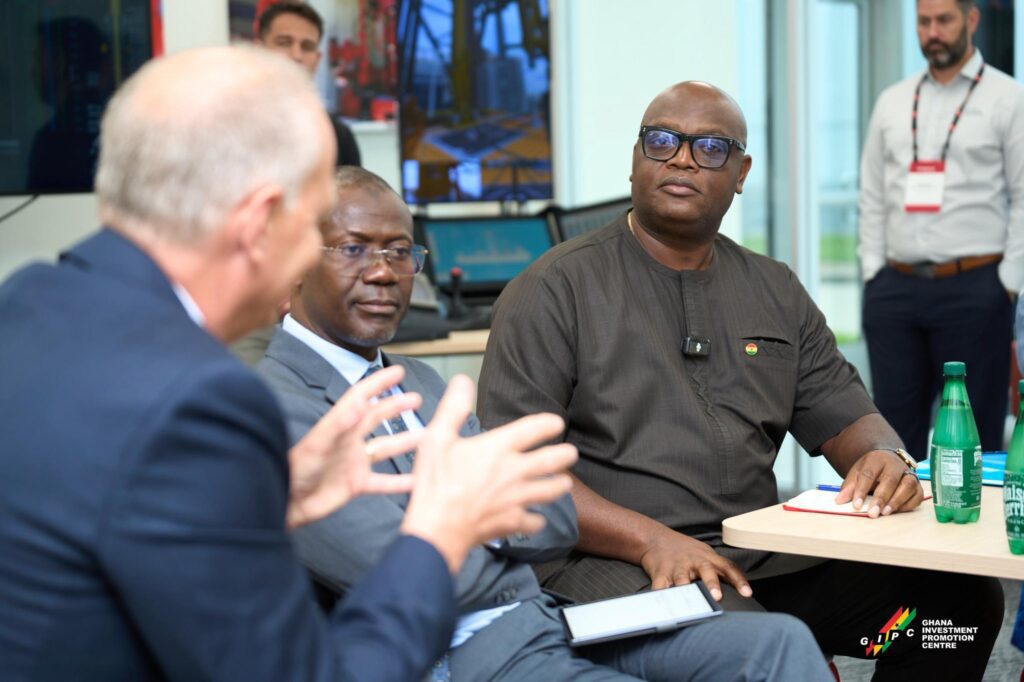
Mr. Madjie’s visit to the Houston facility follows his active participation in the 2026 Offshore Technology Conference (OTC), where the Ghanaian delegation underscored the country’s readiness for responsible and optimized energy investments.
Accompanied by the Deputy Chief Executive Officer of the Ghana National Petroleum Corporation (GNPC), Mr. Hamis Ussif, and representatives from the Ghana Houston Chamber of Commerce, the team conducted an extensive tour of Weatherford’s operations to evaluate the company’s specialized capabilities.
The delegation prioritized discussions on Managed Pressure Drilling (MPD), real-time operational support, and intervention services, which are critical for Ghana as it seeks to optimize production in increasingly complex offshore environments.
This engagement reinforces the government’s commitment to positioning Ghana as a competitive hub for petroleum excellence in the sub-region through strategic partnerships that emphasize technology transfer and human capital development.
Enhancing Production Efficiency through Advanced Drilling Technologies
The integration of Weatherford’s proprietary technologies, such as the Victus™ Intelligent Managed Pressure Drilling (MPD) system, is expected to provide Ghana with a significant technical edge in its offshore operations.

By utilizing automated algorithmic models for real-time analysis, these systems allow operators to maintain precise bottomhole pressure, which is vital for drilling in deepwater terrains where the margin between pore pressure and fracture gradient is narrow.
“Strategic partnerships in technology are no longer optional but a requirement for maximizing our natural resource wealth,” a senior representative from the GIPC noted during the facility tour.
Such technologies minimize the risk of well-control incidents and significantly reduce non-productive time (NPT), ensuring that drilling projects remain on schedule and within budget while protecting the integrity of the reservoir.
Furthermore, the focus on production optimization services through artificial lift and rigless restoration can help Ghana rejuvenate underperforming wells without the massive capital expenditure typically associated with heavy workover units.
Weatherford’s ability to deploy “integrated intervention solutions” means that Ghanaian oil fields can maintain plateau production levels for longer durations.
This technical support is projected to lead to a measurable increase in the recovery factor of Ghana’s existing fields, such as Jubilee and PECAN, by addressing flow assurance challenges and restoring well integrity riglessly.
The adoption of these services aligns with the country’s goal of ensuring that every barrel of oil is extracted as efficiently and sustainably as possible.

Strategic Value Creation and Local Capacity Building
Beyond the immediate technical gains, this collaboration is designed to serve as a catalyst for local content participation and the systematic transfer of specialized skills to Ghanaian engineers.
By establishing a direct pipeline for capacity building, the GIPC and GNPC are ensuring that the “future of Ghana’s energy sector is built on a foundation of indigenous expertise supported by global innovation.”
The discussions in Houston explicitly touched on creating frameworks for training programs that would allow Ghanaian technicians to master real-time operational support and digital oilfield tools. This move is expected to decrease the long-term reliance on expatriate technical labor, thereby retaining more of the petroleum value chain’s economic benefits within the domestic economy.
The collaboration also provides a platform for Ghanaian indigenous companies to partner with global giants in the provision of sub-surface and intervention services.

The GIPC’s proactive stance in Houston signals to the global market that Ghana is not merely seeking passive investment, but is actively pursuing partnerships that offer “responsible energy investment and high-tier technical support.”
This strategy is poised to enhance the investment climate, making Ghana the preferred destination for energy firms looking for a stable and technologically forward-thinking environment in Africa.
Economic Impact and Future Outlook for the Petroleum Sector
The long-term economic implications of this technical alliance are profound, particularly concerning national revenue stability and energy security.
By optimizing production through Weatherford’s advanced intervention and drilling services, Ghana can better hedge against the volatility of global oil prices through consistent and maximized output.
The ability to “survey, monitor, and model performance” through digital twin technologies will allow the GNPC to make data-driven decisions that safeguard the nation’s fiscal interests.
This meticulous approach to asset management ensures that the state receives its fair share of mineral royalties and petroleum revenues while maintaining the health of the fields for future generations.
As the 2026 Offshore Technology Conference concludes, the GIPC’s engagement with Weatherford stands as a testament to Ghana’s evolving role in the global energy discourse.
The move reflects a sophisticated understanding of the “extractive and energy landscape,” where technical prowess is the primary currency of success.
Through these efforts, Ghana is effectively transitioning from a frontier producer to a mature energy economy characterized by high-tech operations, robust local participation, and a clear vision for a sustainable energy future.
The success of these collaborative efforts will likely set a benchmark for how African nations can leverage international technical partnerships to drive national development and industrial growth.
READ ALSO: Government Calls For Contract Renegotiation To Fast Track Road Completion By 2027