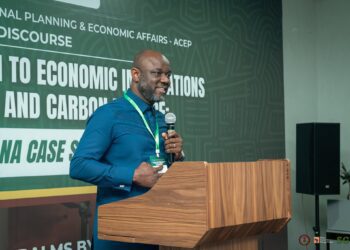
Pauline Anaman, a transactions lawyer and green transition strategist, has argued that the global effort to mitigate climate change is inextricably linked to the energy sector, which is responsible for approximately 76% of all greenhouse gas emissions.
Solving the climate crisis, therefore, necessitates a fundamental energy transition a strategic move away from high-emitting, traditional energy sources toward cleaner, more sustainable alternatives that rely heavily on specialized technologies.
“That is the move away from high-emitting energy sources. If we reduce the emissions in the energy sector, we can solve 70% of climate problems. But addressing energy emission issues in the energy sector requires energy transition technologies.”
Pauline Anaman

These energy transition technologies are essential to decarbonizing global infrastructure, as they provide the mechanical and systematic means to replace fossil-fuel dependence with renewable output.
By shifting the energy landscape through advanced hardware such as high-capacity batteries and modernized grid systems the global community can address nearly 70% of climate-related issues.
This shift requires not only the adoption of new infrastructure but also the strategic management of the critical minerals that serve as the foundational building blocks for these modern technological solutions.
The Mineral Backbone of Clean Technology
The transition away from carbon-heavy energy is entirely dependent on the availability of specific raw materials.

To build the backbone of a low-carbon economy, global manufacturers rely on a steady supply of lithium, cobalt, and nickel for electric vehicle batteries.
Furthermore, the implementation of smart grids which are vital for distributing renewable power effectively demands substantial quantities of copper and aluminium, while improvements in energy management systems are powered by silicon and lithium.
Without these critical minerals, the scaling of green technologies would be impossible.
These materials function as the physical engines of the transition, allowing for the storage of intermittent renewable energy and the efficient transmission of power across nations.
As the world pivots toward electrification, the reliance on these minerals is not merely a supply chain requirement but a cornerstone of environmental policy.
A Scramble for Control
Despite Africa’s critical role in this global shift, holding an estimated 30% of the world’s critical mineral reserves, the continent faces significant challenges in translating this wealth into local development.
A “scramble” for these resources is currently underway, characterized by an influx of bilateral agreements designed to secure raw materials for international powers.

As of 2024, approximately 75 bilateral agreements have been established between individual African nations and various global actors, including the European Union, the United Kingdom, China, Russia, and the United Arab Emirates.
China alone has secured 11 of these agreements, with further pacts signed as recently as this year. Anaman notes that, in many of these instances, the primary motivation for foreign entities is extraction rather than partnership.
“They are not seeking to add value,” she observed, highlighting a persistent trend where the strategic goal remains the removal of raw minerals to fuel external energy transitions, often leaving the source countries with limited industrial growth.
The Path to Sustainable Value
To truly solve energy emission challenges, the discourse must shift from mere extraction to local value addition.

Transition technologies provide a pathway to lower carbon footprints, but they also offer an opportunity for developing nations to climb the industrial value chain by processing minerals domestically.
If countries with rich deposits can pivot from exporting raw ore to manufacturing components such as battery cathodes or grid-ready semiconductors they can transform the energy transition into a driver of regional prosperity.
Addressing the climate crisis, therefore, requires a dual approach: deploying the technology needed to decarbonize the world while ensuring that the critical minerals fueling this movement are managed in a way that provides equitable benefit and sustainable industrialization for the nations that provide them.
READ ALSO: Ghana, UAE Forge Capital Partnership To Modernize Fisheries Sector