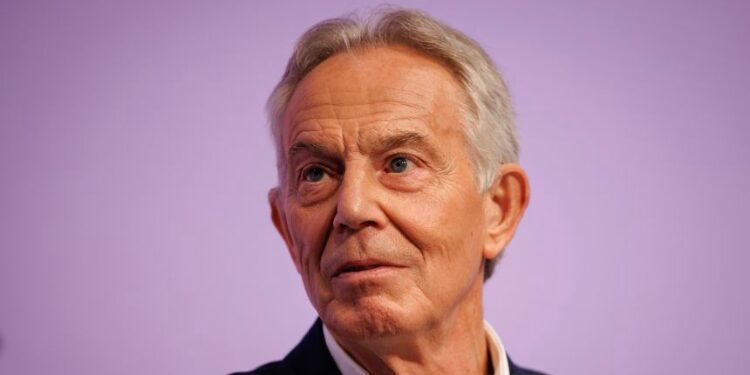
Former British Prime Minister, Sir Tony Blair, has issued a stark warning to the Labour Party, arguing that it risks undermining both its political future and the country’s prospects unless it undertakes a fundamental rethink of its direction and governing strategy.
In a wide-ranging essay examining the future of Labour and Britain’s place in a rapidly changing world, Blair urged the party to return to what he described as the “radical centre”, warning that internal leadership battles and ideological comfort zones were distracting attention from the policy reforms needed to address the country’s mounting challenges.
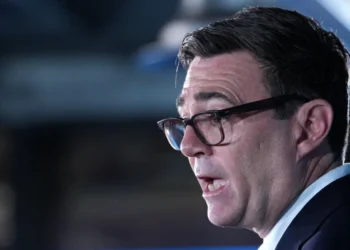
His intervention comes at a particularly sensitive moment for Prime Minister Sir Keir Starmer’s government, which is facing growing political pressure amid concerns over economic performance, public services and the rise of Nigel Farage’s Reform UK. Uncertainty has also intensified ahead of the Makerfield by-election, where Greater Manchester Mayor Andy Burnham is reportedly considering a leadership challenge should he secure victory.
Blair, Labour’s longest-serving and most electorally successful Prime Minister, cautioned that the party was becoming consumed by internal political calculations rather than focusing on developing a coherent vision for governing Britain in an era of profound global change.
According to Tony Blair, “the Labour Party is playing with fire; or, more accurately, with its future, and that of the country.”
He argued that Britain is confronting a series of interconnected challenges, ranging from economic stagnation and geopolitical instability to technological disruption and the accelerating impact of artificial intelligence. According to Blair, these developments require long-term strategic thinking that is often absent from modern politics.
Moreover, Blair delivered a particularly sharp assessment of Labour’s performance in government, suggesting that the party lacks a clear roadmap for navigating the country through a rapidly evolving international environment.
“We don’t have a worked-out, coherent plan for the country in a fast-changing world, and are in the wrong political position from which to devise one and win a second term.”
Tony Blair
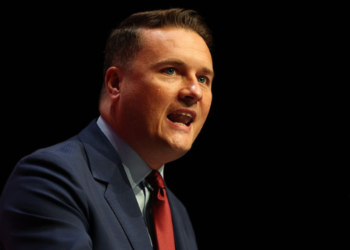
While speculation continues over possible leadership contenders, including Andy Burnham, Deputy Prime Minister Angela Rayner and Former Health Secretary Wes Streeting, Blair argued that replacing Starmer alone would not solve Labour’s deeper problems. “Whether there is a leadership change or not is irrelevant if it doesn’t start with a policy debate,” he stated.
In a direct appeal to Labour members and MPs, he added that, “Trying to force the Prime Minister out before we know what policy direction we’re bringing in is not a serious way of conducting ourselves.”
Blair’s comments carry particular weight given his own experience of internal Labour tensions. He was forced from office in 2007 amid growing pressure from supporters of his successor, Gordon Brown, and Labour went on to lose power in the 2010 general election.
Tony Blair Calls for Labour Reset
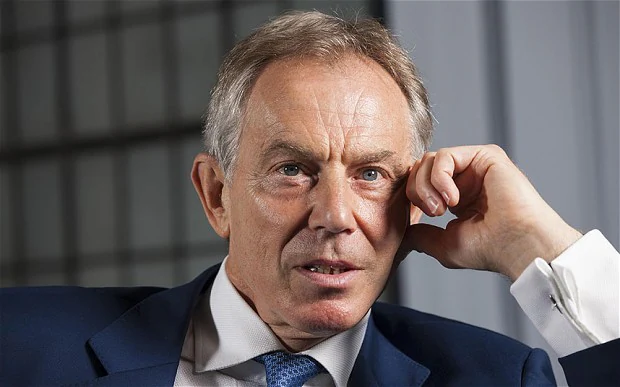
Drawing comparisons with the current administration, Blair argued that today’s Labour government is operating from what he described as a traditional “soft left” position that may be comfortable for party activists but is failing to connect with broader sections of the electorate.
He pointed to public concerns over welfare spending, arguing that Labour had failed to address widespread perceptions that welfare costs are already too high.
Blair also criticised several flagship government policies, suggesting they have created obstacles for economic growth and business investment despite broader macroeconomic improvements.
He argued that measures such as workers’ rights reforms, the accelerated net-zero transition, the phase-out of domestic oil and gas production, increases in the minimum wage beyond inflation and changes to non-dom tax arrangements have collectively created “headwinds, not tailwinds, to British business, despite the macroeconomic gains for which the chancellor is rightly praised”.
“Governments that succeed don’t start with a personality contest. Or a political question, such as how do we ‘save the country’ from Reform. They start with an idea, a project, a governing purpose, an analysis of what is wrong and a plan to put it right.”
Tony Blair
He called on Labour to reclaim what he described as the “best political space” in British politics by returning to the centre ground.
Blair also addressed Britain’s relationship with Europe, arguing that simply reversing Brexit is not a realistic solution to the country’s economic difficulties. Instead, he said Britain must first rebuild its economic competitiveness before seeking any closer relationship with the European Union.
On foreign policy and Britain’s role in the world, Blair warned that the country risks becoming increasingly marginalised if it fails to navigate between competing political currents on both the left and right.
He added that Britain is “caught between the isolationist tendency of parts of the right, and the misguided progressivism of parts of the left, which combined are in danger of leaving Britain marooned on an island of irrelevance.”