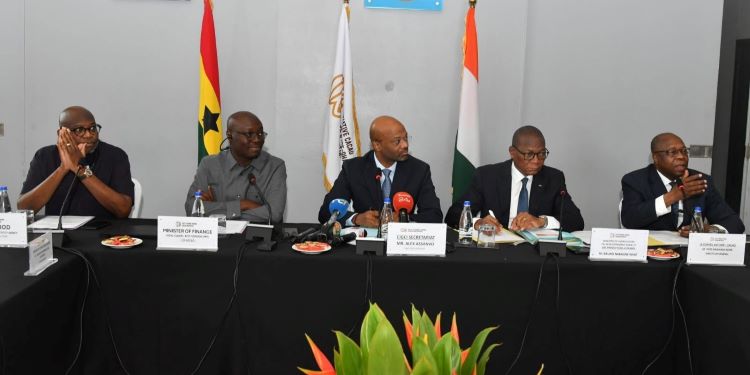
Finance Minister, Dr. Cassiel Ato Forson, acting in his capacity as the Chairman of the Steering Committee of the Côte d’Ivoire-Ghana Cocoa Initiative (CIGCI), has officially opened the ongoing 7th Ordinary Meeting in Abidjan, intensifying Ghana’s cross-border commodities diplomacy.
Convening with West African neighbors to establish a highly unified regulatory front against international market volatility, the high-level diplomatic engagement centered on the harmonization of sovereign commodity pricing mechanisms to fortify national revenue streams against erratic global commercial pressures.
According to Dr. Forson, this critical in-person assembly marks a significant advancement in the strategic partnership between the world’s two dominant cocoa-producing nations, executing a coordinated shift from previous virtual consultative frameworks toward active, face-to-face bilateral policy alignment.
“I recall our virtual meeting of 4 May 2026 and our collective resolve to convene here in Abidjan for this in-person meeting, which is critical to reaffirming and strengthening our collaboration. Sustained dialogue and deeper cooperation are not ends in themselves but rather means to an end.
“While we may not be able to resolve all our challenges here today, our collective determination to make a genuine and lasting positive impact on our farmers, our countries, and future generations should remain the driving force that guides our work”
Dr. Cassiel Ato Forson, Finance Minister
Addressing stakeholders and experts from both Accra and Abidjan, Dr. Forson placed heavy emphasis on transforming joint cocoa policy from standard defensive rhetoric into an active economic shield, noting that the macroeconomic survival of the sub-region relies heavily on continuous maintenance of an unyielding, synchronized transnational alliance.

Placing the financial welfare of rural smallholders at the very center of all fiscal and agrarian decisions, the financial leadership of both nations recognized that sustained institutional dialogue and deeper cross-border cooperation must never be viewed as mere administrative endpoints or standard bureaucratic box-checking exercises.
While acknowledging that a single ordinary meeting cannot immediately dissolve all deep-seated structural friction points within global commodity supply chains, the steering committee is anchoring its current agenda to a shared sense of generational and national responsibility.
For Dr. Forson, the underlying philosophy governing the Abidjan deliberations is built upon a collective determination to execute genuine, lasting, and measurable positive transformations that directly enhance the lives of local producers while safeguarding the broader macroeconomic health of the respective nations.
Acknowledging that the success of the partnership is directly tied to the stability of national budgets, he informed the assembled state officials and regulators that the initiative cannot be allowed to succumb to external market fragmentation or institutional inertia, urging aligned regulatory enforcement, supply management, and joint market declarations.
Restoring Farmer Profitability
To successfully defend the fiscal architecture of both West African states, the CIGCI is pushing forward a major paradigm shift in how the sub-region interfaces with the global commodities market.

Rather than functioning as passive price-takers that merely absorb external commercial manipulations, Ghana and Côte d’Ivoire are actively asserting their combined structural weight as the world’s two leading cocoa-producing nations, engaging with international market participants far more consistently and strategically.
Leveraging their massive collective market share to dictate trade terms and shape the future of the industry rather than constantly adjusting to external disruptions, the joint steering committee aims to accurately anticipate upcoming supply chain imbalances, mitigate severe macro-level pricing shocks, and direct the long-term trajectory of the international cocoa trade.
This strategic cohesion ensures that both sovereign states can protect their domestic gross domestic product baselines and secure stable, predictable export revenues to fund broader public infrastructure developments and national development plans.
To fully realize these macro-economic defenses, Dr. Forson demanded a highly transparent, open, and constructive atmosphere during the intensive technical sessions in Abidjan. He steered the working groups away from vague theoretical policy models to identifying practical, field-ready solutions and concrete sovereign actions.
These targeted interventions are expected to strengthen the administrative bond between the regulatory frameworks of the two nations, creating a seamless mechanism to defend the financial interests of local smallholder networks and guarantee fair cocoa pricing on the global stage.
The measure of success for this binational economic alignment lies entirely in the transformation of the rural agricultural landscape.
The financial leadership of the initiative has made it clear that the traditional cocoa sector must be re-engineered into an industry that is “resilient, deeply prosperous, and highly profitable for both participating sovereign states and individual farming families.”
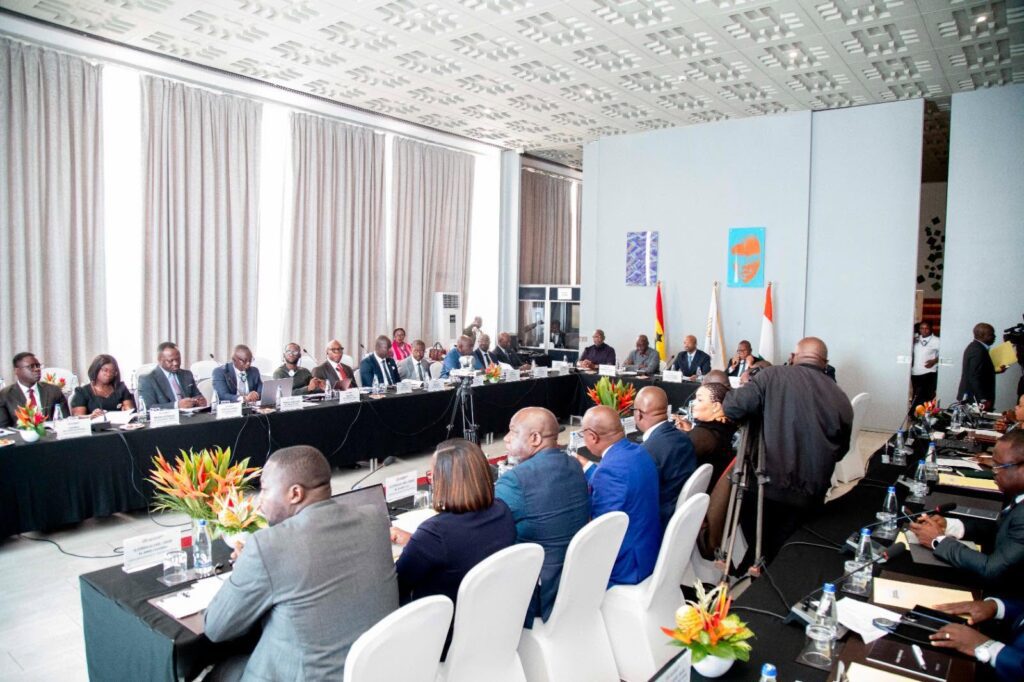
As the 7th Ordinary Meeting moves forward with its intensive deliberations, the unified stance presented by Ghana and Côte d’Ivoire signals a major turning point in West African commodities diplomacy, focusing on concrete institutional actions and practical cross-border solutions.
READ ALSO: Macron To Seek Trump’s Support For End Of Ukraine War