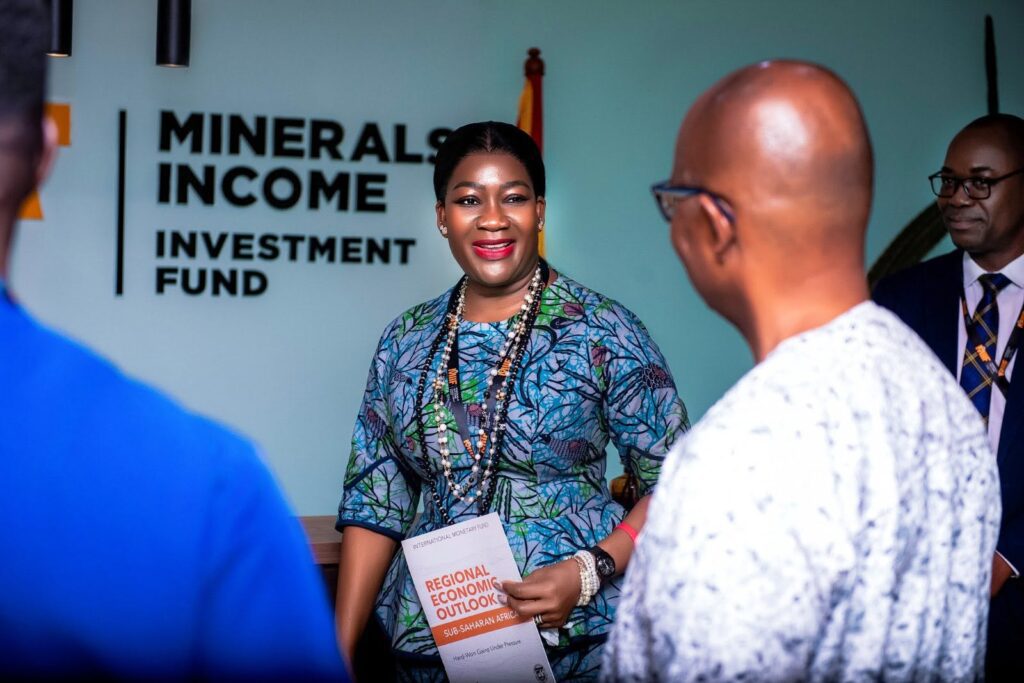
The Chief Executive Officer of the Minerals Income Investment Fund (MIIF), Mrs Justina Nelson, has pledged the Fund’s support for selected government afforestation initiatives across the country.
The strategic decision highlights a progressive pivot toward incorporating comprehensive environmental protections directly into the financing frameworks of Ghana’s extractive industries.
“The meeting explored opportunities for collaboration in advancing Ghana’s natural resource management and environmental sustainability under the government’s RESET agenda.”
Minerals Income Investment Fund (MIIF)
Expanding on this commitment, the afforestation initiative forms part of MIIF’s broader commitment to responsible natural resource management, environmental sustainability, and Ghana’s long-term ecological resilience.
By aligning sovereign mineral wealth with aggressive ecological restoration, the Fund is actively establishing a dual-track economic model where resource monetization does not occur at the expense of national conservation efforts.
“The initiative forms part of MIIF’s broader commitment to responsible natural resource management, environmental sustainability, and Ghana’s long-term ecological resilience,” the Fund added.
Capital Deployment Meets Ecological Preservation
Mrs Nelson made the pledge during a courtesy call on the Minister for Lands and Natural Resources, Mr Emmanuel Armah Kofi Buah, at his office in Accra.
The high-level meeting explored opportunities for collaboration in advancing Ghana’s natural resource management and environmental sustainability under the government’s RESET agenda.
A key area of discussion was afforestation and land restoration, with the Minister underscoring the importance of strong institutional partnerships in restoring degraded lands and expanding Ghana’s forest cover.

Historically, mining activities have left visible ecological scars across various mineral enclaves, emphasizing an urgent need for institutional remediation.
The joint dialogue signals a definitive departure from siloed public administration, blending the financial muscle of MIIF with the regulatory oversight of the sector ministry.
Observers note that integrating mining wealth into direct reforestation actions targets the very roots of resource-driven environmental degradation.
The Mandate for Sovereign Wealth Intervention
To understand the necessity of MIIF’s extended involvement in forestry management, one must evaluate the macro-economic and legal structure of the extractive sector.
While the Fund was established under Act 978 to manage and maximize the value of public mineral revenues, traditional models often focused entirely on immediate asset accumulation and fiscal returns.
True sovereign wealth management, however, dictates that the depletion of finite mineral wealth must be counterbalanced by the creation of permanent, renewable national assets. Forests represent one such critical asset.
Furthermore, integrating an Environmental, Social, and Governance (ESG) framework into state investment strategies has transitioned from a voluntary corporate social responsibility exercise to a strict fiscal imperative.
For Ghana to continue attracting premium international capital for its mining and energy sectors, its sovereign funds must demonstrate an active, measurable reduction in carbon footprints.
By anchoring capital into national afforestation programs, MIIF protects the long-term bankability of the state’s extractive industry while building tangible safeguards against climate vulnerability.
Synergy Under the RESET Agenda
The corporate alignment between MIIF and the Ministry of Lands and Natural Resources directly supports the state’s broader macroeconomic policies.
Capital allocations designated for tree planting and reclaiming topsoils serve as a direct financial catalyst for rural employment and communal stabilization.
These initiatives provide alternative livelihoods within communities historically dependent on alluvial mining or informal cutting, thereby redirecting labor toward conservation.

Ultimately, this partnership builds a framework where ecological accountability is hardcoded into national wealth creation.
Land restoration is no longer treated as an afterthought or a line item solely dependent on struggling treasury budgets; rather, it is financed systematically using a portion of the royalties derived from the earth itself.
Moving forward, the success of the RESET agenda will heavily rely on this explicit synthesis of resource funding and aggressive environmental stewardship.
READ ALSO: Paraguay End Germany’s Penalty Mastery to Reach World Cup Round of 16