For decades, West Africa has been one of the world’s richest gold-producing regions, exporting millions of ounces every year while much of the wealth generated from refining, certification, trading and financing accumulated elsewhere.
Now, governments across the region are trying to change that equation.
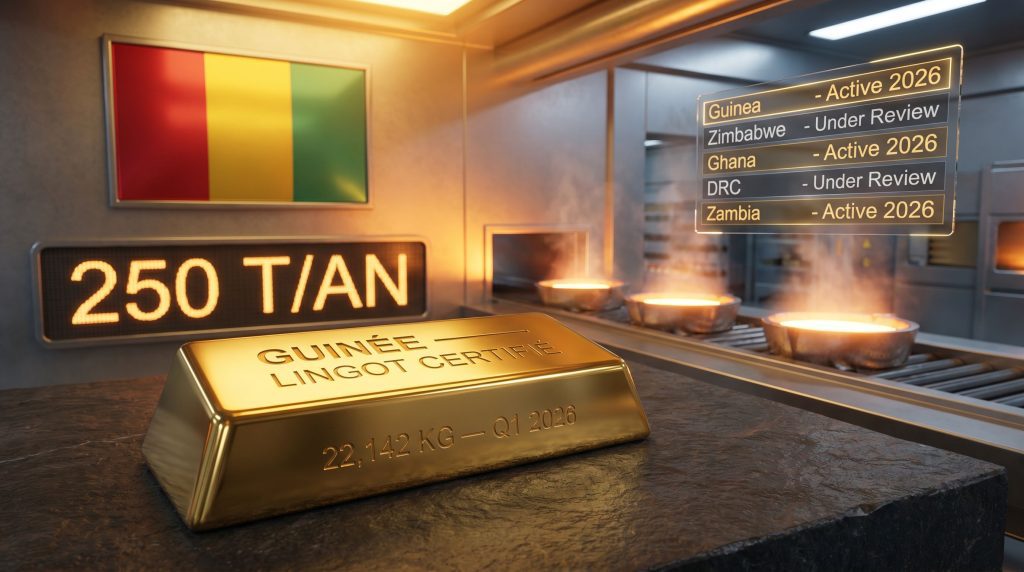
Guinea has become the latest country to reposition its mining industry after announcing an immediate ban on raw gold exports and unveiling plans to establish itself as a regional gold refining hub, joining a broader movement already gathering pace in Ghana, Mali and Burkina Faso.
The policy signals a significant shift in how mineral-rich African countries are approaching resource development, from exporting raw commodities towards building complete value chains capable of generating more jobs, tax revenue and industrial growth at home.
The latest development, first reported by Reuters and highlighted by Norvan Reports, comes as governments across the continent increasingly question whether simply producing more minerals is enough to drive long-term economic transformation.
From gold producer to gold processor
Guinea’s strategy extends beyond processing its own production.
Authorities want the country to compete as a refining destination for gold mined across West Africa, creating a regional processing industry similar to the role played by international bullion hubs.
Speaking about the country’s ambitions, Guinea’s Mines Minister Bouna Sylla said success would ultimately depend on commercial competitiveness rather than government protection.
If each West African country has a refinery, there is no problem. If your refinery is not competitive, it will fail or succeed because of economics, not politics.
Bouna Sylla, Guinea’s Minister of Mines
His remarks reflect an important reality confronting many African resource-producing nations.
Building refineries is only the first step.
Their long-term success depends on attracting miners through competitive pricing, trusted certification systems, efficient logistics and access to international bullion markets.
Why the region is changing course
For years, much of the value generated from African gold has been created outside the continent.
While African countries extracted the metal, higher-value activities, including refining, assaying, international trading, vaulting, commodity financing and certification, largely took place in established global centres such as Dubai, Switzerland and London.
That meant producing countries earned revenue from extraction but captured relatively little of the broader economic ecosystem surrounding gold.

Guinea says that imbalance is precisely what it hopes to change.
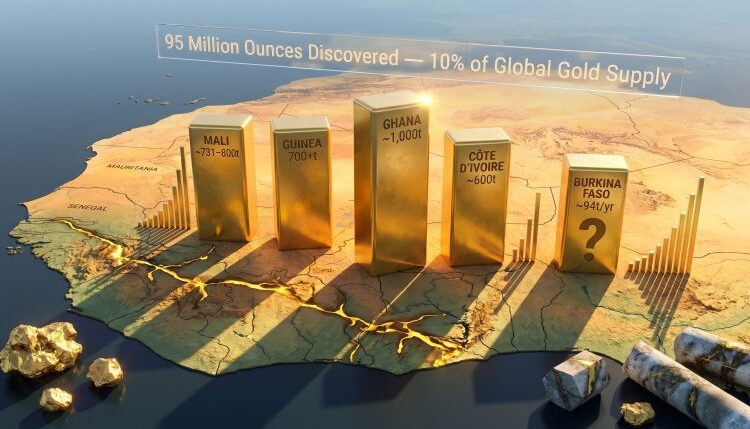
Despite producing approximately 2.32 million ounces of gold worth around US$7 billion last year, the country estimates it retains less than one percent of the overall value generated from the industry.
It is not just about revenue and jobs. Countries like the UAE do not produce gold but built refining capacity to stimulate broader economic growth. We want to create the same value chain.
Bouna Sylla, Guinea’s Minister of Mines
To support that ambition, Guinea has completed a US$30 million refinery expected to begin commercial operations in July.
Officials say the facility will initially process 530 metric tonnes of gold annually before expanding to 733 tonnes after reaching full capacity.
The government is also preparing reforms aimed at improving traceability and formalising artisanal mining activities.
Why Ghana should pay attention
Although the announcement concerns Guinea, its implications extend well beyond one country.
Ghana, Africa’s leading gold producer, has repeatedly stated its intention to increase local value addition rather than exporting minerals in raw form.
Recent policy initiatives, including efforts to strengthen domestic gold trading, expand refining capacity and improve mineral traceability reflect similar thinking.
Guinea’s latest move therefore adds momentum to an emerging regional competition.
Rather than competing solely on production volumes, countries are increasingly competing to become centres for refining, certification and downstream mineral services.

For Ghana, that presents both an opportunity and a challenge.
If more West African countries successfully develop internationally recognised refining capacity, regional producers could retain more economic value while creating skilled employment across industries such as logistics, secure transport, laboratory testing, insurance, financial services and commodity trading.
However, increased competition also means countries must ensure their own refining industries remain commercially attractive.
A refinery that cannot offer competitive pricing or internationally recognised certification may struggle to attract sufficient throughput despite government support.
The economics beyond the refinery
Industry analysts note that banning raw exports alone does not guarantee success.
Experience elsewhere suggests that export restrictions can sometimes encourage informal trading and smuggling if domestic refining capacity is unable to offer miners competitive commercial terms.

Success therefore depends on far more than constructing new facilities.
Reliable regulatory systems, transparent pricing, internationally accepted refining standards and effective anti-smuggling measures are equally important in creating confidence among miners, investors and international buyers.
In that respect, Guinea’s emphasis on economics rather than politics may prove one of the most significant aspects of the announcement.
A regional race with global implications
West Africa already accounts for a substantial share of global gold production.
According to industry estimates cited by Reuters, the region produced around 11 million ounces of gold in 2025, making it one of the world’s most important mining regions.
If more countries succeed in moving beyond extraction into refining and associated services, the region could gradually capture a larger share of the wealth generated throughout the global gold value chain.

That would represent a significant departure from the traditional model in which African countries exported raw minerals while higher-value processing and financial activities took place overseas.
For Ghana, Guinea’s latest policy is another reminder that the future of mining may increasingly depend not on how much gold is produced, but on how much value remains within producing economies.
As competition intensifies across West Africa, the countries that combine competitive refining, credible regulation and trusted certification may ultimately define the next chapter of Africa’s gold industry.
READ ALSO: GRA Intervenes as Torrential Rains Disrupt Business Operations Nationwide