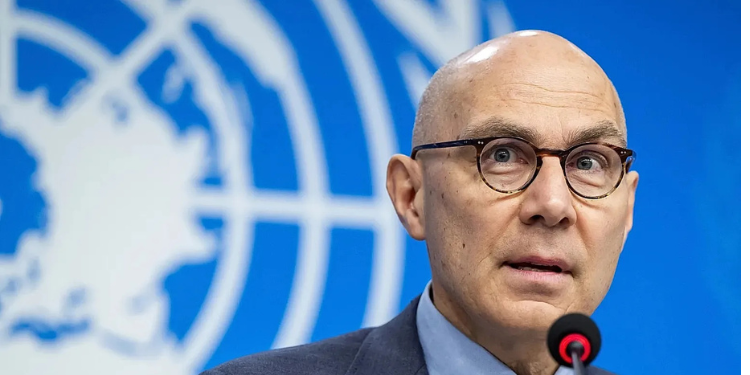
UN High Commissioner for Human Rights Volker Türk has warned that the “painstaking” recovery of bodies from beneath the rubble in Gaza is raising serious concerns over possible war crimes and violations of international law.
According to Volker Türk, the discovery of human remains beneath destroyed buildings is not only a humanitarian tragedy but also an issue with significant legal implications, particularly as authorities continue efforts to locate people who remain missing years after Israeli attacks devastated large parts of the territory.
“The remains of what appear to be entire families are now being unearthed at locations that were pulverized by Israeli attacks. It is heartbreaking that the loved ones of those missing for so long are only now having their worst fears confirmed.”
Volker Türk
The recovery operation has exposed the scale of destruction left behind by years of violence.
Palestinian civil defence authorities have reported that more than 630 bodies and other human remains have been recovered from beneath destroyed buildings across Gaza since November 2025.
Similarly, they estimate that more than 8,000 people remain missing under the rubble.
The UN High Commissioner for Human Rights has called for international investigators to be granted access to all parts of Gaza, stressing the importance of documenting and preserving evidence while recovery efforts continue.
The call comes amid concerns over access to heavy machinery needed to remove rubble. Palestinian authorities revealed that Israel is refusing entry to equipment required to clear destroyed areas, forcing recovery teams in many cases to search through debris by hand.
The limitations have made an already difficult recovery operation slower and more dangerous, while potentially affecting efforts to preserve forensic evidence and determine the circumstances surrounding deaths.
Türk noted that every feasible effort must be made to document and identify victims, preserve forensic information and biological samples, record burial locations and notify families.
Recovery Effort Raises Questions Over Gaza Destruction

UN High Commissioner for Human Rights Volker Türk
The latest discoveries have reinforced concerns about the extent of destruction across Gaza and the number of people who may still be buried beneath buildings destroyed during Israeli military operations.
Türk warned that the remains recovered so far “may only be the tip of the iceberg,” pointing to the widespread destruction of residential areas and other civilian infrastructure across the territory.
Much of Gaza, he stated, “has been flattened by Israeli bombing or demolition and clearing by heavy machinery and explosives.”
He also raised concern about continuing activity in areas where Israeli troops remain deployed, saying that some locations “continue to be levelled by bulldozers with no respect for the dead under the rubble.”
In addition, Türk stressed the need to preserve evidence of possible violations, including at sites that have already been destroyed.
The scale of the recovery effort has become clearer through the work of local authorities. Between June 27 and August 27, authorities reported recovering 233 of 407 bodies believed to have been trapped beneath 20 destroyed buildings, most of them in Gaza City. Among those recovered were 74 children and 106 women.
In September, recovery teams reported finding 96 bodies and human remains at a single site in Az Zeitoun, a neighbourhood southeast of Gaza City that was allegedly struck in November 2023.
Most of those remains were recovered by hand, underscoring the difficult conditions facing teams searching through heavily damaged structures.
“These painstaking recovery efforts are a stark reminder of the gravity and breadth of the destruction three years ago, compounded today by the prolonged suffering and misery brought by years of not knowing.”
Volker Türk
The UN Human Rights Chief added that “the right of families to know the fate of their relatives does not end with identification and a dignified burial. They deserve to know the full truth.”
War Crimes Concerns Re-emerge

The discovery of extensive human remains has also revived concerns previously raised by the Office of the UN High Commissioner for Human Rights over Israel’s conduct of military operations in Gaza.
In a 2024 report, the office examined Israeli attacks carried out between October 9 and December 2, 2023, including the use of heavy bombs weighing up to 2,000 pounds against residential buildings, a school, refugee camps and a market.
Those strikes killed more than 200 people, according to the report, which concluded that some attacks may have violated fundamental principles of international humanitarian law.
International humanitarian law requires parties to a conflict to distinguish between civilians and combatants, ensure that attacks are proportionate and take feasible precautions to protect civilian life.
According to the UN Human Rights Chief, concerns over whether those principles were respected remain relevant as investigators uncover the consequences of attacks across Gaza.
“On a number of occasions, I have expressed grave concerns that Israel’s choices of methods and means of conducting hostilities, including through the extensive use of explosive weapons with wide area effects in densely populated areas, failed to ensure that they effectively distinguish between civilians and fighters.”
Volker Türk
He added, “the discovery of extensive remains under the rubble in Gaza City resurfaces these concerns of war crimes and other atrocity crimes.”
READ ALSO: Allianz Arena and Camp Nou To Host 2028 and 2029 UCL Finals
.