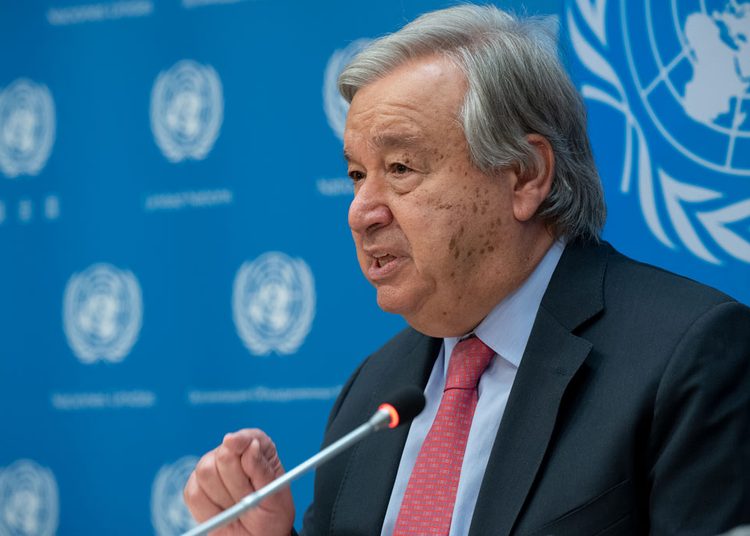
United Nations Secretary-General, António Guterres, has called on countries to advance negotiations towards a legally binding international instrument regulating lethal autonomous weapons systems, warning that the rapid development of such technologies presents growing humanitarian, legal, ethical and security challenges.
The call coincided with the opening of the seventh Review Conference of the Convention on Certain Conventional Weapons in Geneva, where delegates from more than 120 Member States gathered to consider the future regulation of weapons systems commonly known as “killer robots “
“New technologies, including autonomous weapons systems, present new humanitarian, legal, ethical and security challenges.I urge you to seize this moment. Take action to prevent the use and spread of these merciless weapons.”
António Guterres
The UN Chief emphasised that the changing nature of warfare makes it increasingly important for countries to establish clear international rules governing the development and deployment of autonomous weapons.
“Even war has limits,” he stressed, calling on delegates to pursue an agreement that establishes “clear prohibitions and restrictions” on the technology.
He further maintained that the international community must continue protecting civilians from the consequences of armed conflict and preventing unnecessary suffering.
Push for International Controls

The Geneva discussions come amid growing calls within the United Nations for countries to establish a common legal framework governing lethal autonomous weapons systems.
However, Member States remain divided over the nature of a possible international instrument, including whether it should be legally binding and the timeframe for reaching an agreement.
The urgency of the issue has also been reinforced by the growing accessibility of autonomous weapons technology and concerns about the possibility of systems operating with limited or no meaningful human intervention.
In December 2023, the UN General Assembly adopted Resolution 78/241, affirming the need for lethal autonomous weapons systems to comply with international law, particularly international humanitarian law.
The resolution received support from 152 countries, with four voting against and 11 abstaining.
The ongoing Review Conference therefore presents an opportunity for countries to build on previous multilateral commitments and advance discussions towards internationally agreed restrictions on the weapons.
Human Rights Chief Warns Against Machine Decisions

The negotiations follow a separate appeal by UN High Commissioner for Human Rights Volker Türk, who earlier urged States to urgently agree on an international treaty banning certain categories of lethal autonomous weapons.
In a statement, UN Human Rights Chief mentioned the rapid pace of technological advancement and warned that autonomous weapons could soon become widely accessible, increasing the risks associated with their development and use.
“A machine must never have the power to decide whether a human being survives or dies.”
Volker Türk
The United Nations High Commissioner called for prohibitions on autonomous weapons designed or used to target people, as well as systems whose functions and effects cannot be fully understood, predicted, explained and controlled by human operators.
He maintained that decisions involving the use of force must remain subject to human judgement and responsibility, arguing that machines cannot understand the value of human life or assess complex circumstances in the way people can.
Convention’s Wider Humanitarian Mandate

Established more than four decades ago, the Convention on Certain Conventional Weapons provides an international framework for addressing weapons that cause excessive suffering or have indiscriminate effects.
Its work has contributed to efforts to reduce the humanitarian consequences of landmines, improvised explosive devices, incendiary weapons and explosive remnants of war.
The Convention currently has 128 High Contracting Parties, referring to countries that have formally joined the agreement and accepted its legal obligations. It remains one of the central platforms for international discussions on conventional weapons and disarmament.
Beyond autonomous weapons, the seventh Review Conference is expected to examine the humanitarian impact of landmines and emerging methods of warfare that are not adequately covered by existing international instruments.
The discussions are being organised by the UN Office for Disarmament Affairs, which supports international efforts to advance disarmament and strengthen controls on conventional weapons.
As delegates consider the future of autonomous weapons regulation, the absence of consensus on the form and timing of a possible agreement remains a significant obstacle to negotiations.
The conference is expected to provide an important opportunity for Member States to narrow their differences and determine how international rules can respond to the growing technological capabilities of modern warfare.
READ ALSO: Vinicius Admits Subpar Preparation Cause of Inconsistent Form