Human Rights Watch (HRW) has warned that funding shortfalls are undermining humanitarian education programmes in Bangladesh, threatening learning centres that provide schooling for Rohingya refugee children.
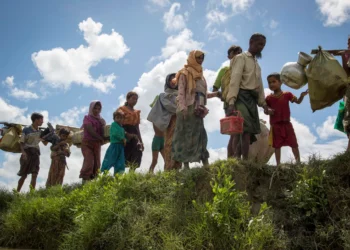
Approximately 312,000 of the estimated 500,000 school-age Rohingya children in Bangladesh’s refugee camps are enrolled in humanitarian education programmes. However, the existing provision remains inadequate, with resources stretched and the possibility of further closures threatening children’s access to learning.
The pressure has intensified as an estimated 90,000 additional refugee children require schooling this year, driven by population growth and new arrivals fleeing atrocities in Myanmar.
Meanwhile, community-led schools established by Rohingya teachers, which serve about 30,000 students, continue to operate without formal legal recognition.
Bill Van Esveld, Associate Children’s Rights Director at Human Rights Watch, stated that “donor governments have turned their backs on education for half a million Rohingya students stuck in the world’s largest refugee camp, but so much could be done to mitigate this crisis.”
According to the report, humanitarian organisations providing education, under the coordination of the United Nations Children’s Fund (UNICEF), received only US$29 million of the US$72 million requested for 2025.
The shortfall forced learning centres to close for several months, while education providers laid off teachers, cancelled early childhood programmes and reduced teacher training.
The situation remains precarious in 2026. Although humanitarian agencies lowered their funding request to $53 million, donors had pledged only $36 million by mid-October, leaving learning centres vulnerable to another round of closures.
“We are struggling to maintain the most basic services. Even textbooks are insufficient. We cannot ensure children receive materials like a pencil, a notebook. Learning centers were damaged by mudslides and climate events, but we do not have funding to carry out repairs.”
Humanitarian Education Official
Teachers working in the centres have also reported inadequate classroom facilities and shortages of learning materials.
Rohingya-Led Schools Seek Official Recognition
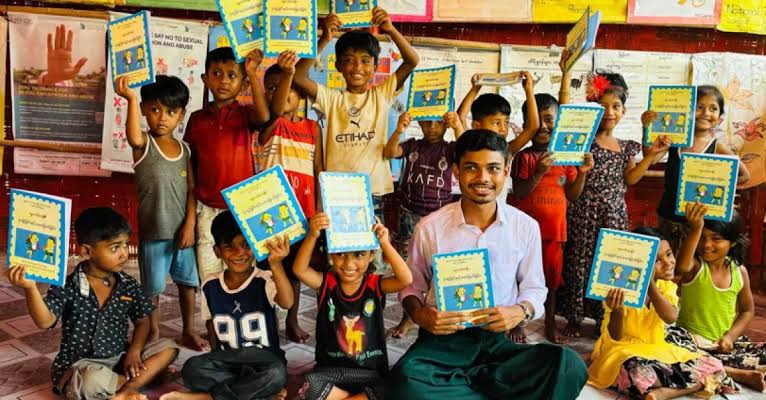
While most Rohingya children depend on donor-supported learning centres, community-led schools established by refugee teachers have emerged as an alternative source of education within the camps.
The Examination Board of Rohingya Refugees, established in 2025, now brings together more than 125 community-led schools serving up to 30,000 students. The network works to improve educational standards through structured teaching and standardised examinations based on Myanmar’s curriculum.
However, the schools continue to face significant operational and legal obstacles. Bangladesh has yet to accredit a curriculum for Rohingya children or grant formal recognition to the community-led institutions.
Their lack of legal status also prevents them from receiving international support directly, leaving many dependent on small fees charged to families and donations from other refugees, including the use of their living shelters as makeshift classrooms.
Bangladesh Urged to Expand Refugee Education Rights
Human Rights Watch explained that the restrictions on Rohingya education have their roots in policies introduced under Bangladesh’s former Awami League government, which was overthrown in 2024.
The previous administration barred Rohingya children from accessing certified education and higher education within the camps and the country’s formal school system. Although it permitted donor-funded humanitarian programmes, it prohibited community-led schools, demolished several institutions and threatened teachers with relocation to Bhasan Char, a remote island.
The current government has taken steps towards easing some of these restrictions, but Human Rights Watch maintains that further action is necessary to protect children’s access to education, particularly as donor funding continues to decline.
The organisation has also framed the issue within broader international obligations, stressing that states must ensure access to quality education without discrimination, irrespective of a child’s refugee status.
The Inter-Agency Network for Education in Emergencies’ Minimum Standards similarly highlight the importance of community participation and leadership in designing and implementing education programmes.
Human Rights Watch argues that these principles support greater engagement with Rohingya teachers and their existing school networks.
The education crisis also comes as international scrutiny of the treatment of Rohingya refugees continues. On November 19, 2026, the International Court of Justice is scheduled to deliver its judgment in a case brought by The Gambia, alleging that Myanmar’s atrocities against the Rohingya during the 2016–2017 military clearance operations constituted genocide and violated the Genocide Convention.
For Rohingya children in Bangladesh, however, the immediate concern remains the uncertainty surrounding their education and the repeated interruptions to their learning.
READ ALSO: MIIF Boss Touts Royalty Progress, Urges Stronger Investment Partnerships