Author: Kay Codjoe, Market Research Consultant and Volunteer Associate at the IMANI Centre for Policy and Education
The rain has no political party. It does not vote NDC. It does not vote NPP. It simply follows gravity. Yet somehow, every rainy season in Ghana follows a familiar script.
The rain falls. Roads disappear. Homes become rivers. Businesses shut down. Politicians tour flooded communities in Wellington boots. Relief items arrive. Promises are made.
Then the water recedes, taking with it our outrage until the next storm. The flood never lies. It reveals exactly what we have refused to fix. For almost ninety years, Ghana has documented major floods.
From Accra’s recurrent urban flooding to the catastrophic June 3, 2015 disaster that combined floodwaters with fire, the pattern has remained unchanged.
Studies have been commissioned, reports produced, budgets approved, donor funds secured, and projects launched. Yet the same communities continue to sink under the same waters, carrying promises that dissolved long before the rain stopped.
This is no longer a natural disaster. The rain is not the problem. Cities elsewhere receive heavier rainfall without collapsing into seasonal emergencies. The failure begins long before the clouds gather. It begins when drains become refuse channels. It begins when wetlands are converted into estates.
It begins when waterways are sold, occupied, or politically shielded. It begins when maintenance becomes optional and enforcement becomes negotiable. The tragedy is not that governments have done nothing.
Successive administrations, whether led by the NDC or the NPP, have dredged drains, launched flood control programmes, secured international financing, and announced ambitious interventions.
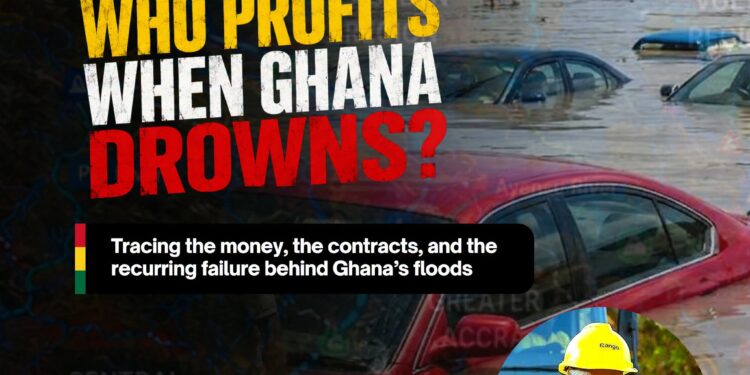
Hundreds of millions of cedis and dollars have been committed. Yet the results have consistently failed to match the scale of expenditure or promise. This leaves a question Ghana cannot keep avoiding. Who profits when Ghana drowns?
Someone certainly does. Who won the contracts to construct our drains? Were the works executed to specification? Who certified them? Which contractors repeatedly returned despite recurring failure? How much has been spent on desilting drains that clog again within months? Who approved construction on waterways?
Which public officials ignored enforcement notices? Which recommendations from previous flood inquiries were quietly abandoned? If the money has been spent, where are the results?
A nation cannot continue allocating vast sums to flood control while watching the same corridors turn into rivers each rainy season. If projects were completed, where is the measurable reduction in flooding?
If budgets were approved, where is the public accounting of outcomes? If master plans exist, why do structures continue to rise in known flood zones without consequence?
Flooding has become more than a failure of infrastructure. It has become an economy. Every disaster triggers emergency procurement, relief contracts, reconstruction works, consultancy fees, and fresh budget lines.
In such a system, failure does not end funding. It multiplies it. Every submerged street is a question. Every collapsed bridge is an audit query. Every displaced family is evidence that something between policy and execution has broken.
Climate change is real, and rainfall intensity is increasing. But climate change did not approve illegal developments. It did not block drains with plastic waste. It did not abandon maintenance cycles after ribbon cuttings. It did not sign contracts, certify incomplete works, or release funds without demanding outcomes.
Those were human decisions. And until that changes, the water will keep returning not as accident but as consequence. Each season becomes a reminder that infrastructure without accountability is decoration, and investment without enforcement is theatre.
Until responsibility is enforced beyond press briefings and budget lines, Ghana will keep drowning in outcomes it has already financed, already been warned about, and already chosen to ignore. Because at that point, the flood is no longer the event. It is the receipt.
READ ALSO: Mahama Calls for Moral Reset to Build Better Ghana