The Minister for Trade, Agribusiness and Industry, Hon. Elizabeth Ofosu-Adjare, has reaffirmed Ghana’s commitment to attracting strategic global investments, assuring investors that the country offers strong opportunities backed by government policy support and macroeconomic stability.
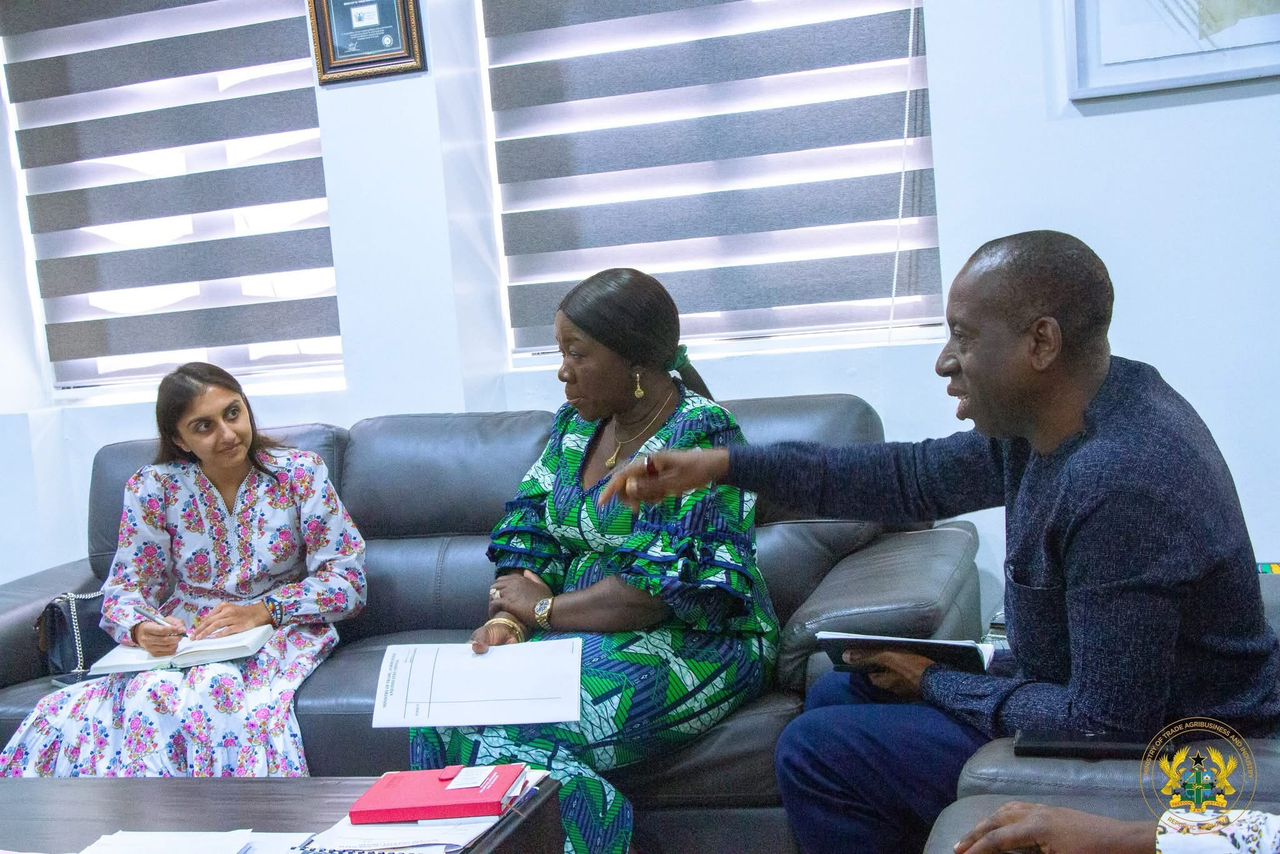
Speaking at a meeting with a delegation led by Shivani Patel, Director of SP Consulting Ltd from the United Kingdom, Minister for Trade, Agribusiness and Industry, Hon. Elizabeth Ofosu-Adjare emphasised that Ghana is actively pursuing partnerships with the private sector to drive industrial expansion and job creation.
“Ghana is open for business, and we are creating the right conditions for investors to succeed. Through strategic industrial projects, stable economic policies and clear regulatory frameworks, we are building an economy that supports innovation, expands manufacturing, creates sustainable jobs and delivers long-term value for both local and international investors.”
Minister for Trade, Agribusiness and Industry, Hon. Elizabeth Ofosu-Adjare,
Hon. Elizabeth Ofosu-Adjare said meeting forms part of a broader effort to court private capital into the country’s priority sectors.
Flagship Projects Anchor Ghana’s Industrial Push
The Minister outlined several priority government initiatives currently underway, including the revitalisation of the Pwalugu Tomato Factory, the development of the Greater Kumasi Industrial Park, and the legacy Marine Drive Project, key flagship programmes expected to boost manufacturing, tourism, infrastructure development, and employment across the country.

Each of these projects touches a different pillar of Ghana’s industrial strategy. The Pwalugu Tomato Factory revival speaks to efforts at strengthening local agro-processing capacity, reducing reliance on imported tomato products while creating jobs for farmers and factory workers in the north.
The Greater Kumasi Industrial Park, meanwhile, positions the Ashanti Region as a growing manufacturing hub, while the Marine Drive Project reflects government’s parallel ambitions in tourism and coastal infrastructure development.
Taken together, these initiatives signal an attempt to diversify Ghana’s industrial base beyond traditional extractive sectors, spreading investment opportunities across agribusiness, manufacturing and tourism simultaneously.
New Policy Frameworks Target Key Sectors
Beyond physical infrastructure projects, the Minister also highlighted recently Cabinet-approved national policies in agribusiness, automotive and component manufacturing, textiles and garments, and pharmaceuticals.
“These policy frameworks are designed to provide clearer regulatory direction, reduce investment risk, and ensure sustainable returns for investors entering these sectors.”
Minister for Trade, Agribusiness and Industry, Hon. Elizabeth Ofosu-Adjare
The four sectors named, agribusiness, automotive components, textiles and pharmaceuticals, represent areas where Ghana has previously signalled ambitions to build domestic manufacturing capacity rather than remain solely reliant on imports.
By formalising Cabinet-approved policy direction in each of these areas, the government appears to be seeking to give investors greater confidence that the regulatory environment will remain stable and predictable over the medium to long term.
UK Delegation Cites Ghana’s Stability and Growth Outlook
The visiting UK delegation offered its own assessment of Ghana’s investment climate, one that appeared to validate the government’s pitch. The delegation described Ghana as a priority investment destination, citing its relative macroeconomic stability, improving institutional framework, and strong growth outlook within the West African sub-region.
Shivani Patel, Director of SP Consulting Ltd, led the delegation’s engagement with the Trade Ministry, a visit that comes as UK-based investors continue to scout opportunities across West Africa’s shifting economic landscape.
The delegation’s characterisation of Ghana’s institutional framework as improving suggests investors are taking note of recent regulatory and policy reforms, even as broader macroeconomic conditions across the sub-region remain closely watch
The engagement did not occur in isolation. The meeting in Accra follows discussions at the recent Ghana UK Summit held in June 2026, indicating a continued momentum in economic dialogue between the two countries following that earlier high-level engagement.
The sequencing suggests a deliberate follow through strategy, with the June summit likely having laid the groundwork for more detailed, sector-specific conversations such as the meeting with SP Consulting Ltd. This pattern, moving from broad summit level commitments to targeted delegation visits, points to an effort by both governments to translate high-level diplomatic engagement into concrete investment interest.
What the Engagement Signals for Ghana’s Investment Climate
For Ghana, this meeting represents another step in an ongoing campaign to reposition the country as a preferred investment destination within West Africa, particularly at a time when investors across the region are weighing opportunities against currency volatility, infrastructure gaps and regulatory unpredictability elsewhere.
The emphasis placed on flagship projects like the Pwalugu Tomato Factory and Greater Kumasi Industrial Park, paired with newly approved sector policies, suggests government is attempting to present a comprehensive investment case, one that combines tangible infrastructure commitments with clearer long-term policy direction.

Whether this messaging translates into concrete capital commitments from UK investors remains to be seen. But with the UK delegation’s own remarks pointing to confidence in Ghana’s macroeconomic trajectory and institutional reforms, Thursday’s meeting appears to have reinforced rather than merely opened the conversation between Accra and London on future investment flows.
Attention now turns to whether SP Consulting Ltd and other UK-based investors move from exploratory discussions toward firm commitments in the sectors highlighted, and how quickly Ghana’s newly approved policy frameworks translate into on the-ground investment activity across agribusiness, manufacturing, textiles and pharmaceuticals.
READ MORE: COCOBOD Releases GH¢2.6 Billion to Clear Cocoa Farmer Debts