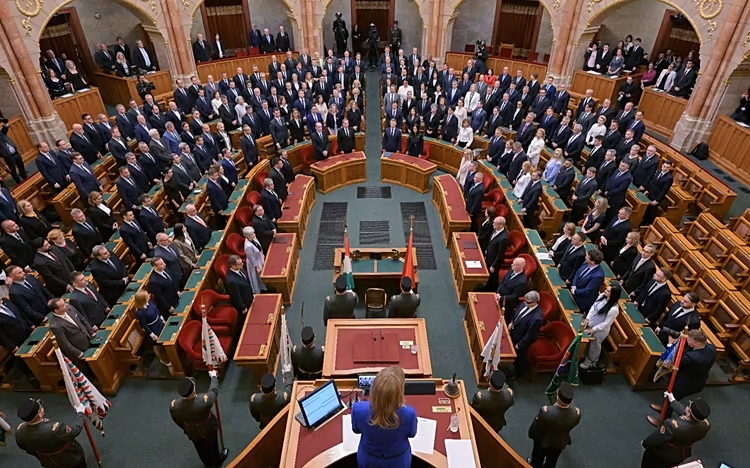
Hungary’s parliament has passed a constitutional revision to oust the country’s President, Tamas Sulyok.
Hungary’s new Prime Minister Péter Magyar accuses the President of being a “puppet” of hardline ex-leader Viktor Orbán.
Legislators from Magyar’s party, Tisza, broke into a half-minute-longstanding ovation after voting to eject President Tamas Sulyok from office in a ballot boycotted by Orban’s nationalist Fidesz party.
The vote is part of an effort by the country’s new leadership to dismantle the autocratic political system of former Prime Minister Viktor Orbán.
The constitutional amendment, which had the stated purpose of “restoring rule-of-law democracy,” passed with 139 votes for and six against.
The amendment also implements reforms to the judiciary and creates a new authority tasked with uncovering alleged financial abuses by Orbán’s government.
After winning in a landslide election in April, Prime Minister Péter Magyar and his pro-European, center-right Tisza party hold a two-thirds majority in Parliament, allowing them to make constitutional changes and roll back many of the policies Orbán implemented during his 16 years in power.
Before the vote, Magyar told lawmakers that it marked “a significant day in the history of modern Hungary and the transition to democracy.” Magyar has argued Sulyok failed to live up to his role as President by neglecting to stand in the way of antidemocratic steps by Orbán’s government.
He promised repeatedly to remove Sulyok during the election campaign, and points to his party’s big win as a clear mandate from voters to fulfill that promise. Magyar has repeatedly called on Sulyok to resign, branding the 70-year-old unworthy of the post as a result of his failure to stand up to Orbán’s divisive rhetoric and attacks on the rule of law.
While mostly a ceremonial role, Hungary’s President is responsible for signing legislation into law and has the power to send bills passed by Parliament to the Constitutional Court for review. That has raised concerns among supporters of the new government that Sulyok, an Orbán-era appointee, could use that power to obstruct its plans.
Since taking office in May, the government has quickly gone to work dismantling what Magyar calls Orbán’s “mafia” by removing numerous political appointees and heads of institutions viewed as having facilitated Orbán’s autocratic regime.
They suspended the news service of Hungary’s public television and radio, which Magyar has argued served as a “propaganda factory” for Orbán’s party, and shuttered Hungary’s Sovereignty Protection Office, an authority seen by Orbán’s opponents as a tool for intimidating critics and silencing independent media.
Fidesz Criticises New Constitutional Amendment
Fidesz has argued the new constitutional amendment is an “unprecedented” assault on Hungary’s democratic order, and last week staged a protest in opposition to the changes which drew around 3,000 people but which Orbán did not attend.
Today, Orbán posted a photograph of Magyar on Facebook with the subtitle, “Democratic Hungary: 1990-2026,” the period since Hungary transitioned from state socialism. Orbán was traveling to the United States today to attend the final three matches of the World Cup.
Prior to today’s vote, Fidesz caucus leader Gergely Gulyás said that the amendment “breaks up the legal system, undermines the rule of law and restricts democracy.” Gulyás announced that he would resign as caucus leader since, due to the imposition of 12-year term limits for lawmakers also included in the amendment, he will not be able to take a seat in Parliament in the next national election.
Fidesz supporters called for a candlelight vigil outside Hungary’s parliament building this evening to demonstrate against what they called the “tyranny” of Magyar’s government.
Sulyok has five days to sign the amendment into law. If he does not, Tisza has vowed to launch an impeachment procedure against him. If Sulyok is removed, Parliament will elect a new President until the government’s planned constitutional reforms are carried out in the autumn, or for a maximum term of five years.
READ ALSO: Trump Announces Reinstatement of Blockade Over Hormuz Strait