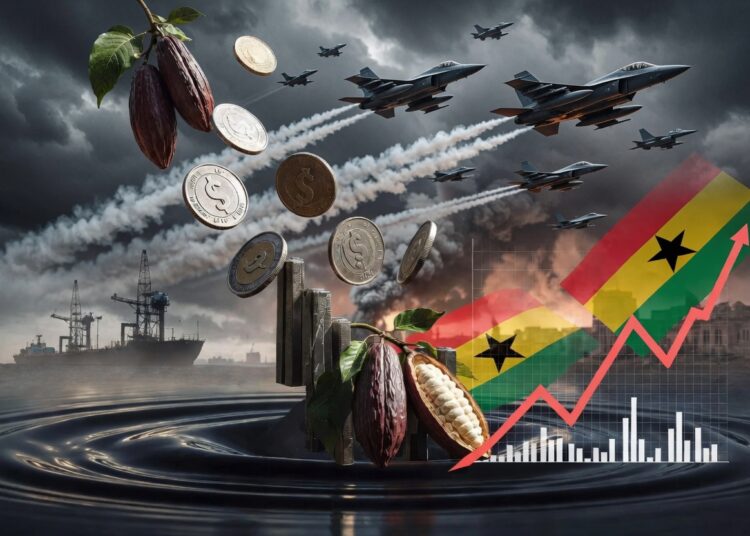
The renewed military confrontation between the United States and Iran has once again placed the global economy on edge, with fears that a prolonged conflict could unleash a cascade of economic consequences far beyond the Middle East.
Although the immediate market reaction has been relatively restrained, the latest exchange of strikes has already pushed Brent crude oil prices to around $76 per barrel, reviving concerns about inflation, supply chain disruptions, and slower global economic growth.
For Ghana, a country heavily reliant on imported refined petroleum products despite being an oil producer, the resurgence of geopolitical tensions could present significant economic challenges. Rising global oil prices threaten to increase fuel costs, place renewed pressure on inflation, weaken fiscal balances, and complicate the government’s efforts to sustain the country’s ongoing economic recovery.
Oil Price Surge Raises Immediate Concerns
The first and most direct consequence of renewed hostilities is the upward movement in global crude oil prices. Investors typically respond to Middle East conflicts by pricing in the risk of supply disruptions, particularly because the region accounts for a substantial share of global oil production.
Although oil prices have not reached the extreme levels witnessed during previous geopolitical crises, analysts caution that any escalation involving major oil shipping routes such as the Strait of Hormuz could rapidly drive prices significantly higher.
For Ghana, higher crude prices translate almost immediately into increased petroleum import costs. Even though Ghana exports crude oil, the country still imports most of its refined petroleum products, making domestic fuel prices highly sensitive to movements in international markets.
Any sustained increase in global oil prices is therefore likely to be passed on to consumers through higher prices at the pumps.
Inflation Risks Could Re-emerge
Ghana has made considerable progress in bringing inflation under control after the severe economic challenges experienced over the past few years. Falling inflation has supported improved consumer confidence, lower interest rate expectations, and a more stable macroeconomic environment.
However, a sharp increase in fuel prices threatens to reverse part of those gains.
Fuel costs affect virtually every sector of the economy. Transportation becomes more expensive, manufacturers face higher production costs, farmers spend more on moving goods to markets, while retailers eventually pass increased operating expenses on to consumers.
The result is broad-based inflation that affects food prices, transportation fares, utilities, and household spending.
Should global oil prices continue climbing, the Bank of Ghana may find itself balancing the need to support economic growth while ensuring inflation expectations remain firmly anchored.

Pressure on Government Finances
The renewed conflict also carries implications for Ghana’s fiscal position.
Higher fuel prices often increase the cost of government operations, including transportation, public services, and infrastructure projects. If authorities decide to cushion consumers through temporary tax reductions or fuel price interventions, government revenues could come under additional pressure.
At the same time, elevated global energy prices may increase the country’s import bill, widening the trade deficit and placing additional strain on foreign exchange reserves.
Although Ghana currently enjoys improved macroeconomic stability following debt restructuring and ongoing reforms under the International Monetary Fund programme, external shocks remain one of the country’s biggest vulnerabilities.
A prolonged geopolitical crisis could test the resilience of these reforms.
Exchange Rate Stability May Face New Challenges
The Ghana cedi has experienced periods of relative stability in recent months, supported by improved foreign exchange inflows, stronger investor confidence, and disciplined fiscal management.
However, higher import costs resulting from expensive oil could increase demand for foreign currencies, particularly the US dollar.
As petroleum importers require more dollars to finance shipments, pressure on the foreign exchange market could intensify. A weaker cedi would further increase the cost of imports, creating another round of inflationary pressures across the economy.
Maintaining exchange rate stability may therefore require continued monetary discipline alongside adequate foreign reserve management.
Businesses May Feel the Impact
Businesses across multiple sectors could experience rising operational costs if oil prices continue to increase.
Manufacturing companies may pay more for transportation, electricity, and imported raw materials. Logistics firms could face higher fuel expenses, while airlines and shipping companies may also see operating costs climb.
Small and medium-sized enterprises are particularly vulnerable because many already operate on thin profit margins. Higher operating expenses could force businesses to increase prices, reduce investments, or postpone expansion plans.
Consumers may ultimately bear much of the burden through increased prices for goods and services.
Opportunities for Ghana’s Petroleum Sector
Despite the risks, the crisis also presents potential opportunities.
As an oil-producing country, Ghana could benefit from higher export revenues if crude prices remain elevated over an extended period. Increased earnings from crude exports could improve government revenues, strengthen foreign exchange inflows, and provide additional fiscal space.
However, these benefits are unlikely to fully offset the broader economic costs associated with higher domestic fuel prices and inflation because Ghana imports most of its refined petroleum products.
The situation reinforces the importance of expanding domestic refining capacity to reduce the country’s exposure to global price shocks.
Strengthening Economic Resilience
The renewed Iran conflict serves as another reminder that geopolitical events can quickly reshape economic prospects thousands of kilometres away.
For Ghana, preserving macroeconomic stability will require prudent fiscal management, effective inflation control, continued exchange rate support, and policies that enhance energy security.
Diversifying energy sources, strengthening local refining capacity, expanding renewable energy investments, and maintaining adequate strategic reserves could help reduce vulnerability to future global shocks.
While financial markets have so far reacted cautiously to the latest developments, uncertainty remains high. Should tensions escalate further, the cascading economic consequences could extend well beyond energy markets, affecting trade, investment, inflation, and global growth.
For Ghana, the challenge will be to remain resilient against external shocks while sustaining the hard-won gains of its economic recovery. The coming weeks will determine whether the renewed conflict remains a temporary geopolitical flare-up or evolves into a prolonged crisis with far-reaching consequences for emerging economies.
READ ALSO: Bank of Ghana Revokes Zeepay Licence Over Serious Breaches