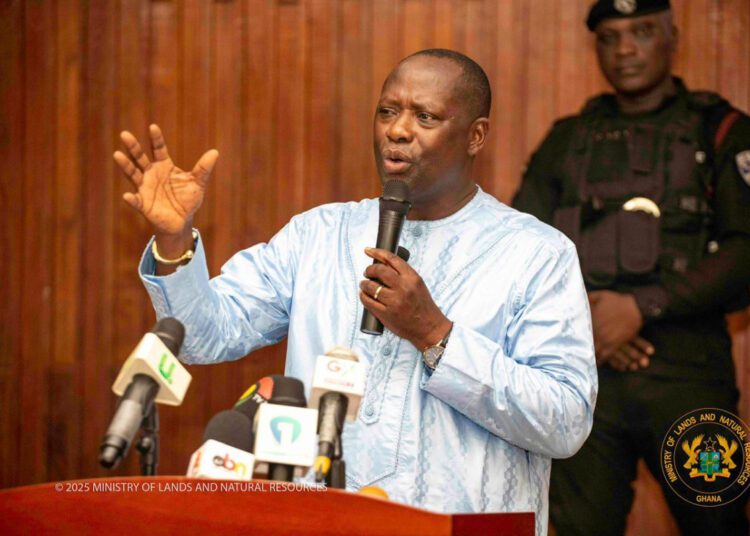
Minister for Lands and Natural Resources, Hon. Emmanuel Armah Kofi Buah, has declared that the Mahama administration will not retreat, relent or surrender in its fight against illegal mining, describing the battle as a defining environmental struggle that this generation must confront. He made the remarks during the Government Accountability Series at the Presidency, Jubilee House.
Hon. Armah Kofi-Buah framed the fight against galamsey as a moral obligation tied to the country’s natural inheritance, arguing that Ghana’s rivers, forests and mineral resources belong to future generations and cannot be sacrificed for short-term gain.
“The fight against illegal mining is a defining environmental battle that our generation must fight. Our rivers are not for sale, our forests are not expendable, our mineral wealth is a sacred inheritance that we have a duty to protect”.
Minister for Lands and Natural Resources, Hon. Emmanuel Armah Kofi Buah
A Declaration Against Impunity
The Minister sent a clear warning to those who continue to profit from environmental destruction, insisting that government’s resolve to pursue offenders remains firm regardless of the challenges involved.

“The era of impunity is over, and the government will continue to pursue everyone who profits from the destruction of our environment. The battle against illegal mining is difficult, but the Ghanaian spirit is stronger.
“We will not retreat, we will not relent, and we will not surrender, but we shall reclaim our rivers, restore our forests, protect our natural wealth and secure a greener, stronger and more prosperous Ghana for posterity”.
Minister for Lands and Natural Resources, Hon. Emmanuel Armah Kofi Buah
His remarks reflect a government keen to demonstrate that its anti-galamsey campaign extends beyond rhetoric into sustained operational activity, backed by figures presented during the same session.
Nationwide Operations Across Six Regions
According to Hon. Armah Kofi-Buah, the National Anti-Illegal Mining Operations Secretariat, known as NAIMOS, sustained a consistent operational tempo against illegal mining during the period under review, targeting activity across six regions considered endemic to the galamsey menace.
These regions include Ashanti, Western, Western North, Eastern, Bono, Ahafo, and Central. The Minister reported that a total of 200 operations were executed across 53 districts within these regions, achieving what he described as an operational strike rate of 84.1 percent.
This figure suggests that the overwhelming majority of planned operations successfully resulted in enforcement action against illegal mining sites and related infrastructure.
Enforcement Targets Mining Sites and Waterways
Beyond the broader operational count, Hon. Armah Kofi-Buah detailed a more specific set of enforcement actions carried out by the Secretariat. He reported that 169 enforcement operations specifically targeted illegal mining sites, forest reserves, river bodies and concession encroachments, representing the core enforcement thrust of the campaign during the reporting period.
These operations targeted the physical infrastructure and human activity sustaining illegal mining across the affected regions, from arrests of individuals involved in the trade to the destruction of equipment and structures used to facilitate galamsey operations.
Arrests and Equipment Seizures
The Minister disclosed that these operations resulted in the arrest of 207 suspects, comprising 161 Ghanaians and 46 foreign nationals. All suspects were processed and handed over to security services for appropriate action, signalling that the operations extended beyond mere disruption into formal legal accountability for those involved.
On equipment seizures, Hon. Armah Kofi Buah reported that between January and June this year, 78 excavators were seized while an additional 90 excavators were immobilised on site.
These machines represent some of the most significant capital investments used in illegal mining operations, making their removal a substantial blow to the economic viability of galamsey activities in affected areas.
Widespread Destruction of Mining Infrastructure
Hon. Armah Buah’s report also detailed extensive destruction of infrastructure associated with illegal mining. He said 2,800 chanfangs, machines commonly used for processing mined material along river bodies, were destroyed across the endemic regions during the period under review.
Additionally, 1,244 makeshift structures associated with illegal mining camps were also demolished, targeting the physical settlements that often support ongoing galamsey operations.

Further seizures included 302 water pumps, 31 vehicles, 72 motorbikes, 18 generators, two pay loaders, five gold detector machines, three outboard motors, three weighing scales and two mini car washing machines, all retrieved from active and abandoned galamsey sites across the affected regions.
Water Pumps Redirected to Irrigation Efforts
In a notable disclosure, Hon. Armah Kofi-Buah revealed that the water pumps recovered during these operations have been handed over to the Ministry of Food and Agriculture to support the government’s irrigation efforts.
This repurposing of seized equipment suggests an attempt to extract practical value from confiscated assets rather than simply decommissioning them, redirecting resources toward legitimate agricultural development.
Weapons Recovered From Mining Enclaves
Perhaps most striking among the disclosures was the scale of weaponry recovered from illegal mining sites. Hon. Armah Kofi Buah reported that operations led to the recovery of 112 pump-action rifles, two sidearms, two locally manufactured rifles, and 1,637 rounds of assorted ammunition, removing what he described as illicit firepower from mining enclaves.
These weapons and ammunition have since been handed over to the Ministry of the Interior for destruction, a move intended to permanently eliminate the risk of these arms re-entering circulation within or beyond the mining communities where they were recovered.
A Campaign Backed by Measurable Results
Taken together, the figures presented by Hon. Armah Kofi-Buah paint a picture of a sustained and multi-pronged enforcement campaign against illegal mining, one that extends from arrests and equipment seizures to the destruction of physical infrastructure and the removal of illicit weapons from mining enclaves.
The scale of operations across 53 districts in six regions suggests a coordinated national effort rather than isolated, localized interventions. Whether this operational tempo can be sustained, and whether it translates into lasting environmental recovery for the rivers and forests affected by years of illegal mining activity, remains to be seen.

For now, government has signalled through both rhetoric and reported action that it intends to maintain pressure on illegal mining operations across the country’s most affected regions.
As NAIMOS continues its operations, attention will likely turn to how these enforcement figures translate into visible environmental restoration, particularly for water bodies and forest reserves that have suffered extensive degradation from years of unchecked galamsey activity.
Hon. Armah Kofi-Buah’s declaration that the government will not retreat sets a clear marker against which future accountability sessions are likely to measure continued progress in this ongoing environmental battle.
READ ALSO: Cabinet Approves Revised Mining Policy to Indigenise Natural Resource Value – Minister Hints