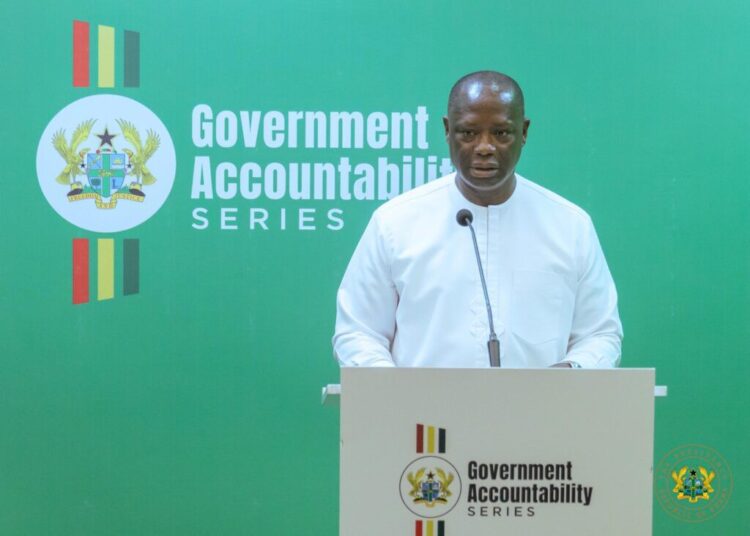
The Minister for Lands and Natural Resources, Hon. Emmanuel Armah-Kofi Buah, has asserted that the implementation of the landmark Minerals and Mining Royalties Regulations 2025 (LI 2517), which introduces a dynamically structured sliding scale royalty framework presents flexible and adaptive structure for both the republic and mining companies.
This regulatory shift is designed to establish a balanced, mutually beneficial fiscal environment, allowing the Republic of Ghana to optimize its revenue generation during periods of favorable commodity pricing while concurrently safeguarding the financial stability of private mining investors during severe market downturns.
“A major milestone this year is the passage of the minerals and mining royalties regulation, which establishes a sliding scale royalty payment, presents strategically adaptive framework for both the republic as the resource owner and mining companies as contractors and investors. This regime ensures that government captures significant revenue during periods of rising commodity prices or production booms, while conversely alleviating financial strain on companies during downturns by reducing rates to prevent negative cash flow, encourage continuous operations, and guarantee job security. And this is very, very important.”
Minister for Lands and Natural Resources, Hon. Emmanuel Armah-Kofi Buah
The newly introduced LI 2517 represents a pivotal transition from the static royalty frameworks of the past, aligning Ghana’s extractive sector with global best practices in mineral resource governance.

The regulation is part of a broader, systemic overhaul of the domestic mining landscape, which also features a comprehensive review of the decades-old 2014 minerals and mining policy to better address contemporary industry challenges.
By institutionalizing this flexible, sliding-scale model, the state aims to protect its sovereign resource wealth while bolstering investor confidence, enhancing overall operational safety, adding downstream value to raw minerals, and systematically curtailing illicit small-scale mining activities across the nation.
Maximizing State Revenues and Protecting Public Wealth
Under the newly established sliding scale framework, Ghana stands to gain immense fiscal windfalls during periods of high commodity pricing, addressing long-standing structural inefficiencies in traditional flat-rate tax systems.
Historically, flat-rate royalties failed to capture the windfall gains generated during global mineral price booms, leaving resource-rich host nations with disproportionately low shares of their sovereign wealth.

LI 2517 directly resolves this by tying the state’s royalty percentages directly to market values. During commodity upswings, the automatic upward scaling of royalty rates secures critical non-tax revenue for the national treasury.
These captured windfalls provide the Ghanaian government with vital capital to fund large-scale infrastructural initiatives, social programs, and public services, ensuring that the nation’s finite mineral resources translate into tangible, long-term economic development for the citizenry.
Securing Corporate Viability and Protecting Local Jobs
Conversely, the regulation acts as an essential financial safety net for mining companies facing sudden macroeconomic recessions or prolonged price slumps. High operational overheads combined with rigid tax structures often drive mining firms into insolvency or forced closures during market downturns.
By lowering royalty rates during price drops, the sliding scale prevents “negative cash flow” and actively supports corporate liquidity.

This structural flexibility allows contractors and investors to maintain their long-term capital investments in the country. Crucially, the policy ensures the “continuity of operations at all times,” allowing mines to remain active rather than entering expensive care-and-maintenance phases.
This operational resilience directly translates to enhanced employment security, safeguarding thousands of local mining jobs and protecting regional economies that rely heavily on the continuous purchasing power of the sector’s workforce.
Structural Reforms and the Evolution of Ghana’s Mining Policy
Ultimately, the enactment of LI 2517 is a cornerstone of Ghana’s broader effort to modernize its extractive sector through comprehensive policy evolution.
The government has successfully reviewed its outdated 2014 minerals and mining policy to create a more robust framework that prioritizes “strengthening regulations, enhancing value addition, improving safety, and combating illegal mining.”
By shifting the regulatory focus toward downstream value addition, Ghana is transitioning from a mere exporter of raw ores to a highly competitive regional processing hub.
This holistic approach, combined with the new progressive fiscal regime, establishes an exceptionally stable, predictable, and transparent investment climate.
The “win-win” framework ensures that while the state maximizes its earnings during market peaks, the private sector remains fully insulated from ruinous operational shocks.
READ ALSO: Henry Hails Spain For Dominant Display Against France