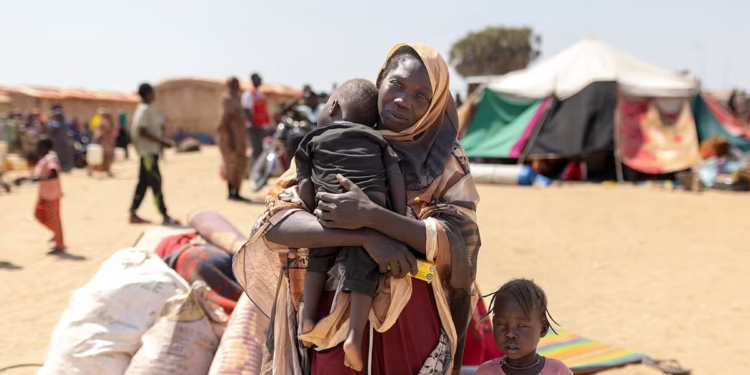
United Nations humanitarian agencies have sounded the alarm over rapidly escalating needs in Sudan’s war-ravaged city of El Obeid, warning that dwindling resources are threatening efforts to support more than 100,000 displaced people seeking refuge in overcrowded camps as the country’s civil war enters its fourth year.
The World Food Programme (WFP) reported that although it has been able to provide emergency food assistance to tens of thousands of people who are seeking shelter in camps throughout the state capital of North Kordofan, the increasing number of displaced families arriving in the city has created urgent humanitarian needs that far outweigh available resources.
WFP Sudan Country Director Abdallah Alwardat detailed the increasingly terrible conditions he saw during a recent visit to El Obeid, where people displaced by months of unrest are battling to subsist on nothing more than humanitarian aid.
“We are providing even not the full food ration to the people, but even that reduced food ration is being shared by the recipients with other families, because they know that they don’t have any other source of income.”
Abdallah Alwardat
According to the WFP, families receiving aid frequently divide their already reduced rations among neighbours and relatives who have received nothing, highlighting the severe shortages confronting humanitarian operations.
The worsening situation in El Obeid has also attracted international concern because of mounting security risks.
United Nations High Commissioner for Human Rights Volker Türk has warned that civilians in the city have endured an 18-month siege marked by continuous drone attacks while fears persist over a possible offensive by paramilitary forces.
For many displaced people, however, the immediate struggle remains securing enough food to survive each day.
Alwardat recalled meeting an elderly woman whose experience reflected the immense hardships facing thousands of vulnerable Sudanese.
“She was waiting to receive the food and she was just thinking how to carry the food back to her tent. She wanted to move it on this little tuk-tuk…So, she was going around to look at other families, if they can share the cost of transferring the food back to the tents.”
Abdallah Alwardat
The latest emergency unfolds against the backdrop of Sudan’s prolonged civil war, which erupted after rival military factions turned against one another following the collapse of the country’s transition to civilian rule after the overthrow of former President Omar al-Bashir.
Since then, fighting between the SAF and RSF has devastated cities, destroyed infrastructure and displaced more than 14 million people. Millions have crossed into neighbouring countries, while countless others remain trapped inside Sudan with limited access to food, healthcare, clean water and protection.
According to humanitarian agencies, almost 20 million people in Sudan are currently experiencing acute food insecurity, making it one of the world’s most serious hunger catastrophes.
The World Food Programme today touches between three and five million of the most vulnerable people each month, with a focus on communities experiencing emergency and catastrophic levels of hunger.
UN Calls for Urgent Scale-Up as Resources Fall Short of Rising Needs
While humanitarian access to El Obeid has improved in recent weeks, UN officials maintain that the most significant barrier to providing life-saving assistance is no longer physical access, but a lack of funding.
Alwardat emphasised that humanitarian organisations have both the operational and logistical capabilities to deliver help, but are hindered by low financial resources.
“WFP has been providing food assistance to over 100,000 people in these camps inside the city. But there are many more displaced individuals sheltering in El Obeid and they need urgent assistance.”
Abdallah Alwardat
He added that the agency is now preparing to expand operations significantly to respond to the growing humanitarian emergency.
Beyond food distributions, WFP is also providing specialised nutritional assistance to approximately 17,000 children living in displacement camps, many of whom face heightened risks of malnutrition after months of conflict and disrupted food supplies.
Despite the immense challenges, Alwardat noted encouraging progress in maintaining humanitarian supply lines. During his journey of roughly 350 to 400 kilometres from Kosti to El Obeid, he observed no active military confrontations, suggesting that aid deliveries remain possible despite the volatile security environment.
However, he warned that commercial activity along the route remained extremely limited, with very few trucks transporting food, fuel or other essential commodities into the city.
The resulting shortages have affected humanitarian partners, many of whom have struggled to distribute assistance because of insufficient fuel supplies.
WFP Sudan Country Director emphasised that,“as long as we have the necessary financial support, I think we have the means and the capacity to sustain that lifeline.”
READ ALSO: Disney+ Reboots Iconic Mickey Mouse Club with Fresh Young Talent