The Minister for Education, Hon. Haruna Iddrisu, has defended the Finance Minister’s mid-year budget presentation as forthright and sincere, while pushing back sharply against criticism from the Minority in Parliament, even as he acknowledged that government must move beyond macroeconomic stability to deliver real job opportunities for Ghanaians.
Speaking in a wide-ranging interview, the Minister argued that Ghana’s economic fundamentals have improved markedly since President John Dramani Mahama assumed office in January 2025, while conceding that genuine progress must ultimately be measured by whether growth translates into jobs and reduced unemployment.
Hon. Iddrisu was unequivocal in his assessment of the recent budget review, describing it as a departure from what he characterised as years of less transparent presentations, while drawing a clear line between legitimate disagreement and what he viewed as unwarranted criticism from opposition lawmakers.
He urged critics to weigh the state of the economy at the point President Mahama took office against current conditions, arguing that such a comparison would reveal significant improvement across key indicators.
To back his position, the Minister pointed to specific economic indicators he said demonstrated tangible improvement in the country’s fiscal fundamentals.
He noted that inflation had fallen from around 53 percent to a current level of roughly 5.8 percent, with a maximum of about 8 percent, while the debt-to-GDP ratio had declined from over 70 percent to somewhere between 48 and 51 percent.
” If the fundamentals of the economy, measured in inflation, what was the state of inflation, and is that the case today? It means the fundamentals in respect of inflation has improved.”
Hon. Haruna Iddrisu, Minister of Education

He added that the reduced debt burden had eased the volume of resources previously consumed by debt servicing, freeing up fiscal space that government could now redirect toward infrastructure and education initiatives. He further noted that Ghana was close to regaining access to international capital markets, having previously been shut out following its debt distress and junk credit rating.
Concession on Jobs and Unemployment
Despite his defence of the government’s fiscal record, Hon. Iddrisu was candid in acknowledging that stability alone does not satisfy the more pressing concern of many Ghanaians employment employment crisis. He indicated that criticism focused specifically on job creation was one he would readily accept as constructive rather than dismiss as unfounded.
“What I will accept as objective, constructive criticism of the economy, is that it has not spurred growth in a way that creates jobs opportunities and addressed unemployment. That I would favourably accommodate. We need to go beyond stability to create opportunities.”
Hon. Haruna Iddrisu
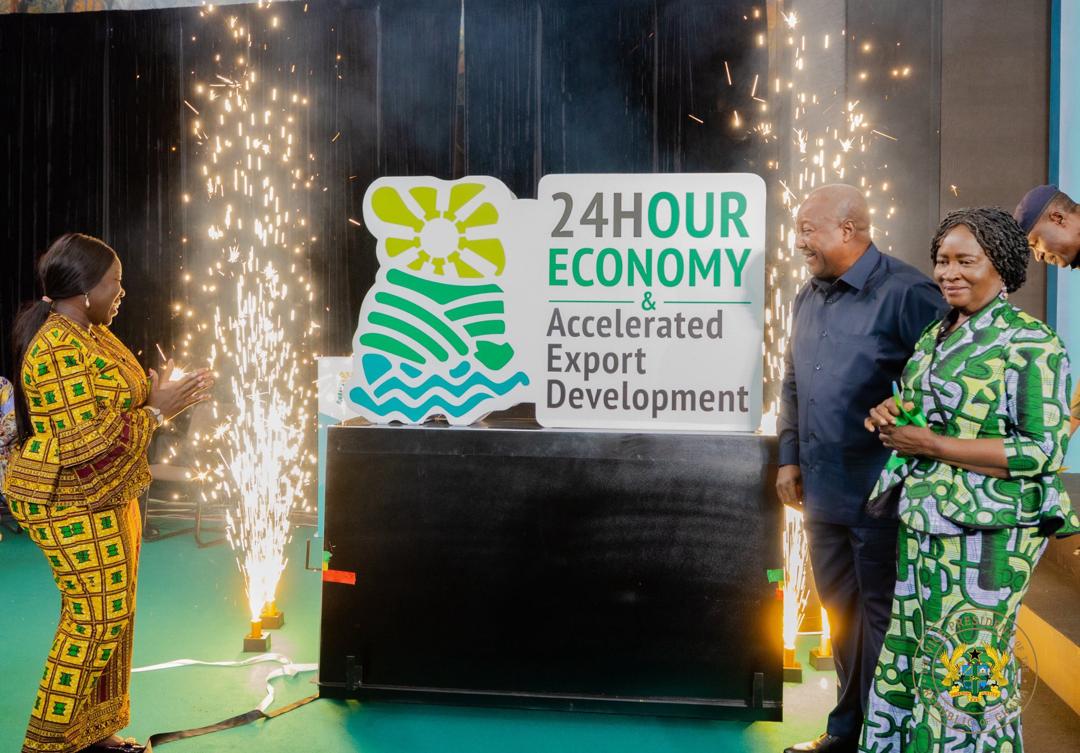
He said this concern was precisely why he found some of the commentary surrounding the government’s 24-hour economy policy unhelpful, describing the initiative as central to government’s strategy for translating macroeconomic stability into tangible economic opportunity.
The Minister laid out what he described as the three core objectives underpinning the 24-hour economy policy, enhancing value addition, reducing reliance on imports, and setting Ghana on a path toward light manufacturing and industrialisation.
He proposed concrete examples of how the policy could be implemented at the regional level, citing dormant textile facilities as candidates for revival under strategic investment arrangements.
He suggested that regions with clear comparative advantages in specific commodities, such as cashew production in the Ahafo Region, poultry farming in the Bono Ahafo Region, and agricultural production around Akuse in the Greater Accra Region, should be targeted for factories and value-addition ventures tailored to their existing strengths, arguing that such an approach would generate jobs directly tied to each region’s natural or established capacity.
Government’s Role as an Enabler, Not a Driver
Reflecting on his own experience as a former Minister for Trade and Industry, Hon. Iddrisu argued that government’s proper role in economic development is to create an enabling environment rather than attempt to drive economic activity directly.
He questioned whether current conditions, including utility tariffs, were sufficiently favourable to private sector participation in the 24-hour economy agenda.
He called for government to go further in providing strategic incentives and exemptions to attract private investment beyond Greater Accra into other regions of the country, warning that unemployment remains what he called a ticking time bomb for Ghana if left unaddressed.
Taken together, the Minister’s remarks reflect a government confident in its macroeconomic record but increasingly aware that public patience is shifting toward demands for visible employment outcomes.
By linking the 24-hour economy policy, regional value-addition strategies, and calls for a more enabling business environment, Hon. Iddrisu’s comments suggest that government’s next major test lies not in defending its fiscal numbers, but in demonstrating that improved fundamentals can genuinely deliver the jobs and opportunities Ghanaians are waiting to see.
READ MORE: Education Minister Announces Plan for National Teacher University in Peki