Roberto Mancini has been handed a second spell as Italy head coach, returning to the national team amid significant upheaval within the Italian Football Federation (FIGC) following a contentious search for a new manager.
The 61-year-old succeeds Gennaro Gattuso, whose left the role in April after Italy failed to qualify for the 2026 FIFA World Cup, extending the nation’s remarkable absence from football’s biggest tournament. Italy have now missed three consecutive World Cups, a run that has intensified pressure on the federation to restore the country’s status among the global elite.
Mancini’s appointment was confirmed just a day after Andrea Pirlo withdrew from consideration for the role. Pirlo had emerged as the leading candidate before stepping aside following criticism over his reported links to a Russian betting company, a controversy that quickly altered the federation’s plans.
The fallout extended beyond the coaching appointment. Technical director Paolo Maldini resigned only weeks after taking up the position, with adviser Leonardo also leaving the federation after disagreements surrounding the decision not to appoint Pirlo.
Former Leicester City manager Claudio Ranieri has now been named as Italy’s new technical director.
A Familiar Face Returns During Uncertain Times
FIGC president Giovanni Malago said Mancini was always his preferred choice, expressing confidence that the experienced coach possesses the qualities needed to guide the national team through one of the most challenging periods in its modern history.
Mancini is no stranger to success with the Azzurri. During his first spell between 2018 and 2023, he transformed a side rebuilding after missing the 2018 World Cup into European champions. Italy’s triumph at UEFA Euro 2020, achieved with a penalty shootout victory over England at Wembley, remains one of the country’s greatest recent sporting achievements.
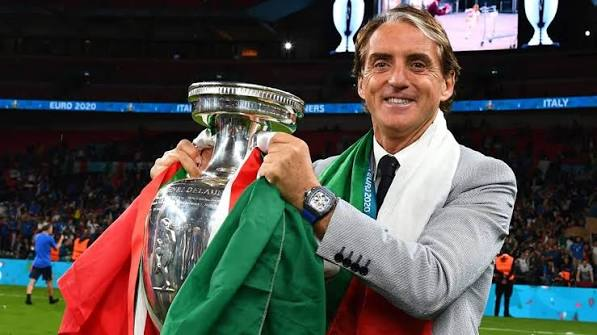
His first tenure also featured a world-record 37-match unbeaten streak, reflecting the team’s consistency and renewed identity. However, those achievements were overshadowed by Italy’s shock defeat to North Macedonia in the 2022 World Cup qualifying play-off, a result that denied the four-time world champions a place in Qatar.
Mancini eventually resigned in August 2023 before taking charge of Saudi Arabia’s national team. His time there was brief, and he later moved to Qatari club Al Sadd. Although he guided the club to the Qatar Stars League title, they fell short in continental competition and finished runners-up in the Qatar Cup before his departure in June.
Before his return, Italy’s Under-21 coach Silvio Baldini had overseen the senior side on an interim basis following Gattuso’s exit.
Rebuilding Confidence Before Another Crucial Campaign
Mancini inherits a team desperate to end years of inconsistency. Despite winning the European Championship only a few years ago, Italy’s inability to qualify for successive World Cups has damaged the country’s reputation and raised questions about the development of its next generation of players.
The federation had reportedly explored several high-profile options during its search, including meetings with Pep Guardiola and Carlo Ancelotti, before Pirlo briefly became the leading contender. The rapid changes at the top underline the uncertainty that has surrounded Italian football in recent months.

From an analytical perspective, bringing back Mancini represents a balance between stability and familiarity. Rather than embarking on another long-term experiment, the federation has turned to a coach who already understands the national team structure, the expectations of Italian supporters, and the demands of international football.
At the same time, the decision carries its own risks. While Mancini’s achievements are unquestionable, his previous tenure also ended amid disappointment after Italy failed to reach the 2022 World Cup.
His second spell will inevitably be judged less by past accomplishments than by his ability to reverse the team’s decline and ensure qualification for major tournaments.
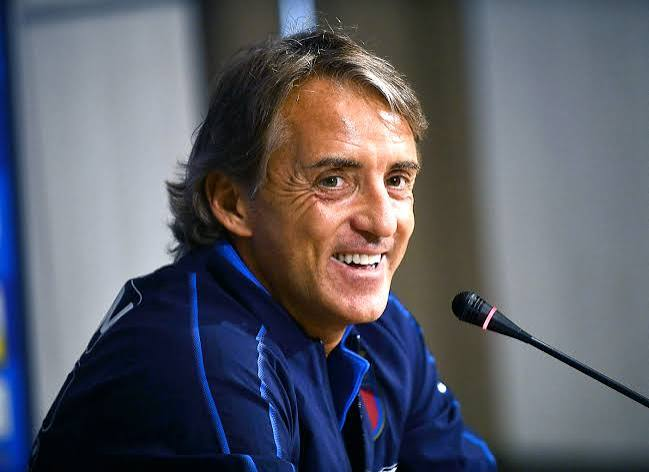
The appointment also signals that the federation believes its problems extend beyond the identity of the coach. With Ranieri assuming the technical director’s role following Maldini’s departure, Italy appears to be reshaping both its football leadership and long-term sporting strategy.
Mancini’s immediate challenge will come in the UEFA Nations League, where Italy begin their campaign at home against Belgium on September 25 before travelling to face Turkey three days later.
Those fixtures will offer an early indication of whether his return can restore confidence to a national team eager to move beyond recent disappointments and reclaim its place among Europe’s leading football powers.
READ ALSO: Poll Projects Ato Forson, Asiedu Nketia Defeating Bawumia in 2028