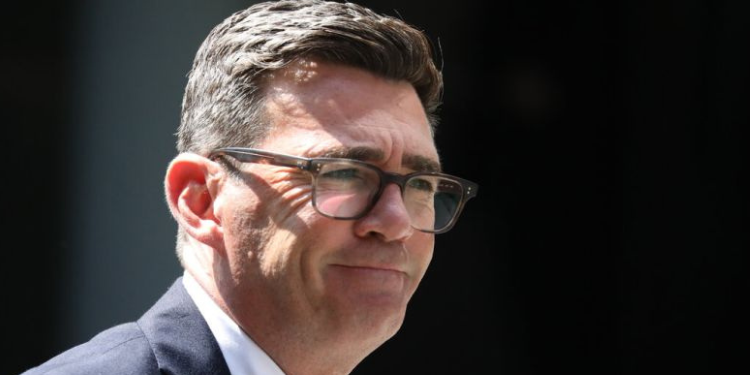
UK Prime Minister Andy Burnham has warned employers against relying too heavily on artificial intelligence and virtual interviews during recruitment, arguing that excessive use of technology risks preventing young job seekers from showing their personality, enthusiasm and potential.
Burnham stated on the careers podcast “Jimmy’s Jobs of the Future,” hosted by former political adviser Jimmy McLoughlin, that the growing shift toward online recruitment processes may disadvantage candidates who perform better through personal interaction rather than structured digital assessments.
The Prime Minister criticised the growing “culture” of conducting job interviews via platforms like Zoom and Microsoft Teams, questioning whether such approaches allow young applicants to properly demonstrate their skills and character.
“One thing I really don’t like is this culture now of interviewing via Zoom or Teams,” Burnham stated, adding: “How does a young person shine in that situation?”
His comments come as United Kingdom faces renewed concerns over youth employment, with more than one million people aged between 16 and 25 currently not in education, employment or training.
Official figures show the number of young people outside work and education has reached its highest level in more than 12 years, raising fears of a growing generation struggling to secure opportunities.
At the same time, job vacancies have fallen to their lowest level in five years, increasing competition among applicants and pushing many employers to adopt automated recruitment tools designed to process large volumes of applications.
Artificial intelligence is increasingly being used by companies to screen CVs, rank candidates and manage early stages of recruitment. According to LinkedIn data, around 89% of UK recruiters expect to increase their use of artificial intelligence in hiring processes this year.

However, Burnham argued that while technology may improve efficiency, it does not necessarily create a fairer system for applicants, particularly young people who may lack professional experience or established networks.
“How do you get over some of your personality, your passion?” It seems to me to then work against people who have that side to their character and work for those who are just giving the more formulaic answer.”
Andy Burnham
Burnham further indicated that, he had observed similar challenges affecting younger people close to him, highlighting concerns that recruitment systems could unintentionally favour candidates who are better at navigating automated processes rather than those who possess creativity, determination and interpersonal skills.
The sentiments coincide with mounting complaints from young job searchers who claim that contemporary hiring procedures have grown more impersonal. According to some applicants, the procedure feels “robotic and brutal,” and they have submitted hundreds of applications without hearing back.
The mix of economic uncertainty, fewer job openings, and computerised hiring procedures has made it more difficult for many young individuals just starting their careers to land their first jobs.
If immediate action is not taken to increase access to job and training, Britain runs the risk of producing a “lost generation” of young people, according to a new report headed by former minister Alan Milburn.
Milburn’s report found that career opportunities for young people are “not growing, they’re shrinking”, warning that one in six young people could be outside education, employment or training within five years unless significant reforms are introduced.
Burnham Pushes Workplace Experience Scheme to Help Young People Build Careers

In addition to criticising digital recruitment, Burnham presented ideas to help young people make a better transition from school to the workforce, such as increasing access to mentorship and professional experience.
According to the Prime Minister, businesses who provide teenagers six-week work experiences may be given preference when applying for government contracts.
Additionally, he indicated support for expanding the number of lengthier 45-day internships for 16 to 18-year-olds. This would provide young people more time in the workplace to learn practical skills, comprehend professional expectations, and cultivate relationships with employers.
Burnham contended that significant exposure to the workplace could aid in bridging the gap between education and employment, especially for young individuals without access to professional networks or family ties.
The Prime Minister also called on senior business executives to play a greater role in supporting young people by offering opportunities to shadow them and gain insight into different careers.
Such measures, he suggested, could help address inequality in access to employment opportunities by ensuring that success does not depend solely on personal connections.
The push comes as policymakers face increasing pressure to respond to Britain’s youth employment challenges.
Analysts have warned that prolonged periods outside work or education can have long-term effects on earnings, career progression and mental wellbeing.
READ ALSO: Akwaboah Drops New Highlife Single Urging Financial Readiness for Marriage