Sammy Gyamfi, Esq., Chief Executive Officer of the Ghana Gold Board (GoldBod CEO), has issued a compelling call to action, demanding a fundamental paradigm shift in how the African continent governs its vast natural resources and leverages its global diaspora.
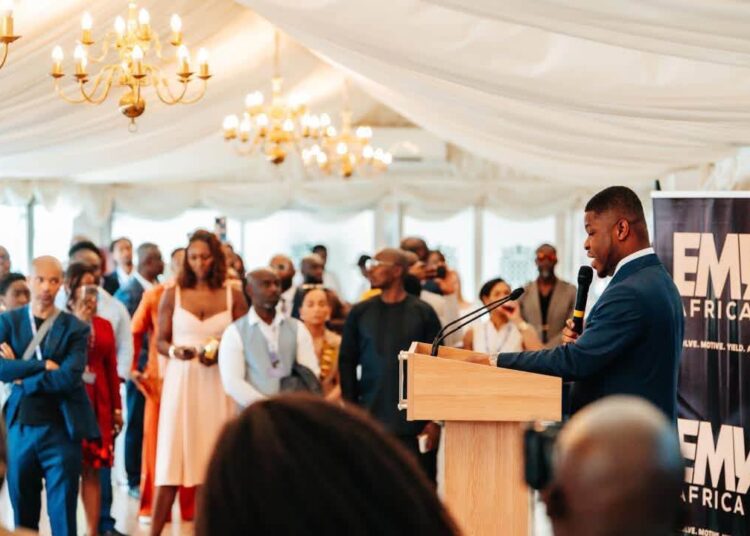
Speaking at the EMY Africa Africa Rising Symposium in London, the GoldBod head emphasized that the narrative surrounding Africa’s economic emergence must transcend rhetoric to become a tangible, lived reality.
He underscored that true socio-economic ascension will remain elusive unless African nations transition away from being passive exporters of raw primary commodities and instead establish themselves as direct owners, industrial builders, and primary value creators within the global supply chain.
“Our task, then, is not simply to celebrate the growing relationship between Africa and its diaspora. It is to convert that relationship into a productive force: capital that builds, institutions that endure, and ownership that keeps more African value in African hands.”
Sammy Gyamfi, Esq., Chief Executive Officer of the Ghana Gold Board

Expanding on this vision, Gyamfi stressed that the historic relationship between the African continent and its diaspora must be systematically restructured into an engine of economic value addition and institutional strength.
He pointed out that while Africa’s global geopolitical footprint is expanding rapidly, the crucial strategic battle lies in who ultimate controls the ownership rights to its mineral wealth, energy reserves, and domestic consumer markets.
Without intentional policy shifts that retain mineral processing and financial architecture locally, the continent risks repeating historical extraction patterns that enrich offshore entities while leaving host communities with environmental degradation and economic vulnerability.
Redefining Economic Ownership and Value Retention
The fundamental imperative to move away from raw resource exportation stems from decades of asymmetric trade dynamics that have historically drained Africa’s economic potential.
When raw minerals such as gold, lithium, and bauxite are shipped overseas in their unrefined forms, host nations export critical downstream jobs, tax revenues, and technological advancement alongside the raw ore.

Retaining value domestically requires establishing state-of-the-art refining, smelting, and manufacturing infrastructure directly on the continent.
By processing primary gold into London Bullion Market Association (LBMA) standard bars or transforming lithium into battery components within West Africa, host nations can multiply their export revenues exponentially, stabilize local currencies, and establish self-sustaining industrial ecosystems that insulate domestic economies from external commodity price shocks.
Harnessing the Strategic Power of the Global Diaspora
To achieve this industrial transformation, the African diaspora represents a vital, underutilized strategic catalyst rather than merely a source of financial remittances.
As the GoldBod chief noted during his London address, the global African diaspora constitutes “a reservoir of expertise, skills, technology, capital, networks, credibility, influence, and lived experience in systems that Africa must now master for itself.”

Mobilizing this global network allows African nations to bridge critical gaps in technical know-how, venture capital, and governance framework design.
Diaspora-led investments can directly finance downstream processing plants, support local mining service companies, and establish institutional trading platforms that guarantee fair value for locally mined commodities.
This strategic collaboration creates a sophisticated financial corridor that shifts the narrative from foreign aid dependence to sovereign wealth accumulation and collaborative equity investments.
Turning Demographic Reality into Economic Dividend
The urgency of executing this structural shift is further highlighted by Africa’s unprecedented demographic expansion.
Citing the Mastercard Foundation’s Africa Youth Employment Outlook 2026, Gyamfi highlighted that the continent currently houses roughly 532 million young people aged 15 to 35, a figure projected to climb consistently through the 2070s.

This vast youth population can serve as the world’s most dynamic engine of industrial productivity if domestic extractive sectors are integrated into broader manufacturing value chains.
However, failing to build local processing industries risks transforming a potential demographic dividend into a severe economic crisis characterized by widespread youth unemployment, systemic social instability, and accelerated brain drain.
By transforming raw resource wealth into sustainable local industries, African leadership can build an inclusive economic framework where young Africans actively construct, own, and lead the continent’s industrial future.
READ ALSO: Ghana Risks Missing Big Opportunity, Chamber of Commerce CEO Warns