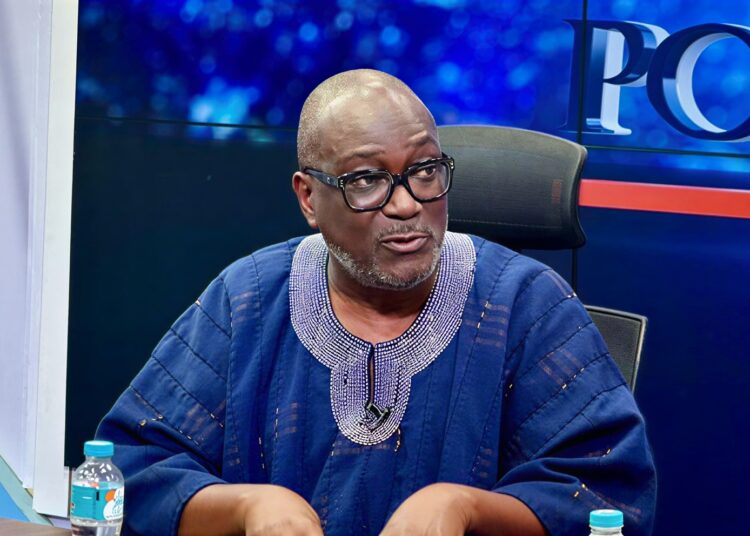
The Chairman of the Constitutional Review Committee and Executive Director of CDD, Professor Henry Kwasi Prempeh, has observed that constitutions differ fundamentally from everyday political debates because they establish the enduring principles upon which governance, leadership succession and the distribution of state power depend. From his view, constitutional reforms deserve careful deliberation since they influence future generations long after current political office holders have left public service.
According to the Chairman, every participant in the review process should evaluate the proposed reforms beyond immediate partisan interests. He explained that constitutional provisions should be assessed from the standpoint of ordinary citizens who will continue to live under them long after present political administrations have ended.
“This is going to last beyond any party’s tenure, any president’s tenure. You should look at it as creating a state and society your children and grandchildren will be proud to inherit.”
Professor Henry Kwasi Prempeh
Professor Prempeh encouraged political leaders to embrace a patriotic obligation throughout the review process. He outlined that the Constitution governs the recruitment of national leadership, the exercise of political authority and the orderly transfer of power, making it too significant to become another contest between rival parties.
The Constitutional Review Committee Chairman also argued that reducing the exercise to partisan competition could undermine the opportunity to introduce meaningful institutional reforms. In his view, Ghana risks missing transformative changes if constitutional amendments are approached as victories for one political tradition over another.
Analysing the next phase of the process, Professor Prempeh advocated extensive public engagement before any final decisions are reached. He explained that broad national participation would strengthen public confidence while ensuring competing proposals are examined on the strength of their merits.
Additionally, he proposed sustained national debate ahead of any voting process. The emphasis, he noted, should remain on testing ideas through open discussion instead of rushing constitutional decisions whose impact will extend well beyond the present generation.
Turning to the implementation timetable, Professor Prempeh acknowledged that valuable time has already been lost following the submission of the committee’s work. He disclosed that it would have been more beneficial if government’s own constitutional proposals were submitted earlier as part of the committee’s nationwide consultations.
Referencing the electoral calendar, the Constitutional Review Committee Chairman recognised the practical importance of synchronising a referendum with local government elections to encourage stronger voter participation. Even so, he reiterated that the quality of public deliberation should remain the overriding priority as Ghana advances towards the next stage of constitutional reform.
Public Participation Key To Lasting Constitutional Reforms
Professor Henry Kwasi Prempeh also indicated that broad public participation will determine the credibility of Ghana’s constitutional reform process, explaining that differing proposals from stakeholders should strengthen national dialogue. He observed that varying perspectives are expected because the committee’s nationwide consultations naturally differ from positions developed within government.
Professor Prempeh explained that the committee deliberately constituted outside government and the political establishment to gather independent views from citizens across the country. According to him, members travelled extensively to engage communities, civil society organisations, professional groups and other stakeholders before compiling their recommendations.
Discussing the committee’s approach, the Constitutional Review Committee Chairman outlined that consultations extended beyond elite circles to include ordinary Ghanaians from different regions. Consideration was also given to parliamentary caucuses, former presidents, the President and other interest groups to ensure that diverse opinions informed the report.
“The committee was drawn from outside government and consulted across the length and breadth of the country. Different conclusions were always likely to emerge.”
Professor Henry Kwasi Prempeh
From his perspective, it would have been more beneficial if government’s constitutional proposals had been presented to the committee at the beginning of the exercise. Such an approach, he explained, would have allowed those proposals to be tested through public consultations alongside submissions from other stakeholders.
Additionally, Professor Prempeh remarked that the government’s recently published position paper now represents one contribution within a wider constitutional conversation. He added that opposition parties and other organised groups may also present alternative proposals as public engagement continues.
An important phase, he observed, lies in how competing viewpoints are evaluated through reasoned discussion instead of political rivalry. The emphasis, he suggested, should remain on identifying reforms capable of strengthening Ghana’s democratic institutions for future generations.
Addressing the broader objective of the review exercise, Professor Prempeh welcomed indications that issues surrounding political party financing, campaign expenditure and the rules governing political participation are receiving attention. Those matters, he noted, could significantly improve democratic accountability if handled through genuine national consensus.
Constitutional Review Needs Wider Public Scrutiny Before Parliamentary Approval
Professor Henry Kwasi Prempeh also outlined the need for broader public engagement before constitutional amendment bills reach Parliament, arguing that the review process should establish a credible precedent for future reforms. He explained that constitutional amendments require a different level of participation because they define the country’s governance framework for generations.
Professor Prempeh observed that the Constitutional Review Committee has already completed an extensive round of nationwide consultations before presenting its report to government. According to him, the next stages should remain open to additional submissions so that differing opinions continue to shape the final outcome.
Addressing the government’s proposed timetable, the Constitutional Review Committee Chairman questioned whether stakeholders would have sufficient opportunities to influence the draft legislation before it is gazetted. Subsequently, he indicated that the period preceding the introduction of the bill offers an important opportunity for further dialogue among political parties, civil society organisations and ordinary citizens.

“We must get it right because this becomes the template for future constitutional reforms. A constitution deserves a process that attracts the widest possible public participation.”
Professor Henry Kwasi Prempeh
Turning to Parliament’s role, Professor Prempeh noted that legislative procedures already provide room for memoranda, committee hearings and public submissions. In his assessment, those mechanisms should be fully utilised to strengthen transparency and improve public confidence in the review process.
Additionally, he pointed out that Ghana’s previous constitutional amendments did not benefit from such an extensive consultative exercise. Earlier amendments, he recalled, were largely processed within Parliament, making the current review the country’s first broad based attempt to undertake significant constitutional reforms through nationwide engagement.
The exercise therefore presents an opportunity to establish a durable model for future constitutional amendments. The emphasis, he explained, rests on ensuring that the review process demonstrates openness, inclusiveness and public ownership at every stage.
Analysing the referendum process, Professor Prempeh remarked that entrenched constitutional provisions demand especially high public participation because of the constitutional thresholds required for approval. He suggested that inadequate public education and limited engagement could affect voter turnout and the eventual success of the referendum.
READ ALSO: Gold Fields, Two Others to Lead AMW 2026 Gold Growth Dialogue