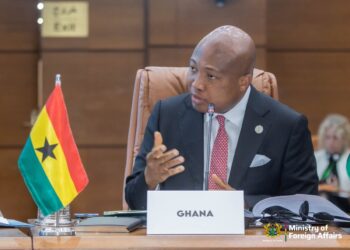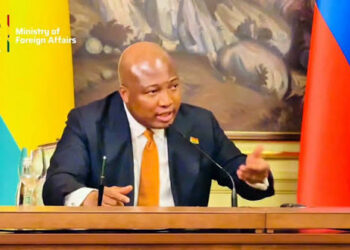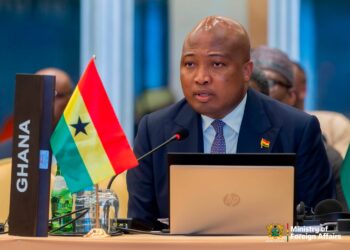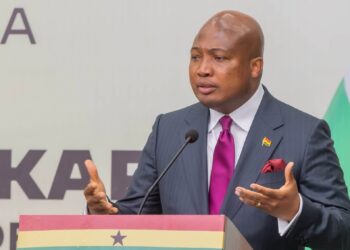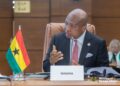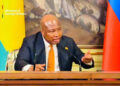

President John Dramani Mahama and Jamaican Prime Minister Andrew Michael Holness held joint media statements following bilateral talks during President Mahama’s State Visit to Jamaica, covering trade expansion, port connectivity, disaster relief cooperation and plans to activate direct flights between Accra and Kingston.
Prime Minister Holness opened his remarks by highlighting the tangible outcomes already emerging from a business forum held between the two countries the previous month, connecting companies across several sectors. He specifically noted Jamaica’s interest in learning from Ghana’s fintech expansion, describing it as a model worth studying.
“We have observed the rapid growth of Ghana’s fintech sector and are keenly watching how that ecosystem continues to expand. There is much Jamaica can learn from Ghana’s experience in developing a vibrant digital financial services industry”.
Most Honourable Andrew Michael Holness, Prime Minister of Jamaica
Connecting Ports Across the Atlantic
Prime Minister Holness welcomed President Mahama’s planned visit to the Port of Kingston, drawing parallels between Ghana’s and Jamaica’s respective ambitions to serve as regional gateways for trade.
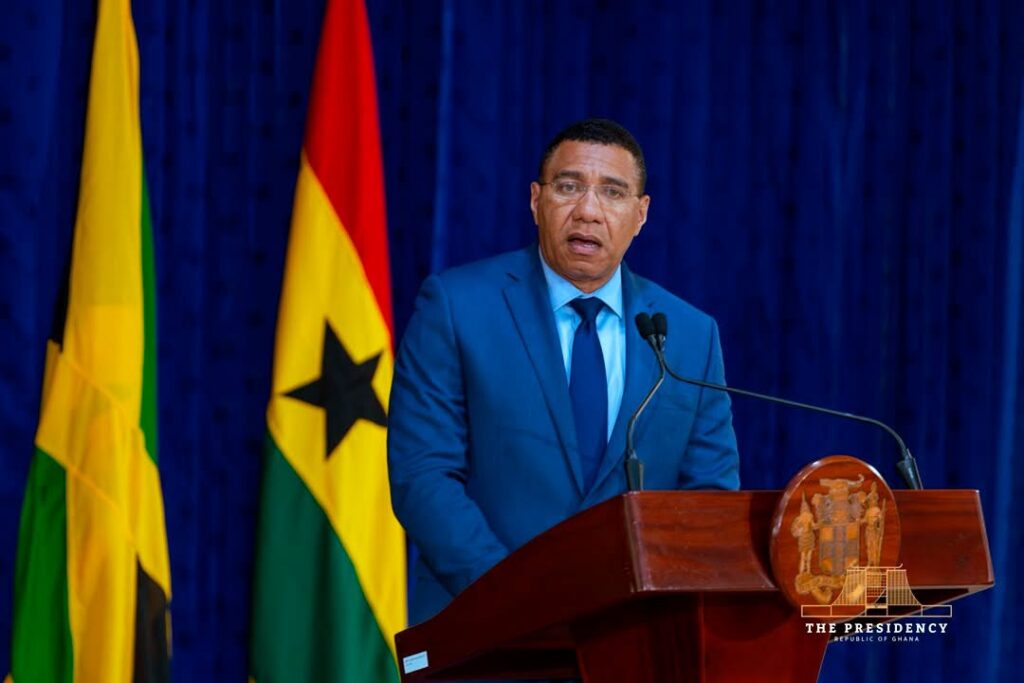
“Just as Ghana is expanding its ports and logistics operations to become the gateway to West Africa, Jamaica is strengthening its own ports and logistics infrastructure to serve as the gateway to the Caribbean and Latin America”.
Most Honourable Andrew Michael Holness, Prime Minister of Jamaica
He explained that connecting the two port systems could create mutual trade advantages for exporters and investors on both sides of the Atlantic. Prime Minister Holness noted that connecting the two countries’ ports can provide exporters and investors on both sides of the Atlantic with more efficient access to new markets.
For Prime Minister Holness, this would make it easier for Ghanaian exporters to reach the Caribbean and the Americas, while enabling Jamaican exporters to access Africa, particularly through the opportunities created by the African Continental Free Trade Area.
Gratitude for Ghana’s Hurricane Melissa Support
Prime Minister Holness turned to express deep appreciation for Ghana’s humanitarian assistance following Hurricane Melissa, which struck Jamaica the previous October, highlighting the direct role Ghanaian personnel played in the country’s recovery.
“Ghana’s humanitarian assistance, together with the invaluable contribution of the Ghana Army Corps of Engineers, played a meaningful role in our recovery by helping reconstruct roofs in the hardest-hit communities of Aong, Black River, Middle Quarters and Thornton in the parish of St Elizabeth”.
Most Honourable Andrew Michael Holness, Prime Minister of Jamaica
He confirmed that both governments had agreed to formalise arrangements enabling faster mobilisation of such assistance whenever future disasters occur, in either direction. He described the scale of Ghana’s outreach as historically significant for the wider Caribbean region.
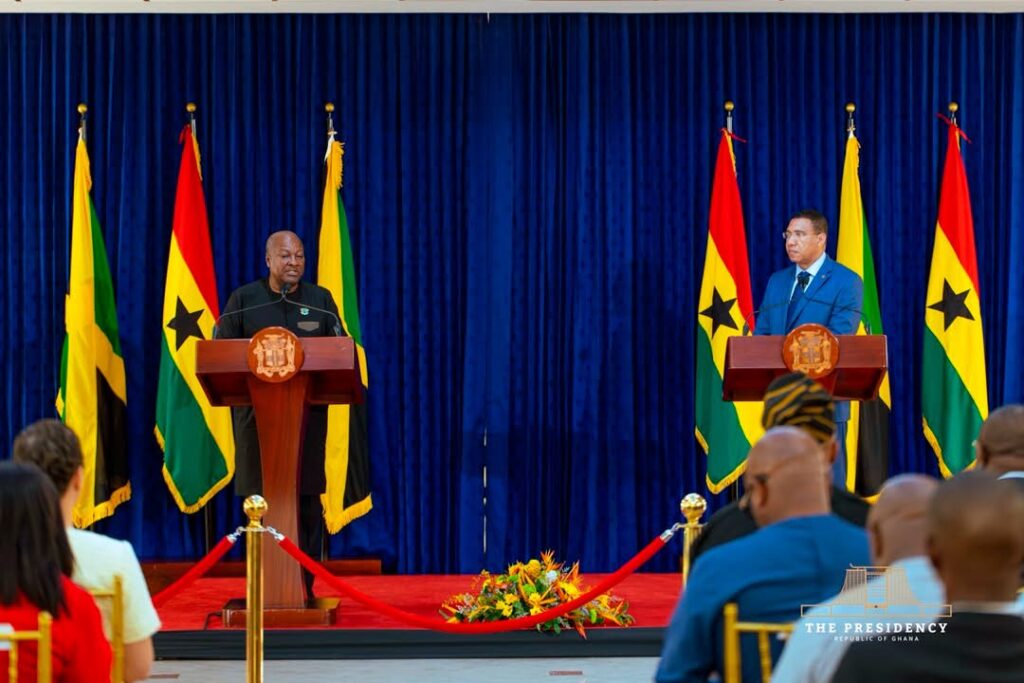
“I believe this is the first time we have experienced such extensive humanitarian outreach from the African continent to our region. It is a powerful demonstration of meaningful South-South cooperation”.
Most Honourable Andrew Michael Holness, Prime Minister of Jamaica
Prime Minister Holness closed his remarks with formal thanks on behalf of Jamaica and a warm welcome to President Mahama. “May this State Visit mark another defining chapter in the enduring friendship between our two sovereign nations,” he said.
Mahama Reflects on Pan-African Roots
Responding, President Mahama thanked Prime Minister Holness for the invitation and confirmed he had extended a reciprocal invitation for Jamaica to visit Ghana during its 70th Independence Anniversary celebrations next year.
He then traced the historical bonds between the two nations back to the Pan-African Congress movement, highlighting the influence of key figures on Ghana’s own independence journey.
“With the rise of Pan-Africanism during the colonial era, many great African and Caribbean leaders came together through the Pan-African Congress to begin the movement for liberation from colonial rule. Among those outstanding Pan-Africanists were Marcus Garvey, our own Dr Kwame Nkrumah, and many others”.
President John Dramani Mahama
He elaborated on Garvey’s direct influence on Nkrumah’s economic vision for post-independence Ghana. According to President Mahama, President Nkrumah acknowledged that Marcus Garvey inspired several of his ideas on Pan-Africanism and the struggle against colonial domination.
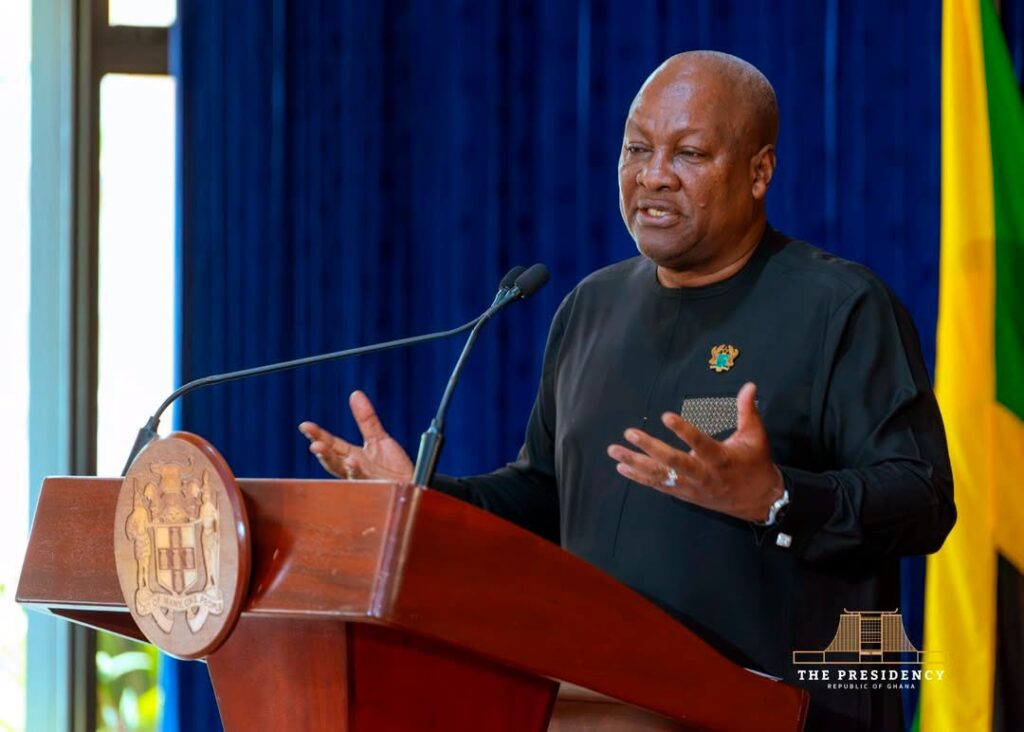
“This influence is evident in many of the programmes President Nkrumah implemented after Ghana attained independence. The industries he established and the economic programmes he pursued reflected Garvey’s vision of African self-reliance and economic empowerment”.
President John Dramani Mahama
He noted specific symbols connecting the two legacies, including Ghana’s Black Star and the historic Black Star Line. “It is therefore no coincidence that Ghana adopted the Black Star as its national symbol, a concept championed by Marcus Garvey. Likewise, the establishment of the Black Star Line reflected Garvey’s own vision of African economic independence,” he said.
Bob Marley’s Enduring Influence
President Mahama extended the historical narrative to include Prime Minister Michael Manley’s role within the Non-Aligned Movement, before turning to musician Bob Marley’s global influence on African liberation movements.
“In later years, the Prophet Bob Marley emerged as another inspirational figure whose music gave hope and confidence to people of African descent around the world. His song celebrating Zimbabwe’s independence remains deeply inspiring.
“His message of African liberation resonated across the continent, extending beyond Zimbabwe to South Africa and other countries that eventually secured their freedom”.
President John Dramani Mahama
He expressed anticipation for an upcoming visit to a site honouring Marley’s legacy. “Even today, his powerful lyrics urging us to emancipate ourselves from mental slavery continue to inspire generations of Africans and people of African descent worldwide. I am therefore looking forward very much to visiting the Bob Marley Museum later this afternoon,” he said.
From Liberation to Economic Emancipation
President Mahama framed the current relationship between Ghana and Jamaica as an extension of the historical solidarity between the two nations, now focused on economic rather than political liberation.
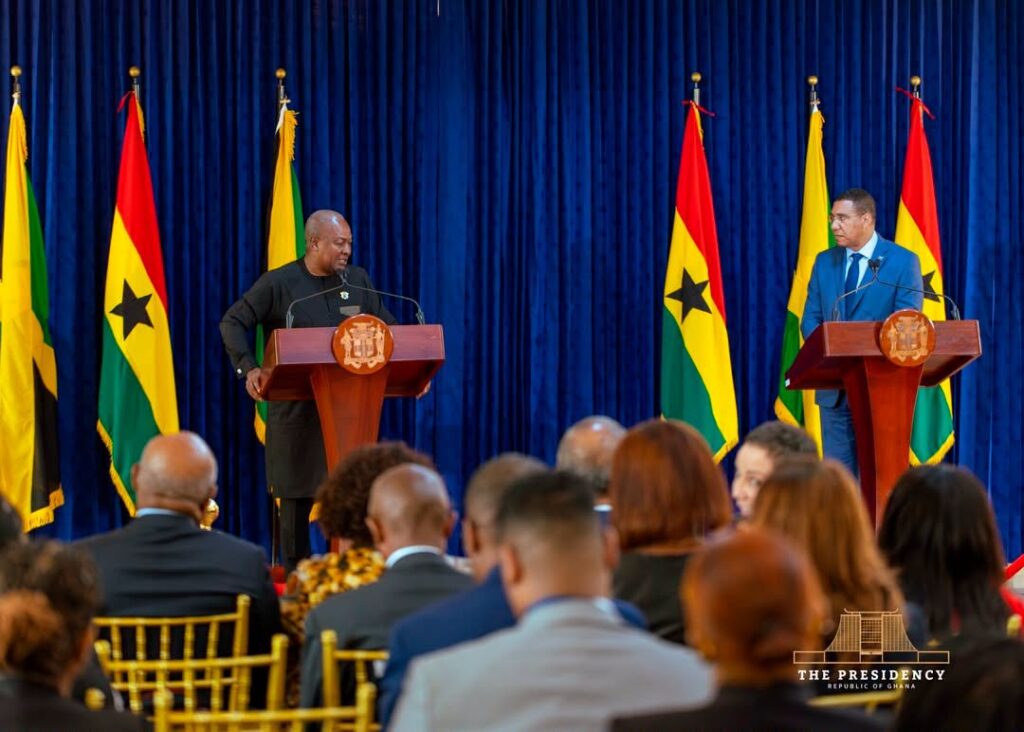
President Mahama highlighted the bilateral talks’ focus on connecting Ghanaian and Jamaican businesses as a pathway toward stronger cross-investment between the two countries.
“There are enormous opportunities in Jamaica, just as there are in Ghana. Both our nations aspire to become economic hubs within our respective regions. By connecting these hubs, we can strengthen investment flows while facilitating the movement of people, goods and services between Ghana and Jamaica”.
President John Dramani Mahama
He detailed plans to meet Jamaican business leaders later that day at the Port of Kingston, where discussions would focus on investment opportunities tied to the African Continental Free Trade Area.
According to President Mahama, through AfCFTA, investors can manufacture in one African country and export freely to 54 others, creating access to a market of approximately 1.4 billion people with a combined GDP approaching US$3 trillion.
He noted that similar opportunities await Ghanaian investors interested in Jamaica’s real estate, construction and manufacturing sectors.
Fast-Tracking the Bilateral Air Services Agreement
President Mahama confirmed that both governments discussed activating the Bilateral Air Services Agreement between Ghana and Jamaica, currently pending before Ghana’s Parliament.
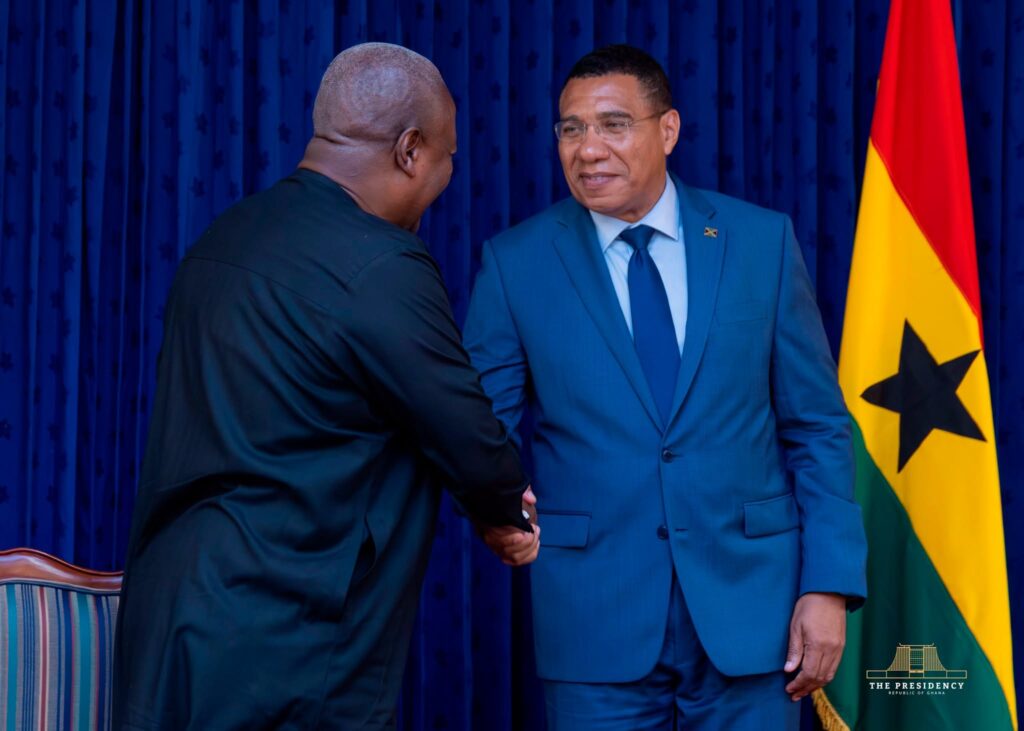
“This will allow either our national carriers or approved third-party airlines to operate direct flights between Accra and Jamaica, significantly strengthening connectivity between our peoples”.
President John Dramani Mahama
The joint statements from President Mahama and Prime Minister Holness reflect a relationship that draws deeply on shared Pan-African history while pursuing concrete economic and logistical cooperation for the present day.
From port connectivity and AfCFTA-driven trade opportunities to formalised disaster response arrangements and fast-tracked air travel links, the discussions signal a partnership moving beyond symbolic goodwill toward measurable structural cooperation between West Africa and the Caribbean, with both leaders expressing clear intent to translate historical solidarity into lasting economic partnership.
READ ALSO: ‘No Lessons Learned’: Expert Warns DR Congo’s Ebola Outbreak Mirrors Past Failures