The government has sought to separate its temporary diesel relief programme from the financing challenges facing Ghana’s electricity sector, warning against what it describes as an inaccurate public narrative that the intervention is being funded with money intended for power infrastructure and electricity operations.
The clarification emerged after the announcement of a GH¢2.00 per litre reduction in the regulatory margin on diesel, a measure that has triggered questions within energy and policy circles about the source of the funding and the potential implications for a power sector that continues to carry significant financial obligations.
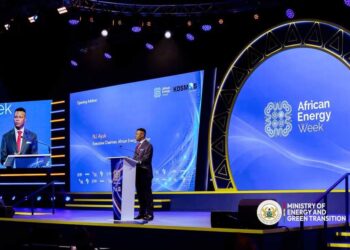
Speaking on eyewitness News, Ministry of Energy and Green Transition spokesperson Richmond Rockson said the intervention should not be interpreted as a transfer of resources from electricity financing to petroleum-price management.
We are not taking any money from the power sector.
Richmond Rockson
According to the Ministry, the relief package is being financed through adjustments to petroleum-related margins and levies rather than through funds allocated to electricity generation, transmission or distribution.
These are margins and levies that will be due government and the industry, but there will be some suspension in some cases and some reductions in some cases to be able to deal with that.
Richmond Rockson
The distinction is important because the power sector and the downstream petroleum sector, although both part of Ghana’s broader energy economy, operate through different financing mechanisms.

Officials argue that the temporary diesel intervention does not alter the funding arrangements for electricity-sector obligations.
The clarification comes at a time when fuel pricing has become increasingly sensitive.
Recent benchmark adjustments by the National Petroleum Authority pushed diesel sharply higher, prompting concerns about transport costs, logistics expenses and the broader inflationary effect on businesses and households.
By responding directly to the financing question, the Ministry appears to be addressing not only consumer concerns but also the confidence of utilities, investors and other stakeholders who are closely watching the government’s handling of energy-sector revenues.
A narrower focus than the public debate suggests
The government’s diesel measure has often been discussed as if it were a broad fuel subsidy.
The Ministry’s explanation suggests something more limited.
Rather than reducing the international cost of diesel, the intervention temporarily lowers a domestic regulatory component of the final pump price.

The measure is expected to take effect on Tuesday, 4 August 2026, and is intended to run for one month unless reviewed.
That narrower design matters. A broad subsidy covering both petrol and diesel would carry a much larger fiscal cost and could create stronger distortions in the fuel market.
By focusing only on diesel, the administration appears to be targeting the fuel with the greatest impact on transportation, logistics and production costs.
Diesel is the dominant fuel for commercial transport, haulage, agriculture, mining, construction, manufacturing and many backup generators used by businesses across the country.
Changes in diesel prices therefore tend to spread through the economy more quickly than changes in petrol prices.
The power sector remains the bigger financial risk
The Ministry’s rebuttal also reflects a broader concern: the power sector is still carrying substantial financial pressures of its own.
Payments to independent power producers, fuel suppliers, transmission operators and distribution companies remain central to the sector’s stability.

Any perception that resources were being diverted away from those obligations could affect confidence in ongoing reform efforts.
Rockson maintained that the electricity sector has separate financing arrangements and would not suffer a funding shortfall because of the diesel intervention.
The immediate issue, however, is not only whether money is being transferred from one account to another.
The deeper question is whether repeated petroleum-price interventions could eventually create pressure on energy-sector revenues more generally if compensating measures are not clearly identified.
The transparency challenge
The Ministry has explained that the intervention will be financed through adjustments to margins and levies, but it has not yet provided a detailed public breakdown of which specific charges are being reduced or suspended, the estimated fiscal impact of the measure, or how the revenue effect will be absorbed within the broader petroleum pricing framework.

In energy policy, the credibility of a temporary intervention often depends less on the announcement itself than on the clarity of the financing mechanism behind it.
This is particularly important in Ghana, where public debate over energy levies has intensified in recent years.
Consumers have become increasingly sensitive to questions about how petroleum-related charges are collected, allocated and used.
Why the clarification matters
The significance of the Ministry’s comments lies in the fact that they were delivered in response to concerns that had already begun circulating publicly.
By using the news to address the issue directly, the Ministry is attempting to prevent the diesel intervention from becoming entangled with broader debates about electricity-sector debt, infrastructure investment and power-sector reform.
That communication strategy is itself revealing. It suggests officials recognise that confidence in energy-sector management depends not only on policy choices but also on the ability to explain those choices clearly and quickly.
A useful distinction between petroleum and electricity policy
The current debate highlights an important distinction that is often blurred in public discussion.
Petroleum pricing and electricity financing are connected through the broader economy, but they are not the same policy problem.
Fuel-price interventions are typically aimed at transport, logistics and inflation, while power-sector financing is aimed at sustaining generation, transmission and distribution.
Confusing the two can lead to incorrect assumptions about where costs are being borne.
At the same time, governments cannot ignore the fact that both sectors ultimately affect household welfare and business competitiveness.
Higher diesel prices raise transport and production costs, while weaker power-sector financing can threaten electricity reliability.
The challenge is to manage one problem without worsening the other.
A temporary cushion, not a permanent fix
The Ministry’s clarification does not change the underlying reality that fuel prices remain heavily influenced by international petroleum markets and exchange-rate movements.
Recent increases in global refined-product prices and pressure on the cedi have pushed domestic fuel benchmarks higher.
The diesel relief may soften the immediate impact, but it does not remove the structural exposure of Ghana’s fuel market to global volatility.
That is why the current measure should be understood as a short-term stabilisation tool rather than a permanent pricing solution.
The more durable questions remain unresolved: how to improve energy-sector revenue collection, how to strengthen efficiency in both the petroleum and electricity sectors, and how to reduce the economy’s vulnerability to external fuel-price shocks.
The real test begins now
The government has succeeded in drawing a clear rhetorical line between diesel relief and power-sector funding.
The next test is operational.

If the reduction is reflected in lower diesel prices, helps moderate transport and logistics costs, and expires without creating new revenue pressures elsewhere in the energy sector, the intervention is likely to be viewed as a targeted and defensible response to temporary market stress.
If the financing details remain unclear or further interventions become necessary, the debate over energy-sector priorities and revenue management is likely to intensify.
For now, the Ministry’s message is unambiguous: the diesel relief is being financed within the petroleum pricing framework, and the power sector, according to the government, is not being asked to pay for it.
READ ALSO: Intravenous Infusions Returns to Profit After Major Turnaround on GSE