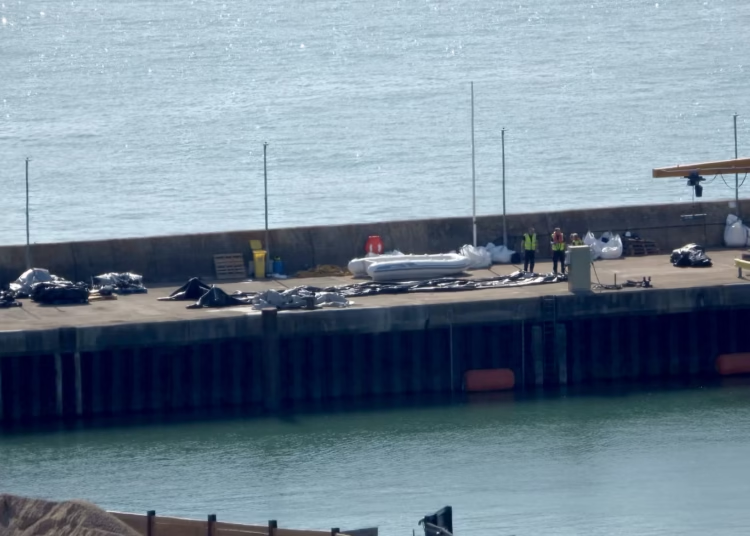
A record 230 migrants have crossed the English Channel to United Kingdom in a single boat, exposing the growing scale and danger of people-smuggling operations even as the overall number of small-boat arrivals this year remains below levels recorded in previous years.
The migrants arrived in Dover after travelling from the French coast overnight aboard as a “mega dinghy.” The crossing represents the largest number of people recorded arriving in the UK on a single small boat, surpassing the previous record of 165 people who made the journey aboard one vessel in July.
The latest crossing has renewed pressure on UK Government to strengthen its efforts to prevent small boats from leaving the French coastline, while also highlighting the increasingly dangerous tactics being employed by criminal networks facilitating journeys across one of the world’s busiest shipping routes.
Small boats have become a central feature of irregular migration to Britain in recent years, with people-smuggling gangs increasingly turning to larger vessels capable of carrying substantially more passengers. The strategy allows criminal groups to attempt fewer crossings while transporting greater numbers of people on each journey, potentially reducing the number of launch operations that French authorities need to intercept.
However, the growing size of the boats has not reduced the dangers faced by those making the journey. Instead, officials and rescue organisations have repeatedly warned that overcrowding, poor-quality vessels, unpredictable weather and mechanical failures can quickly turn crossings into life-threatening emergencies.
The latest record crossing comes only weeks after another overcrowded dinghy carrying 173 people experienced serious difficulties in the Channel after its engine caught fire.
French authorities rescued all 173 people from that vessel with assistance from two British Border Force boats and a Royal National Lifeboat Institution lifeboat. The incident demonstrated the risks created when increasingly large numbers of passengers are placed on vessels that may not be capable of safely completing the journey.
Despite the record number of people on today’s boat, overall small-boat arrivals to UK have fallen compared with previous years. Around 14,000 people made the crossing between January and July, according to figures cited in the latest reporting.
The Home Office disclosed that the decline showed that government measures were beginning to have an impact, while acknowledging that the latest incident demonstrated the continued ability of organised criminal networks to facilitate dangerous crossings.
According to a Home Office spokesperson, “this latest incident demonstrates the reckless and dangerous tactics employed by the criminal gangs facilitating these crossings, who continue to put lives at risk by cramming ever greater numbers of people onto unseaworthy vessels.
“We are making progress, with the number of small boat crossings down this year and the lowest number recorded for the month of July since 2020. But we must go further, which is why we have signed a payment-by-results deal with the French to put 40 per cent more boots on the ground on French beaches.”
Home Office spokesperson
The record crossing has nevertheless become politically significant, particularly for Reform UK leader Nigel Farage, who has repeatedly made irregular migration a central part of his political platform.
Responding to the arrival on X, Farage stated that, “at 2.30am this morning a boat carrying 230 people was taken into Dover.”
“This is a record number in a single vessel. It’s yet more proof that this illegal invasion is a national security emergency.”
Nigel Farage
UK, France Target Smugglers as Dinghies Grow Larger
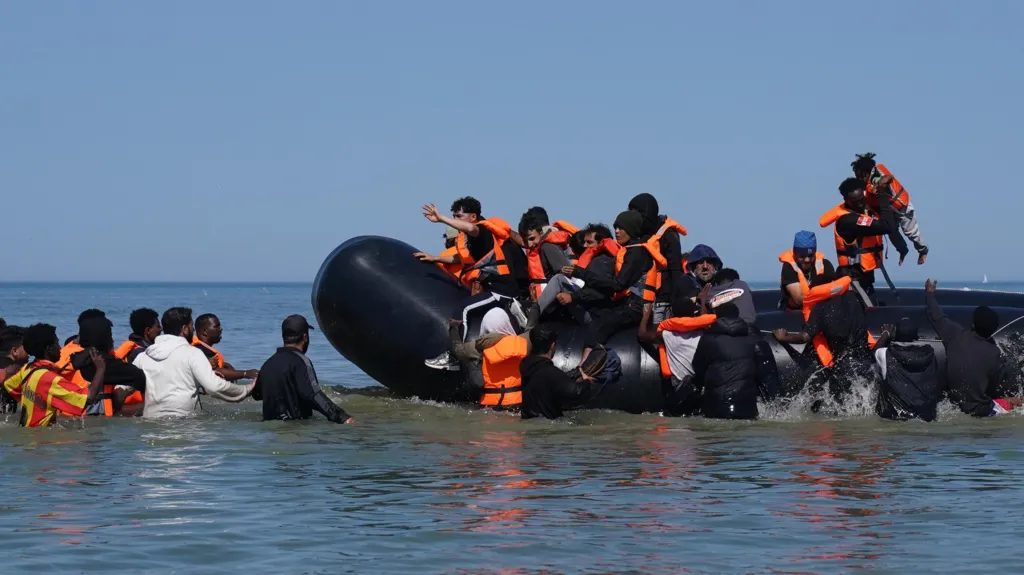
The growing capacity of Channel boats has become an increasingly important concern for governments, with criminal networks apparently seeking to transport more people in fewer journeys.
Rather than relying exclusively on numerous smaller vessels, smugglers are increasingly using larger inflatable boats that can carry well over 100 passengers. While the tactic may allow gangs to reduce the number of launches required to move large numbers of people, it also creates significant safety risks.
A single mechanical failure, fire, collision or loss of stability can place hundreds of passengers in immediate danger.
The 173-person incident earlier in August provided a stark example. After the boat’s engine caught fire, passengers required rescue by French authorities, supported by British vessels and an RNLI lifeboat.
Such incidents have increased pressure on enforcement agencies to disrupt crossings before vessels enter the Channel rather than relying on emergency services to rescue people after boats encounter difficulties at sea.
Charlie Eastaugh, director of maritime and small boats at Border Security Command, stated British and French authorities were pursuing a broad strategy designed to disrupt organised immigration crime at multiple stages.
He explained that, “it is an active, layered campaign to attack the organised immigration crime model at every stage: upstream, across Europe, in northern France and Belgium, and in the UK.”
“The incidents we have seen in the Channel over the last few weeks are a stark reminder of the dangers posed by criminal gangs exploiting people for profit. It is easy to look at out-of-context images and think little is happening to stop these crossings this is simply not true. I know personally how tirelessly French officers have been working to disrupt launches before they reach UK shores.”
Charlie Eastaugh
He added, “their efforts include facing violent people with weapons, dispersing huge crowds, arresting smugglers, seizing equipment and collating vital evidence to help our prosecutions which are at a record high.”
Meanwhile, British authorities have sought greater cooperation with French law enforcement, including increased patrols and intervention on beaches used by smugglers.
The objective is to prevent boats from launching in the first place and to dismantle the networks responsible for supplying vessels, recruiting passengers and organising crossings.
READ ALSO: Infantino Under Growing Pressure: UEFA, 2 Others Demand Accountability Over FIFA Crisis