

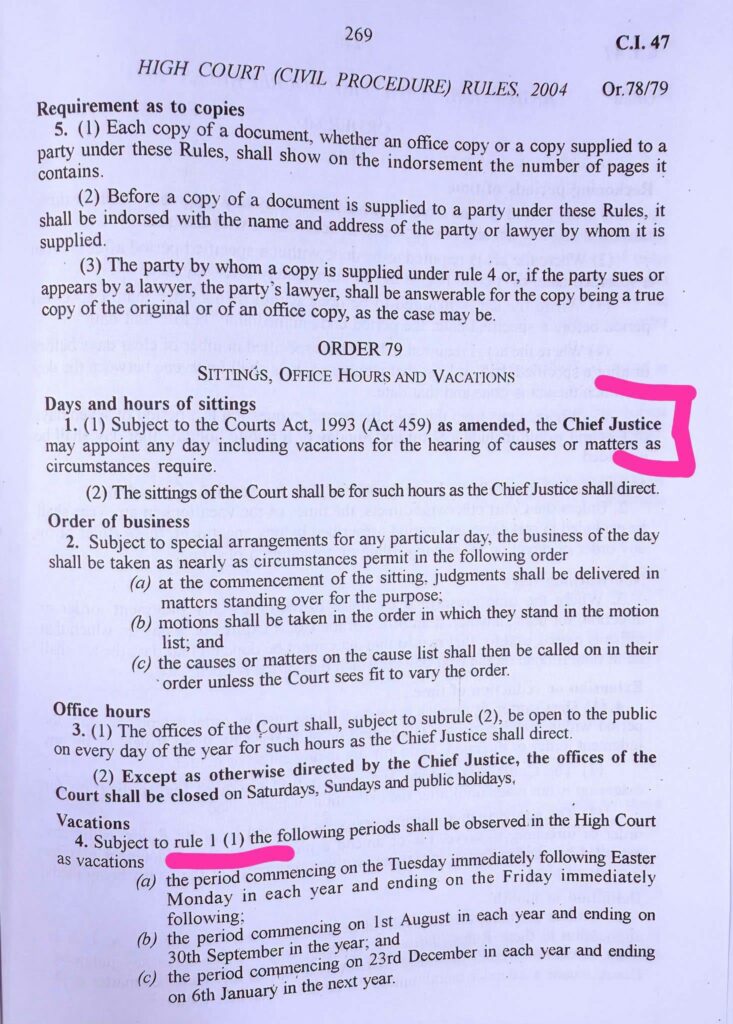
Deputy Attorney-General Dr Justice Srem-Sai has rejected the argument that Ghana’s courts must stop sitting during the legal vacation, pointing to the text of Order 79 of the High Court (Civil Procedure) Rules, 2004, and to the Chief Justice’s express power to appoint any day, vacation included, for the hearing of cases.
He set out the position in a public statement as the Ghana Bar Association pressed the Chief Justice to halt sittings in part-heard criminal trials. Dr Srem-Sai argued that the vacation periods listed in the rules are themselves made subject to that power, and that lawyers relying on an alleged convention must first prove one exists.
A convention, he said, is a question of fact requiring evidence of consistent practice and of a shared belief that the practice binds as law, and even a proven convention cannot displace an express statutory provision.
What Order 79 actually says
The statement opens by directing readers to the rule itself rather than to custom. “Below is the law on legal vacations. It does not say that courts are to shut down,” Dr Srem-Sai wrote.

His reading turns on the relationship between two subrules. Rule 4 lists the vacation periods observed in the High Court, running from the Tuesday after Easter Monday to the following Friday, from 1 August to 30 September, and from 23 December to 6 January in the following year. But the rule opens with the words “Subject to rule 1 (1).“
“As you may see from Rule 4 below, the legal vacation schedule is, by Rule 1(1), subject to the CJ’s decision to give warrants to a judge to work during the vacation”.
Dr Justice Srem Sai, Deputy Attorney General and Minister for Justice
The two-part test for a convention
Having addressed the text, he turned to those who ground their objection in tradition rather than in the rules. He set out what proof of a convention demands.
“The existence of a convention is a question of fact which must be established by evidence of two things (a) consistent practice, AND (b) opinion juris – that is, the uniform opinion that the practice is binding as law rather than a preference or convenience.”
Dr Justice Srem Sai, Deputy Attorney General and Minister for Justice
The distinction he draws is between habit and obligation. Lawyers and judges may have treated the vacation as a period when trials pause, but a settled preference for rest, however widely shared, does not create a rule of law.
Why he says the practice fails that test
The Deputy Attorney-General then argued that the historical record undercuts the claim rather than supporting it, because Chief Justices have long issued the very warrants now under challenge.
“The practice, as we know it, doesn’t support the existence of such an alleged convention. CJs have consistently, throughout the ages, given vacation warrants to judges who have conducted trials”
Dr Justice Srem Sai, Deputy Attorney General and Minister for Justice
If warrants have issued repeatedly across successive administrations, then the first limb of the test collapses. There is no consistent practice of courts closing, only a pattern of vacation sittings authorised case by case.
A convention cannot override an express provision
His third argument treats the first two as moot. Even if the Bar could establish the practice and the belief, he wrote, the hierarchy of sources settles the matter. “An alleged convention cannot operate to override an express provision of law. The express provision of law on the matter is Order 79 of CI 47,” he wrote.
He closed with the sharpest line in the statement, aimed at where the power to stop a case actually lies. “No law or practice gives a lawyer or our associations the power to determine whether court proceedings should go on,” he wrote.
The intervention lands in the middle of a live confrontation between the Bar and the Judiciary. In a letter dated 10 August 2026 to Chief Justice Paul Baffoe-Bonnie, the Ghana Bar Association said three law firms had reported being served with notices requiring their lawyers to appear before specific judges to continue part-heard criminal cases during the vacation.
The firms are Zoe, Akyea & Co, Dame & Partners and Sam Okudzeto & Associates. The Association argued that the availability and willingness of counsel has always been a key consideration in whether a matter proceeds during the vacation, and that where counsel indicate they are unavailable, the court should not proceed.
It acknowledged, however, that vacation courts may sit to deal with urgent and interlocutory matters, which narrows the dispute to part-heard trials rather than to vacation sittings as such.
Two readings of the same rule
Days earlier, Samuel Atta Akyea had written to the Chief Justice declining sittings scheduled during the legal vacation, saying the direction would require the accused persons’ lawyers to work beyond the legal year while other lawyers rest, and urging that the warrant be withdrawn and the matter adjourned to term time.

The disagreement now sits on two levels. The Bar frames the vacation as a settled institutional practice that protects both bench and bar, and treats counsel’s unavailability as a practical bar to proceeding.
The Deputy Attorney-General Dr Srem-Sai frames it as a schedule that the rules themselves make subject to the Chief Justice’s discretion, with no independent force capable of resisting a warrant.
Resolving it will fall to the Chief Justice, who issued the warrants and who holds the power under rule 1(1) that both sides are now reading against each other. Until he responds to the Bar’s letter, the judges named in those warrants remain listed to sit, and the lawyers who say they will not attend remain on a collision course with courts that intend to proceed.
READ ALSO: Jinapor Pushes Deeper Upstream Reforms as Production Concerns Grow