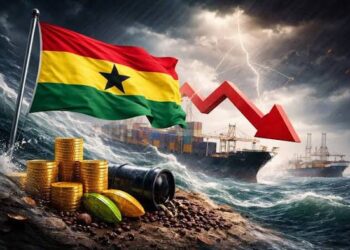
Ghana’s economy recorded a 5.1% year-on-year expansion in May 2026, maintaining its growth trajectory but raising fresh concerns about the changing structure of economic activity.
The latest Monthly Indicator of Economic Growth (MIEG) released by the Ghana Statistical Service (GSS) shows that economic activity remained positive during the month, although growth moderated significantly compared with the 6.6% recorded in May 2025.
The figures point to an economy that is still expanding, but increasingly relying on the Services sector to sustain momentum while Agriculture loses some of its previous strength.
Services Sector Takes Centre Stage
The Services sector emerged as the biggest force behind Ghana’s economic expansion in May, recording a 7.2% year-on-year growth.
Although this was slightly lower than the 7.5% recorded in May 2025, the sector continued to outperform the other major sectors and remained the largest contributor to overall economic growth.
According to the GSS, information and communication activities were among the key areas supporting the sector’s performance.
The dominance of Services highlights the growing importance of digital activities, communications and other service-based businesses to Ghana’s economy.
The sector accounted for 51% of overall economic growth during the month, putting it significantly ahead of Industry and Agriculture.
This strong performance helped cushion the economy against weaker growth in Agriculture and the moderation recorded across other parts of the economy.
Agriculture Slows Sharply
While Services continued to power growth, Agriculture delivered one of the biggest concerns in the latest figures.
The sector expanded by only 3.6% in May 2026, compared with a remarkable 9.8% growth recorded during the same period in 2025.
The GSS attributed part of the slowdown to the exceptionally strong performance recorded by Agriculture in May 2025.
However, the sharp moderation has still attracted attention because of the sector’s importance to food production, rural employment, household incomes and exports.
Growth during the latest period was driven mainly by crops and livestock.
Agriculture contributed 21.2% to overall economic growth in May, making it the third-largest contributor behind Services and Industry.
The slowdown could become particularly significant if it persists into subsequent months, especially amid concerns about food prices and the livelihoods of farming communities.
Industry Maintains Steady Momentum
Ghana’s Industrial sector also recorded positive growth, although its performance moderated slightly from the previous year.
Industry expanded by 4.2% in May 2026, compared with 4.6% in May 2025.
Mining and quarrying were identified as major drivers of industrial growth, underlining the continued importance of extractive activities to the country’s economic performance.
The sector accounted for 23.8% of overall economic growth during the month.
While Industry did not match the pace of Services, its continued expansion demonstrates that Ghana’s economic recovery is not being driven exclusively by service-related activities.
The challenge, however, remains ensuring that industrial expansion creates stronger links with other parts of the domestic economy.
GSS Raises Sector Concentration Warning
The latest figures have triggered a significant warning from the Ghana Statistical Service.
The GSS cautioned that Ghana’s growth is becoming increasingly dependent on the Services sector.
While strong Services growth is positive, excessive reliance on one sector could expose the economy to greater risks if conditions affecting that sector deteriorate.
The concern is particularly relevant because Agriculture and Industry remain critical to employment, food security, exports and domestic production.
A more balanced growth structure could therefore provide Ghana with greater resilience against future economic shocks.
Food Prices and Rural Incomes at Risk
The slowdown in Agriculture could have consequences extending beyond headline economic growth.
The GSS warned that weaker agricultural expansion could affect food prices, rural incomes and export earnings.
Agriculture plays a major role in supplying food to the domestic market. A sustained slowdown in production could place additional pressure on food availability and prices.
For farmers and rural households, weaker agricultural activity could also translate into lower earnings, particularly if production challenges are accompanied by higher input costs or limited access to markets.
The sector is also important to Ghana’s export ambitions, making agricultural productivity crucial for strengthening foreign exchange earnings.
Call for Stronger Agricultural Support
The GSS has urged government, the Bank of Ghana and businesses to make greater use of the Monthly Indicator of Economic Growth when making policy and investment decisions.
It also recommended stronger support for Agriculture through improved access to inputs, irrigation and storage infrastructure.
Such interventions could help reduce production constraints while improving the ability of farmers to preserve and market their output.
Better storage facilities could also help reduce post-harvest losses, while improved irrigation could lessen the vulnerability of farmers to rainfall patterns.
What the 5.1% Growth Means
The May growth figure provides a mixed picture of Ghana’s economic performance.
On one hand, the economy continues to expand at a solid pace, with Services showing considerable resilience and Industry maintaining positive momentum.
On the other hand, the slowdown from 6.6% to 5.1% and the sharp moderation in Agriculture suggest that policymakers cannot afford to focus solely on the headline growth rate.
The latest figures reinforce the need for broader-based economic expansion.
Ghana’s challenge will be to maintain the momentum generated by Services while strengthening Agriculture and Industry so that growth is distributed more evenly across the economy.
The Monthly Indicator of Economic Growth is an experimental high-frequency measure designed to provide an early signal of economic performance before quarterly Gross Domestic Product figures are released.
As policymakers assess the latest numbers, the message is clear: Ghana is growing, but the composition of that growth is becoming increasingly important.