Africa’s gas challenge is increasingly shifting from the question of resource availability to whether the continent has enough infrastructure to move, process and deliver gas to the markets that need it.
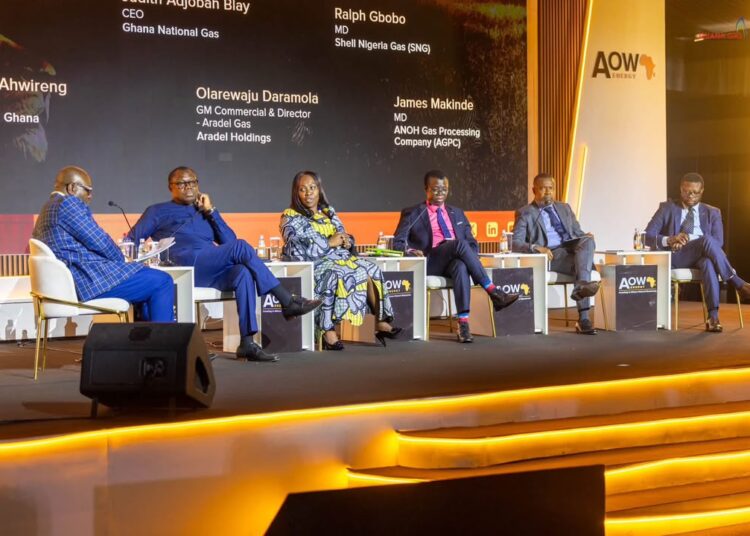
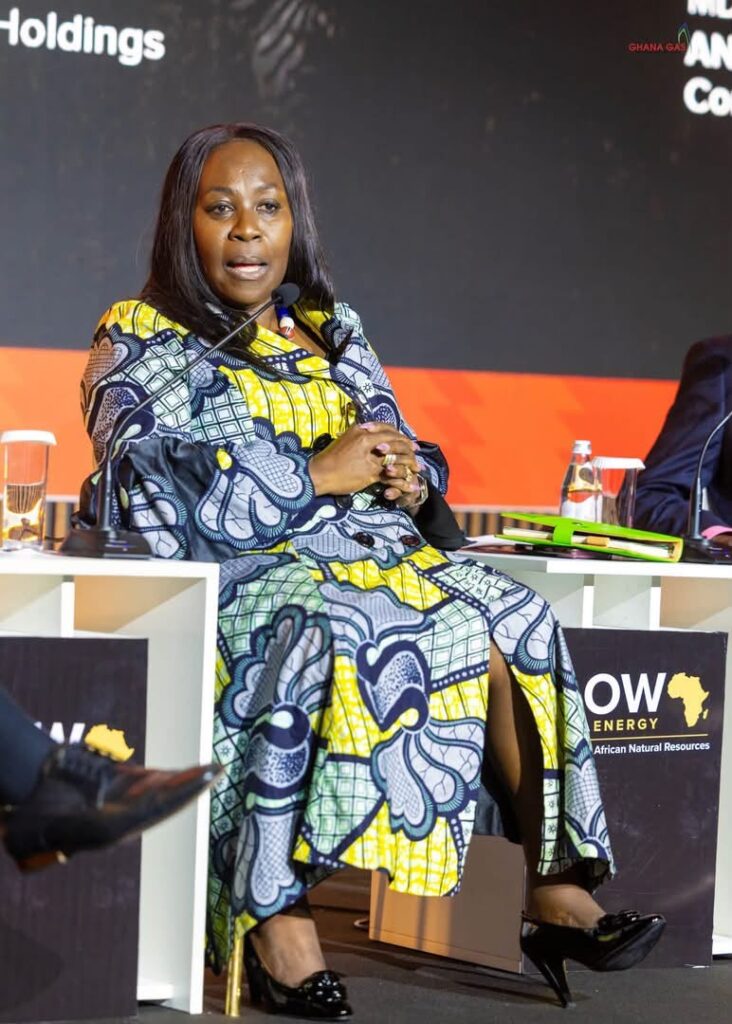
That was the central message from the Chief Executive Officer of the Ghana National Gas Company Limited, Ms. Judith Adjobah Blay, during Africa Oil Week (AOW) 2026 in Accra, where she called for greater investment in strategic midstream infrastructure to connect gas supply with demand and unlock wider economic opportunities.
Speaking as a panellist on the theme, “Building the Backbone: Midstream Gas Infrastructure as the Link Between Supply and Demand,” Ms. Blay argued that Africa’s considerable gas resources would have limited economic impact without the infrastructure required to bring those resources into productive use.
“Africa’s gas resources can only deliver meaningful economic transformation when the infrastructure, investment and partnerships required to connect supply to demand are in place.”
Judith Adjobah Blay, Chief Executive Officer, Ghana National Gas Company Limited
Her intervention at AOW 2026 placed Ghana’s midstream ambitions within a broader continental challenge: building the physical systems capable of converting gas reserves into reliable energy, industrial inputs and economic value.
The issue is particularly important for Ghana, where natural gas occupies a strategic position in electricity generation and the development of the wider petroleum value chain.
Ghana’s Gas Strategy Requires More Than Production
For Ghana, increasing gas availability is only one part of the energy-security equation.
The country has invested in infrastructure to process domestic gas, including the Atuabo Gas Processing Plant, while government is pursuing additional capacity through the proposed second gas processing plant, GPP2.
The objective is to increase the quantity of gas that can be processed and supplied to thermal power plants and other users.
But expanding supply without resolving transportation and distribution constraints could simply move the bottleneck further along the value chain.
This is where the midstream sector becomes strategically important.
Processing facilities need reliable gas feedstock.
Power plants need dependable fuel supply. Industrial users require predictable volumes and pricing.
Producers need infrastructure capable of receiving associated gas from offshore fields. Each part of the chain depends on the others.
The implication is that gas infrastructure must increasingly be viewed as an integrated system rather than a collection of individual projects.
A new processing plant can increase available gas, but its economic contribution is constrained if pipelines cannot transport the additional volumes.
Similarly, additional pipeline capacity has limited value if upstream production and processing capacity remain inadequate.
Ms. Blay’s emphasis on the “backbone” of the gas industry therefore speaks directly to a structural issue facing Ghana and other African producers.
The continent may possess substantial hydrocarbon resources, but resource ownership alone does not guarantee energy security or industrialisation.
Midstream Investment Could Shape Industrial Competitiveness
The economic argument for midstream investment extends beyond keeping power plants supplied.
Reliable gas infrastructure can influence the competitiveness of industries that depend on affordable and predictable energy.
It can also create the conditions for greater utilisation of domestic resources rather than relying on imported fuels when local gas cannot reach consumers.
Recent discussions around Ghana’s gas-to-power strategy have highlighted the potential financial implications of this transition.
Energy-sector officials have argued that greater substitution of liquid fuels with natural gas could significantly reduce generation costs and foreign-exchange outflows.
That makes infrastructure investment a potential cost-reduction strategy, rather than merely a capacity-expansion exercise.
The wider industrial opportunity is equally important.
Natural gas can serve as an energy source for electricity generation while also supporting industrial processes and petrochemical development.
The more effectively gas can be processed and transported, the greater the possibility of developing downstream activities around it.
For Ghana, that could strengthen the connection between petroleum resources and the country’s industrialisation ambitions.
The challenge, however, is ensuring that infrastructure investments are commercially viable and properly integrated into national energy planning.
Partnerships Needed To Unlock Large Infrastructure Projects
Ms. Blay also placed partnerships at the centre of the investment conversation.
Large midstream projects require substantial capital, specialised technical expertise and long-term commercial commitments.
African governments and national energy companies therefore face the challenge of attracting international investment while ensuring that projects contribute meaningfully to domestic capacity and economic development.
That balance has featured prominently across AOW 2026, where Ghana has sought to present itself as an investment destination while simultaneously emphasising greater local participation and value creation.
The same principle applies to the gas sector.
International investors can provide financing, technology and project-development expertise, while African institutions can contribute knowledge of local markets, resources, regulatory environments and national development priorities.
The effectiveness of such partnerships will depend on whether they produce infrastructure that is financially sustainable and capable of supporting long-term domestic demand.
This is particularly relevant as Ghana considers a range of investment structures for major gas infrastructure projects.
The objective should not simply be to attract capital for individual projects.
It should be to develop an interconnected midstream network capable of supporting the country’s electricity system, petroleum industry and industrial base over several decades.
Africa’s Gas Opportunity Faces An Infrastructure Test
The discussion at AOW 2026 comes at a time when African countries are attempting to balance energy security, industrial development and the global transition towards lower-carbon energy systems.
Gas occupies a complicated position within that debate.
For many African economies, particularly those still struggling with electricity access and unreliable supply, gas can provide dispatchable power while renewable energy capacity expands.

But the benefits depend on whether countries can build the infrastructure required to utilise the resource efficiently.
That makes investment decisions taken today important beyond the immediate petroleum cycle.
Infrastructure built around gas production can either become a foundation for industrial development or remain underutilised if supply, demand and transportation networks are poorly coordinated.
For Ghana, the proposed expansion of gas-processing capacity, pipeline infrastructure and thermal generation creates an opportunity to address several challenges simultaneously: reducing dependence on expensive liquid fuels, strengthening electricity supply, improving utilisation of domestic gas and supporting industrial activity.
The opportunity also comes with a warning.
Building infrastructure for its own sake will not resolve Ghana’s energy constraints.
Projects must be linked to credible demand, upstream supply, financing structures and a clear understanding of how the different components of the gas value chain interact.
Ms. Blay’s intervention consequently places the midstream sector at the centre of a much larger conversation about Africa’s economic future.
The continent’s next challenge may not be finding gas.
It may be building the infrastructure capable of turning the gas already available into reliable electricity, competitive industries, stronger domestic value chains and sustainable economic growth.
READ ALSO: GAF Completes Accra-Kumasi Expressway Clearing Ahead of Schedule