Ghana is seeking to strengthen its position as a destination for international investment by prioritising business-friendly policies, industrial development and government accountability, as African countries compete to attract capital for economic growth.
The strategy signals a shift in how the country intends to present itself to multinational corporations, manufacturers and other investors.
Rather than relying primarily on its reputation for democratic governance and political stability, Ghana wants its economic policies and business environment to become stronger reasons for investors to establish or expand operations in the country.
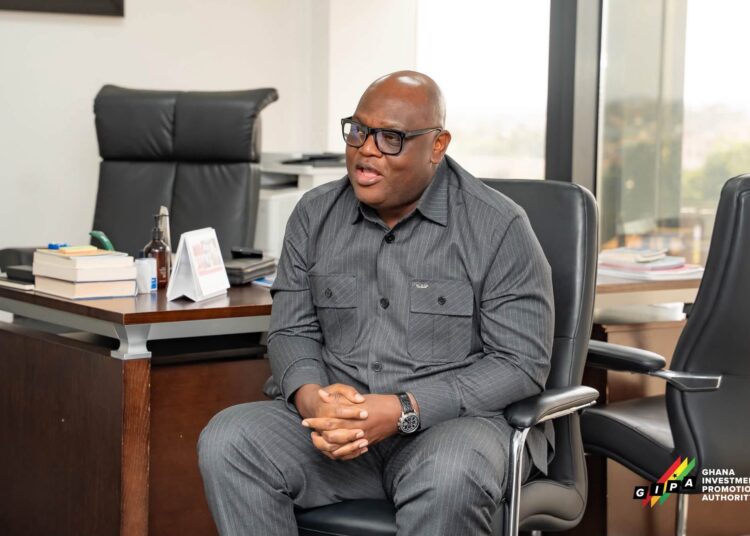
Mr. Simon Madjie, Chief Executive Officer of the Ghana Investment Promotion Authority (GIPA), outlined this approach during a media interview stressing that stability alone is no longer sufficient to distinguish Ghana from competing investment destinations.
“Ghana is not just selling political stability. Ghana is selling reforms,” he said
His remarks reflect a broader challenge facing Ghana’s investment drive: converting its political and geographical advantages into commercially attractive opportunities that generate sustainable returns for businesses and economic benefits for the country.
Investors assessing potential destinations typically consider the cost of production, access to markets, taxation, infrastructure, regulatory requirements and the availability of skilled labour.
These factors influence where companies locate factories, establish regional offices and commit long term financing.
For Ghana, the task is to ensure that its investment policies address these practical considerations while creating opportunities for domestic businesses to participate in expanding industrial and export markets.
Industrial Policies Take Centre Stage
Mr. Madjie pointed to changes in tax and customs legislation and the development of policies targeting textiles, agribusiness and component manufacturing as elements of Ghana’s efforts to improve its investment environment.
The emphasis on productive sectors reflects the importance of attracting capital that supports domestic production rather than relying predominantly on the importation and distribution of finished goods.
“We know we have natural advantages, but we’ve moved beyond that to creating an environment where businesses can actually thrive and prosper.”
CEO of GIPA, Mr. Simon Madjie
The success of this approach will depend on how effectively the policies address the operational requirements of individual industries.
Textile manufacturers need reliable energy, access to raw materials, appropriate industrial facilities and competitive distribution networks.
Agricultural investors require dependable supplies of produce, modern storage, processing capacity and transport systems that connect farms to domestic and international markets.
A component manufacturing similarly depends on access to industrial inputs, technical expertise and established buyers capable of sustaining demand.
These requirements highlight the need to connect investment promotion with practical project preparation.
A prospective investors needs clear information about available opportunities, operating costs, infrastructure, regulatory obligations and potential routes to market before committing substantial resources.
Also, tax and customs reforms must also produce tangible improvements. Simplified procedures, predictable charges and timely clearance of imported machinery and production inputs can help reduce costs and improve business planning.
Consequently, the value of Ghana’s reforms will be determined not simply by the policies introduced but by the extent to which businesses experience improvements in their daily operations.
Government Coordination Becomes
Investment decisions are also influenced by the consistency with which public institutions implement government policy.
Mr. Madjie emphasised that investor confidence must be supported by leadership and cooperation throughout the public sector, including ministries, government agencies and local authorities.
“You need reforms to keep growing your investment here, and who is offering you that credibility through leadership at every level, from the head of state, who is the president, through the minister, to agencies, to local municipal, this is what we are offering.”
CEO of GIPA, Mr. Simon Madjie
A coordinated system would make responsibilities clearer, improve communication between agencies and establish more predictable approval processes.
GIPA’s role in this environment extends beyond introducing investors to Ghana. Effective investment facilitation also requires helping businesses navigate administrative procedures, identifying obstacles and working with relevant institutions to resolve them.
Investment Success Must Be Measurable
Ghana’s ability to compete for international capital will ultimately depend on the economic outcomes generated by the investments it attracts.
The African Continental Free Trade Area (AfCFTA), whose Secretariat is located in Accra, provides an important regional opportunity.
A more integrated African market could create additional demand for Ghanaian manufactured goods, processed agricultural products and other exports.
However, access to a wider market does not automatically guarantee commercial success. Ghana must offer businesses the infrastructure, production efficiency and border procedures needed to serve customers competitively across the continent.
“A place to thrive, a place to do business, and a place to prosper,” he said.
The value of announced projects is one indicator, but it does not establish how much money has actually entered the economy or what benefits have been realised.
A capital deployed, jobs created, exports generated, local businesses incorporated into supply chains and taxes paid provide additional measures of performance.
Distinguishing between proposed investments, signed agreements, financed projects and operational businesses would also give policymakers a clearer picture of progress.
Such reporting could help identify which reforms are producing results and where further intervention is necessary. It would also strengthen public accountability by connecting investment announcements to measurable economic outcomes.
Ghana must equally avoid making tax concessions the principal basis of competition. An investment environment built on predictable regulations, efficient institutions, reliable infrastructure and a productive workforce offers a stronger foundation for sustainable growth.
The country’s next phase of investment promotion will therefore depend on its ability to demonstrate that policy commitments translate into practical improvements for businesses.
Political stability remains an important advantage, but long-term competitiveness will be determined by execution.
If Ghana can reduce operational barriers, strengthen industrial capacity and deliver consistent returns alongside wider economic benefits, its reform agenda could become a more compelling proposition for global investors.
READ ALSO:Ghana’s Energy Future May Depend on More Than Solar