Category: World

  • Deadly Shootout Leaves Occupied West Bank Under Curfew

    Deadly Shootout Leaves Occupied West Bank Under Curfew

    The Israeli military has ordered a curfew in the occupied West Bank following an outbreak of violence in which six people were killed.

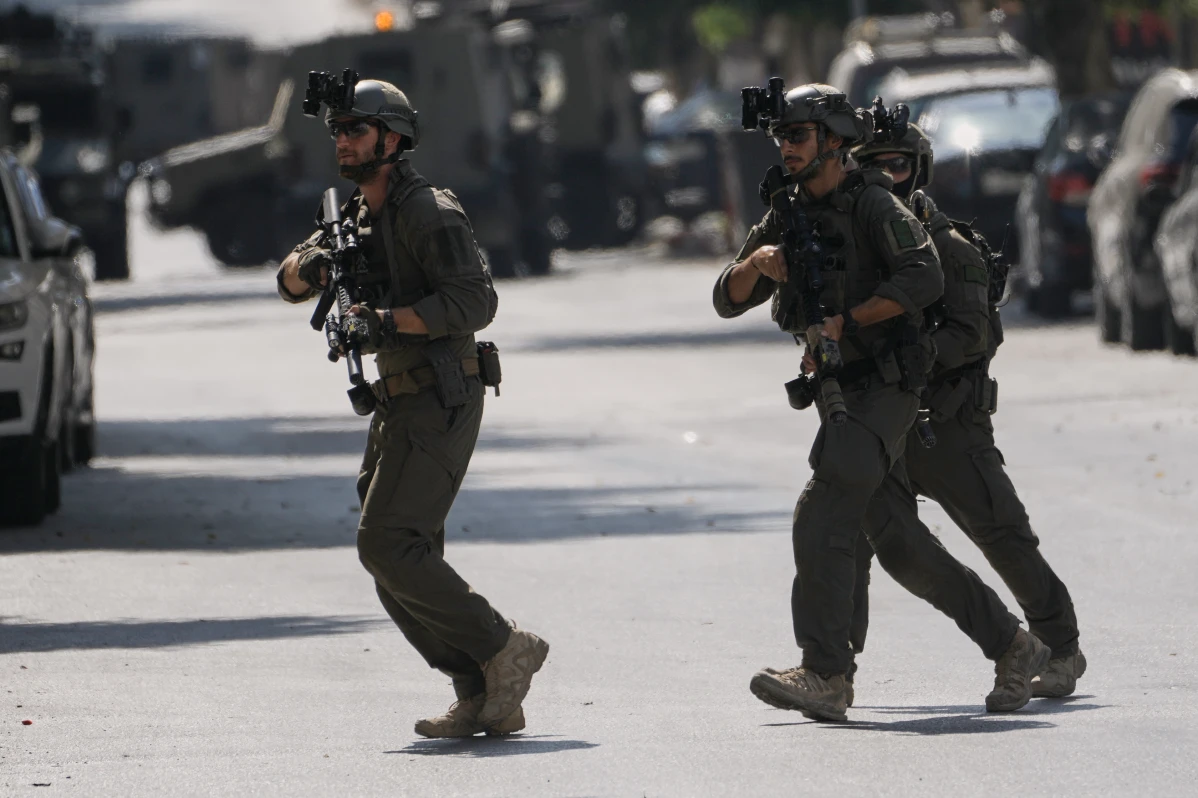
    Four Palestinians and two Israeli soldiers were killed today as Israeli forces and settlers confronted Palestinians southwest of the city of Nablus.
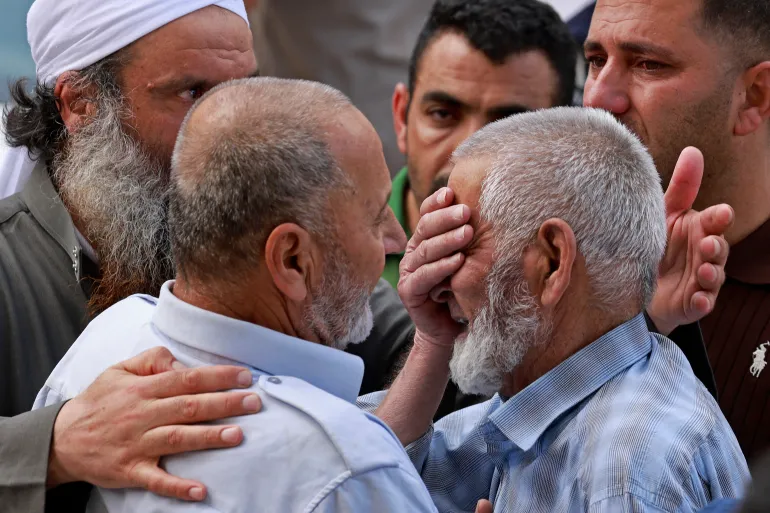
    Family members of one of the four Palestinians killed on Friday weeps outside a hospital in Nablus, in the occupied West Bank.

    According to reports, the violence was sparked as Israeli settlers attacked the town of Tal, which is close to the illegal Israeli settlement of Havat Gilad. Local and security sources said that the settlers opened live fire as Palestinians tried to protect their homes.The Israeli army said that it had dispatched troops to the area following “an attack on Israelis hiking in the area.”

    Four other Palestinians were injured in the attack on the town of Tal, “three of them critically”, as well as two Israelis, Palestinian health officials said.

    Shortly afterwards, the Israeli military announced it was preparing a major “counter-terror” operation in the West Bank, and had “more arrests to carry out”. Troops were then reported to have surrounded Nablus.

    The military claimed a Palestinian had stolen a weapon from local security personnel and fired at the Israeli settlers, wounding several Israelis. It added that four Palestinians were killed “on the spot”, including the one who did the shooting.The military later reported that two soldiers were killed close to Tal during “operational activity.”

    Palestinians in the West Bank have been facing a wave of violence as Israel’s hard-line government, dominated by settler leaders and supporters, has overseen a surge in settlement construction over the past four years. The international community overwhelmingly considers Israeli settlement construction in these areas to be illegal and an obstacle to peace.

    The rate of new settlements and violence has accelerated dramatically since the recent wars in Gaza, Lebanon, and Iran broke out. According to the Palestinian health ministry, the killings in Tal bring the toll to 87 Palestinians killed by Israelis across the West Bank since the beginning of the year, including 21 shot by settlers.

    United Nations figures indicate some 850 Palestinians have been wounded in the context of attacks by Israeli settlers since the start of the year.

    Israeli Prime Minister Benjamin Netanyahu pledged to respond firmly to the Israeli deaths. In a post on X, Netanyahu said that he and Defence Minister Israel Katz had instructed the army to take a “series of forceful steps against terror.”

    He said that these steps include: demolishing the home of the Palestinian reportedly responsible for the death of the Israeli near Tal; collecting weapons and revoking work permits in Palestinian villages he claimed “serve as terror hotspots”; bolstering Israeli forces across the West Bank; setting up checkpoints; and accelerating the regularisation of farms and the establishment of new ones. Netanyahu added that they will allow Israeli security forces to “operate freely and at full strength.”

    Far-right Israeli Finance Minister Bezalel Smotrich called on the army to act with an “iron fist” against the Palestinian town and its surroundings.

    “The people of the farms and the heroic settlement pioneers are the defensive wall of the State of Israel. We will continue to strengthen and honour them for their steadfast stand for our existence.”

    Bezalel Smotrich

    Smotrich added that the villages of Tell, Iraq Burin and Beit Furik “need to look exactly like the refugee camps in Nablus and Tulkarm,” referring to the mass demolition campaign that displaced tens of thousands in the West Bank towns last year.

    “It is necessary to evacuate the population there for their protection and to clear these villages of terrorist infrastructure. A sharp, determined, and unequivocal military action is required here and now.”

    Bezalel Smotrich

    The Palestinian foreign ministry condemned the latest killings in the “strongest terms”.

    “The Ministry affirms that this massacre represents a renewed image of the ongoing Nakba to which our Palestinian people are subjected, and reflects the integration of crimes and roles and the deliberate escalation of these coordinated crimes between the occupation authorities and their forces and settler gangs.”

    Palestinian foreign ministry

    Israel’s Hardline Response Sparks Concerns

    Netanyahu’s hardline response only increases concerns regarding further escalation in a region torn by conflicts – Gaza, Lebanon, Iran – that have Israel at their heart.

    Ayman Safadi, Jordan’s Foreign Minister warned that the Israeli government is “pushing the West Bank towards explosion.”

    “Its blatant violations of the historical and legal status quo at Jerusalem’s Holy Sites are illegal and dangerous provocations. They are pushing the region towards another disastrous conflcit that will reverberate.”

    Ayman Safadi

    Human rights group B’Tselem warned the violence could spin out of control as Israeli settlers and soldiers amass near multiple Palestinian cities.

    Yuli Novak, the group’s Executive Director, noted that Israeli violence is spreading across the West Bank, “fueled by Israeli politicians openly calling for revenge.” Novak added, “We know where this leads. Millions of Palestinians are now completely exposed to further attacks, with no one protecting them.”

  • Wildfires Force Mass Evacuations Across Spain and France

    Wildfires Force Mass Evacuations Across Spain and France

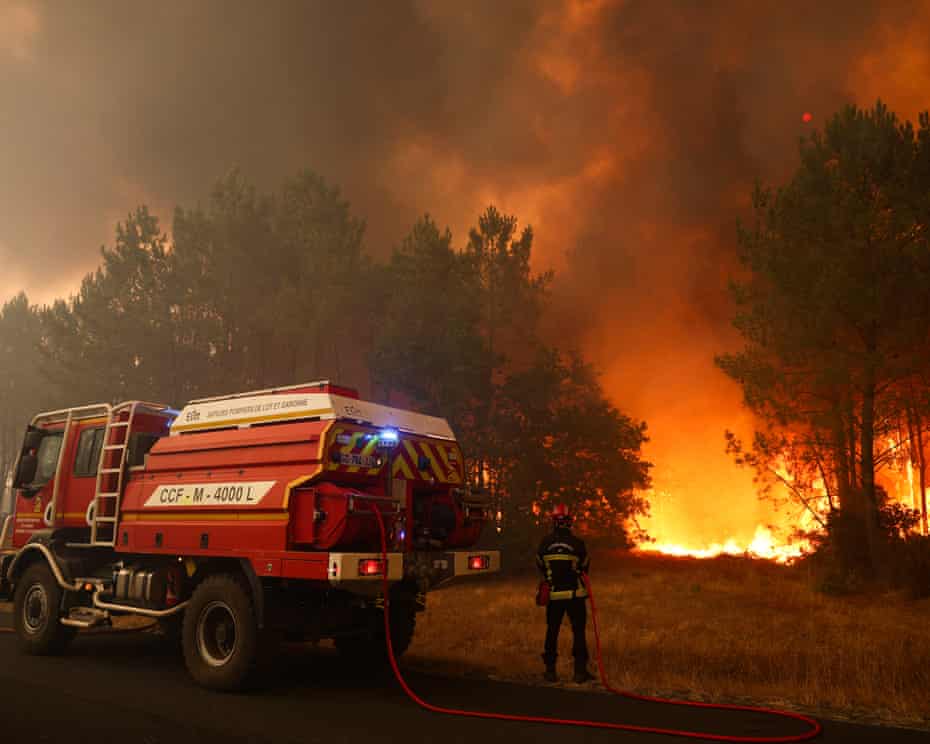
    More than 80,000 people have fled huge wildfires in Spain and France.

    French authorities ordered the total evacuation, by land and sea, of one of the country’s best-known holiday spots.

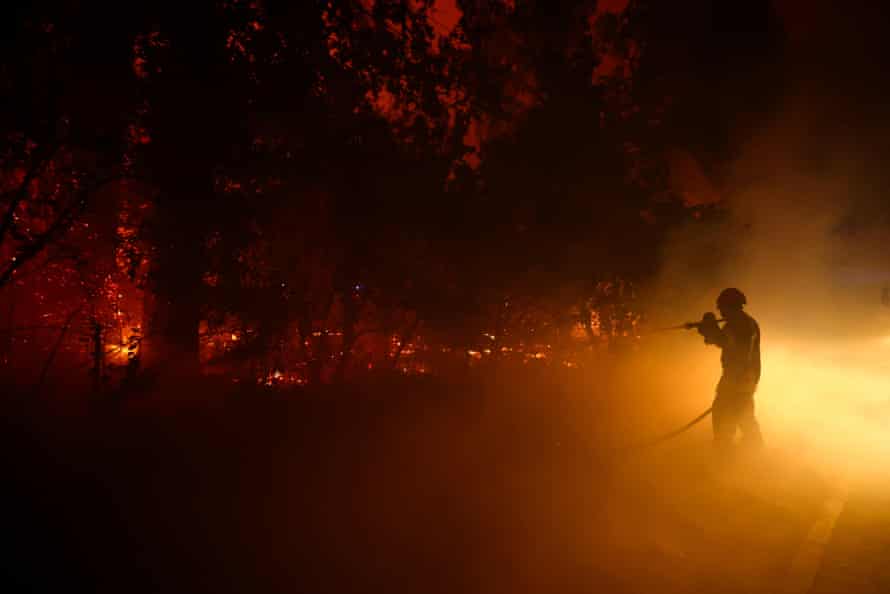
    Authorities in south-west France ordered the Cap Ferret peninsula on the Atlantic coast evacuated “village by village” in the face of an “intense, highly unpredictable” wildfire that has burned through more than 12,500 hectares (30,900 acres) of forest.

    A firefighter battles flames in Cap Ferret.

    More than 44,000 people had been evacuated in two days to escape the Cap Ferret fire, the Gironde prefecture said, including thousands of holidaymakers in campsites and rental homes. Boats ferried hundreds off piers on the peninsula on Friday as the blaze threatened to cut off the only road to it.

    About 800 firefighters and four water-bombing planes were battling the Gironde blaze north of Arcachon Bay, but the fire, which began on Wednesday near the village of Saumos 25 miles (40km) west of Bordeaux, was not yet stabilised.

    Numerous roads in the area, including those leading to Cap Ferret, popular with French and international holidaymakers, and home to the villas of many celebrities and millionaires, were closed to all but essential traffic. Eighty houses had burned.

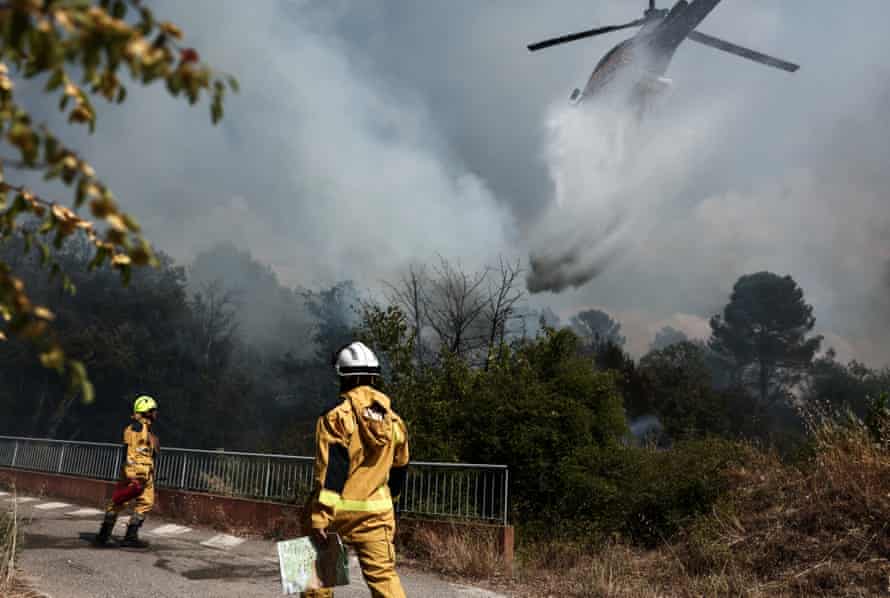
    A helicopter drops water over a burning area as a wildfire flares up again in Pontevès, south-east France.

    A second fire raging in the region, farther south near the popular holiday resort of Biscarrosse, had also burned through more than 2,500 hectares, the Landes prefect, Gilles Clavreul, said, and led to the evacuation of about 25,000 people. Clavreul stated that more than 600 firefighters were struggling to contain that blaze.

    “The fire front looks very bad. There are a great many new fire starts ahead of the main blaze. The situation is highly dynamic and unfavourable.”

    Gilles Clavreul,

    France’s Interior Minister, Laurent Nuñez, said that 32 wildfires of varying size and intensity were burning across France, with 50,000 hectares scorched already so far this year.

    Spain’s government declared its first national emergency for a wildfire as two major blazes merged into one outside Madrid and a third was on the verge of joining them, amid searing heat and tinder-dry conditions across much of southern Europe.

    Madrid’s regional leader, Isabel Diaz Ayuso, said, “This is the worst wildfire in our region’s history,” describing “an unprecedented situation: a perfect storm of extremely high temperatures and relentless winds.”

    Spain’s government declared a national emergency on Thursday evening after wildfires ⁠threatened communities near the capital and in the neighbouring province of Ávila, forcing more than 19,000 people to evacuate overnight and on Friday.

    The interior ministry said the decision was taken because of the simultaneous outbreak of several fires, adverse weather conditions and ⁠the need to mobilise extensive resources from several public administrations

    The regional government of Madrid requested assistance, describing the situation as one of “extreme gravity.” It said that at least four active fires could advance “beyond current extinguishing capacity.”

    Spain’s Prime Minister, Pedro Sánchez, chaired an emergency response meeting at the Moncloa palace this morning as the state meteorological office warned that the danger of more fires remained very high or extreme across much of the country.

    “We’re living through a dramatic situation, not just in various Spanish provinces but also in regions of neighbouring countries. Forest fires are devastating thousands of hectares and affecting numerous communities.”

    Pedro Sánchez

    He promised the government had deployed “all available resources. It will be by your side during the emergency and the recovery.” The Prime Minister also thanked “all the emergency services that are fighting day and night.”

    In an update issued today, Spain’s environment ministry said 29 big forest fires had been recorded so far in 2026, compared to an annual average of nine between January and the end of July per year over the past decade. Forest fires had burned about 114,796 hectares, compared with 25,133 by the same time last year.

    France, Spain Seek EU Help Amid Wildfires

    Both countries sought EU help. France’s President, Emmanuel Macron, said that he had activated the EU’s civil protection mechanism as the country, which has endured three almost back-to-back heatwaves since May, battled numerous wildfires mainly in the south-west and south-east.

    Macron, who described the situation as “extremely intense,” said, “We will soon be able to count ‌on reinforcements from two Croatian aircraft, two Portuguese planes, as well as two heavy helicopters from the Czech Republic and Slovakia.”

    Spain’s interior ministry has also requested fire-fighting aircraft through the EU’s civil protection mechanism, which aims to strengthen civil protection cooperation between EU countries and 10 additional participating states.

    The severity of fires in the EU has broken records for the time of year, data from the European Forest Fire Information System shows, with about twice as much land burned by 22 July than the average for that date over the past two decades.

  • UK Prime Minister Opens No 10 North

    UK Prime Minister Opens No 10 North

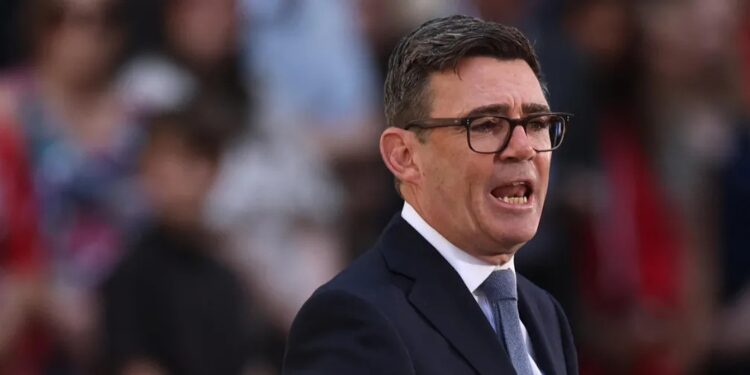
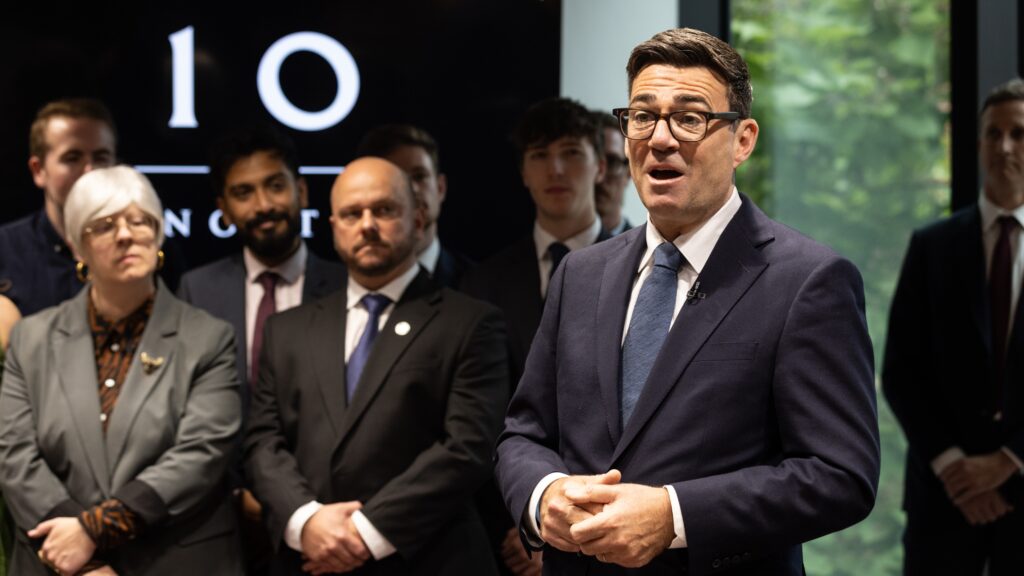
    UK Prime Minister, Andy Burnham has officially opened No 10 North in Manchester, describing the new government hub as a landmark step in his plan to redistribute political and economic power away from Westminster and deliver “growth in every corner of the country.”

    The opening of No 10 North, a satellite branch of Downing Street based in north-west England, marks one of the flagship initiatives of Burnham’s new Labour administration.

    The office is intended to bring senior government decision-making closer to communities outside London, reinforcing the Prime Minister’s long-standing commitment to devolving powers to regions and nations across the United Kingdom.

    According to the UK Prime Minister, the project signified considerably more than just a symbolic shift of government activities. Instead, it marks the start of a major shift in how Britain is governed, with more power being shifted from Whitehall to regional authorities.

    “It’s not just a new office. Through this place power is going to flow, energy is going to flow, new ideas are going to come through.”

    Andy Burnham

    The Prime Minister argued that successive governments had concentrated too much political influence in London, making it harder for communities elsewhere to shape national policy or secure investment tailored to local needs.

    According to Burnham, establishing No 10 North demonstrates his government’s determination to rebalance the country’s political landscape, noting that, “No 10 North is going to take that up to the next level.

    UK Prime Minister Andy Burnham

    The Prime Minister emphasised that, he understood that negotiations with London had been difficult in the past and ‘sometimes it’s felt like an argument with people in the centre of government’ due to the balance of power.

    “It’s sending a message to everybody here who has come in to No 10 North in its early days that you’ve got the full support of government from the very top – Prime Minister, Chancellor, first Secretary of State, that’s a very powerful message that we’re sending today, that the political commitment is there.”

    Andy Burnham

    Burnham stressed that the initiative was designed to benefit the entire United Kingdom rather than simply northern England, insisting that every region and nation would benefit from decisions being made closer to local communities.

    “There’ll be many voices out there, I can hear them all already, often London based, but not exclusively. They like to say, ‘Oh, this will just be the new levelling up, or another sort of short-lived gimmick’, and they’ll also say ‘What’s it going to cost?’”

    Andy Burnham

    He added, what does it cost for everybody to troop down to London every time there’s a meeting when you need to make an argument about something? What does that cost? So actually, isn’t it better that we have a North Pole that balances the South Pole of our country, where power will always be concentrated?”

    Opposition Questions Cost as Burnham Defends Decentralisation

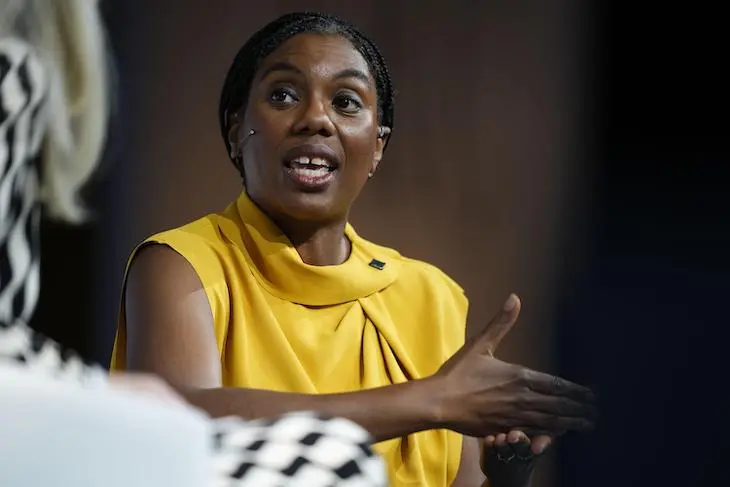
    Conservative Party leader Kemi Badenoch

    While the government has presented No 10 North as a major constitutional reform, opposition parties have questioned whether the new office will genuinely improve decision-making or simply create another layer of government bureaucracy.

    Conservative Party leader Kemi Badenoch dismissed the initiative as a political stunt.

    “No 10 North” was a “gimmick” she said, arguing that “it does not make decision-making any better, it’s just creating another branch of the civil service in a different place.

    Kemi Badenoch urged Burnham to focus on broader economic transformation rather than localised initiatives.

    “But he’s mostly talking about the little things bus fares. He’s not talking about AI, he’s not talking about how we create jobs.”

    Kemi Badenoch

    She also questioned the financial implications of the new office, indicating that any future Conservative government would first examine its costs before deciding whether to retain it.

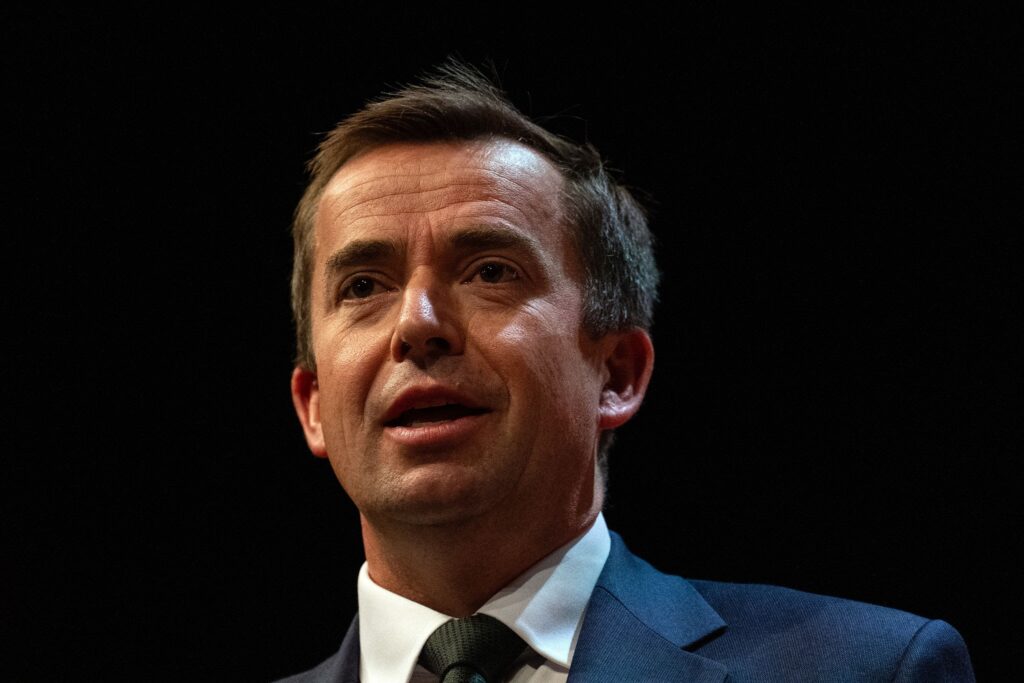
    Liberal Democrat MP Calum Miller

    Moreover, Liberal Democrat MP Calum Miller also called for the Manchester office to demonstrate tangible national benefits rather than serving as a convenient regional workplace for ministers.”

    He stated that No 10 North must be “more than just a convenient Friday working from home base for him and other Manchester MPs.”

    “He needs to demonstrate it’s more than just that and that this represents something for the whole country  that rural and coastal communities that have been really left behind are actually part of his plan for decentralisation.”

    Calum Miller

    The new government hub will initially operate from Heron House in central Manchester, a building shared with intelligence agencies, while a permanent government complex is being constructed in the Ancoats district.

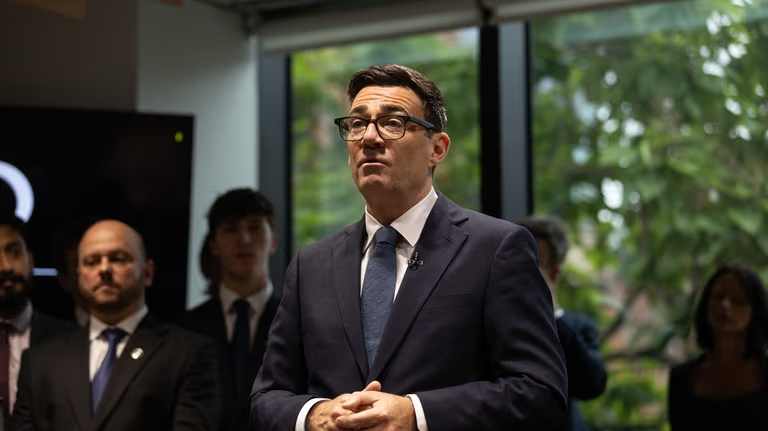
    UK Prime Minister Andy Burnham

    UK Prime Minister Andy Burnham is expected to work regularly from Manchester. Under the new arrangements, No 10 North will take on more responsibility for strategic devolution and regional economic growth decisions, while the Treasury and the Ministry of Housing, Communities, and Local Government will continue to contribute to policymaking.

    The establishment of No 10 North builds on broader efforts by successive British governments to decentralise the civil service. Recent figures indicate that only around one in five civil servants is now based in London, with the number continuing to decline as departments expand their presence across the country.

    For Burnham, however, the Manchester office represents more than relocating officials. It is intended to become the centrepiece of a wider effort to reshape Britain’s governance by ensuring that decisions affecting local communities are increasingly made closer to the people they impact.

    Whether No 10 North becomes a lasting symbol of constitutional reform or, as critics suggest, an expensive political experiment will depend largely on its ability to deliver the regional growth and stronger local decision-making that the Prime Minister has promised.

  • Bangladesh President Resigns Over Ill Health

    Bangladesh President Resigns Over Ill Health

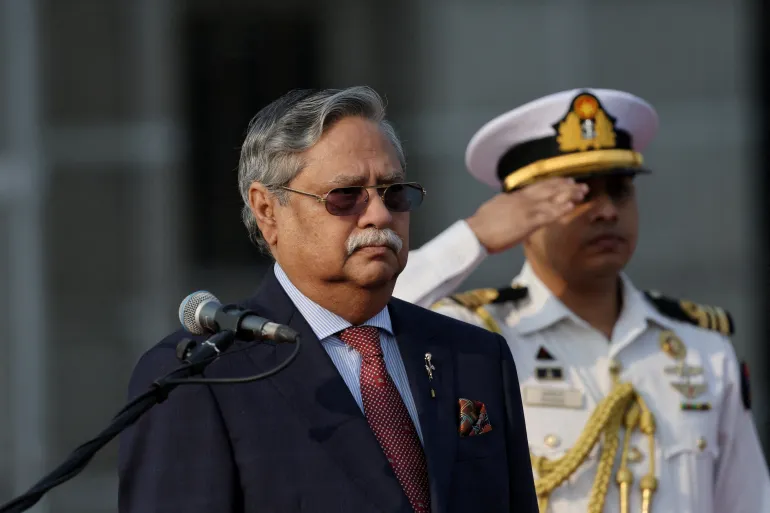
    Bangladesh President Mohammed Shahabuddin has resigned two years ahead the end of his full five-year term, citing health reasons for his decision.

    In a statement announcing his decision, Shahabuddin said that health concerns had made it increasingly difficult for him to carry out the responsibilities of the office.

    Shahabuddin said in a statement released by his press secretary, “Recent medical examinations have diagnosed me with a condition known as Autonomic Neuropathy. Due to this condition, I occasionally experience momentary loss of consciousness.”

    The move comes amid rising demand from opposition parties for him to step down.

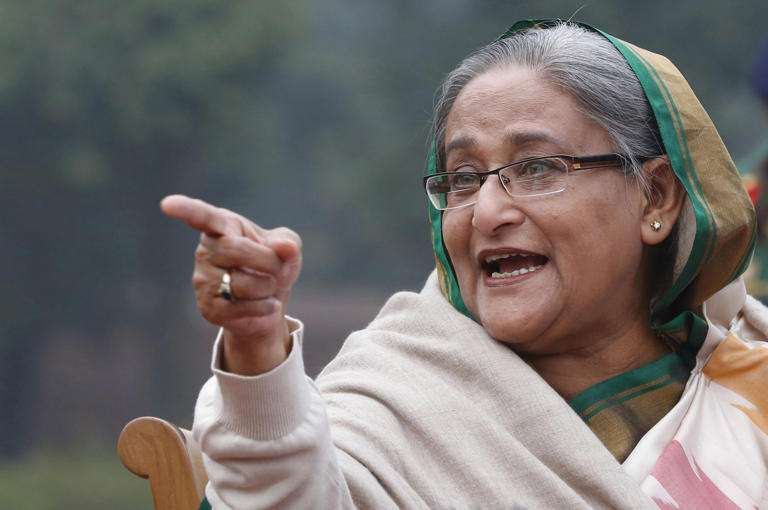
    The resignation comes amid media reports that Shahabuddin spoke on the phone with ousted Prime Minister Sheikh Hasina, who is living in India, during a visit by the former to the UK for medical treatment in May this year, according a Dhaka-based news agency.

    Ousted Bangladeshi Prime Minister, Sheikh Hasina.
    Ousted Bangladeshi Prime Minister, Sheikh Hasina.

    Shahabuddin has refuted the media report. “I am suffering from various health complications,” he told the news agency when asked about the reason for his resignation. “I have nothing more to add at this moment,” he added.

    He had travelled to London on May 9 and returned on May 18. Shahabuddin has been the President of the South Asian nation since April 2023. His term was meant to end in 2028. He oversaw the country during a volatile period after Hasina was ousted in August 2024 by youth protesters and until a caretaker government was formed days later.

    Hasina is currently living in exile in India’s capital, New Delhi, but is expected to return to Bangladesh in December, according to a news agency.

    Earlier this month, Hasina said in an interview that she and her allies would return from exile in India and face the court in Bangladesh. Last year, the International Crimes Tribunal in Bangladesh found Hasina guilty of allowing lethal force to be used against protesters.The UN Human Rights Commission has estimated that at least 1,400 people died during the unrest which eventually saw Hasina flee the country.

    The court sentenced her to death in absentia.In the months following her departure, her party, the Awami League, has been banned from politics, and many of its leaders jailed. “My party leaders and workers are being subjected to tremendous repression,” she said during the interview earlier this month. “If death comes, I want it to come on my own soil, where my parents are buried and where their blood was shed,” she added.

    The resignation is likely to intensify discussions about the country’s political future, particularly as Bangladesh prepares for the next phase of its constitutional and electoral processes. The selection of Shahabuddin’s successor is expected to attract close attention from both the ruling party and the opposition.

    The resignation also comes as Bangladesh continues to face broader economic and political challenges, including inflation, employment concerns and efforts to strengthen investor confidence. Analysts note that maintaining political stability will remain important as the country seeks to sustain economic growth and attract foreign investment.

    International observers have closely monitored political developments in Bangladesh in recent years, encouraging dialogue among political stakeholders and calling for peaceful democratic processes. Several rights organisations have also urged all parties to respect constitutional institutions and avoid actions that could further heighten tensions.

    Bangladesh’s Parliament Speaker To Be Acting President

    The Speaker of the Jatiya Sangsad, the national parliament, will perform the duties of the President until a new one is elected, the statement added.

    Shahabuddin said in a letter to Parliament Speaker Hafiz Uddin Ahmed today, “I am seriously ill … therefore, I am unable to perform my duty of the constitutional post.”

    According to the Constitution, the President’s resignation becomes “effective upon submission of a signed letter to the Speaker,” the President’s Spokesperson, Sarwar Alam, said.

    A new President must be elected within the next 90 days, according to the constitution.

    His resignation leaves Hasina with no allies in high office five months before her planned return.

    Following the ouster of Sheikh Hasina’s government in the July mass uprising, sweeping changes were made across the board. Many of her allies were removed, ranging from top-ranking bureaucrats and police officials who had served under her administration to others in key positions. Shahabuddin was one of the few allies to remain in office.

    However, as Bangladesh’s President, his role is largely ceremonial. While he is the Head of state, the Executive power rests with the Prime Minister and cabinet.

    Attention is now focused on how the leadership change will affect the country’s political landscape. While Shahabuddin cited health as the reason for his resignation, the timing of his departure amid sustained political pressure is expected to remain a subject of debate in the weeks ahead.

  • FAO Unveils Global Strategy to Tackle Transboundary Animal Diseases

    FAO Unveils Global Strategy to Tackle Transboundary Animal Diseases

    FAO Global Partnership Programme for Transboundary Animal Diseases has been unveiled as a new global strategy to strengthen the fight against animal diseases that continue to threaten food security, disrupt trade, damage livelihoods and create risks for human health.

    The Food and Agriculture Organization of the United Nations (FAO) introduced the initiative as a country-led approach designed to improve prevention, detection and response to transboundary animal diseases (TADs), which can spread rapidly across borders and cause severe economic and social consequences, particularly in low- and middle-income countries.

    The programme, known as the FAO Global Partnership Programme for Transboundary Animal Diseases (GPP-TAD), seeks to transform how countries prepare for and respond to major animal health emergencies by creating stronger partnerships between governments, farmers, private sector actors, financial institutions and international organisations.

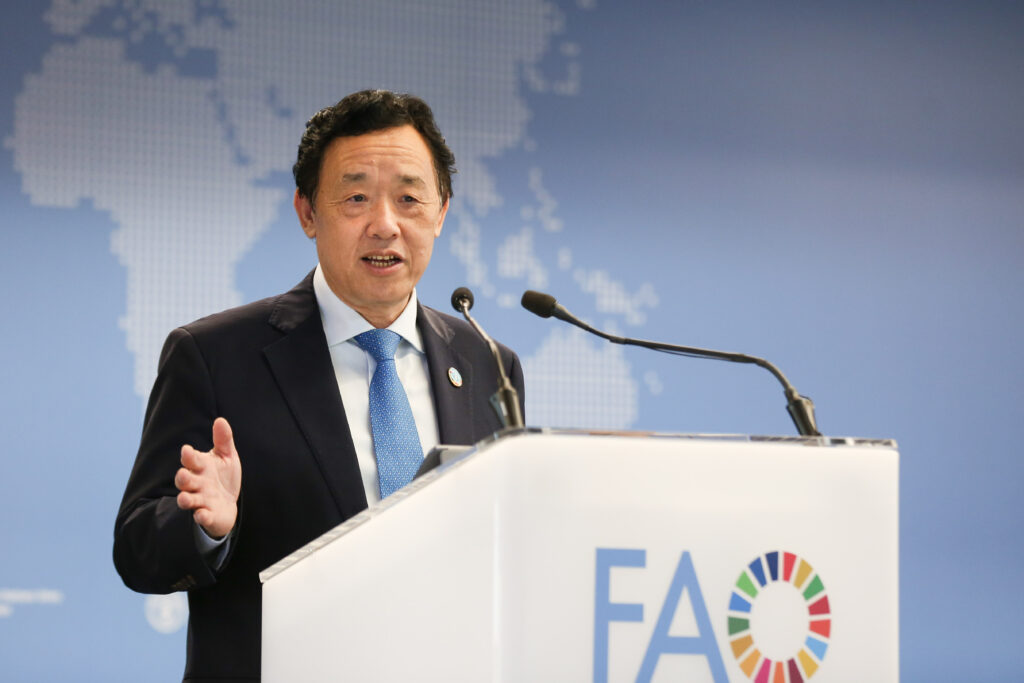
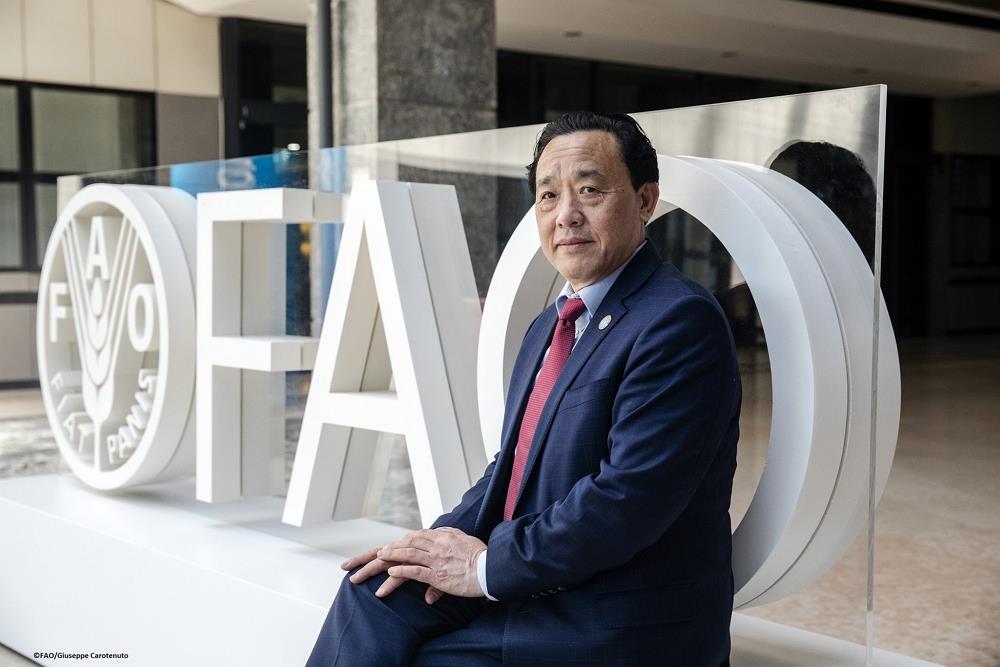
    According to FAO Director-General Qu Dongyu, the world must move away from reacting only after disease outbreaks occur and instead invest in prevention, cooperation and long-term preparedness.

    “We must ensure that the next chapter of global animal health is not defined by crisis, but by cooperation, responsibility and shared success.”

    Qu Dongyu

    He warned that transboundary animal diseases remain among the most urgent threats facing global food systems, rural economies and public health.

    FAO Director-General Qu Dongyu

    Diseases such as highly pathogenic avian influenza, foot-and-mouth disease, African swine fever and New World screwworm have demonstrated the speed at which animal health emergencies can cross borders and affect millions of people.

    According to FAO, these diseases are spreading faster, reaching wider areas and causing greater economic damage than in previous years, placing additional pressure on already vulnerable communities that depend heavily on livestock for income and food security.

    Qu stressed that investing in prevention is significantly cheaper than responding to large-scale outbreaks after they occur.

    He pointed to the recent introduction of the SAT1 serotype of foot-and-mouth disease into Asia, warning that the outbreak could result in annual losses of up to $2 billion based on FAO impact assessments.

    “The only way to avert crises downstream is investing upstream in prevention through a One Health approach.”

    Qu Dongyu

    He also called for a broader understanding of the One Health approach, arguing that animal health cannot be separated from wider environmental and human health concerns.

    “We can no longer speak only of zoonotic diseases. We need a right interpretation of a One Health holistic approach which encompasses soil health, animal health, plant health, human health and environmental health.”

    Qu Dongyu

    GPP-TAD was launched in response to the rising understanding on a global scale that better coordination and sustainable funding are needed for current methods of controlling animal illnesses.

    With 110 nations filing official letters expressing their intention to join the program, the initiative has already attracted a lot of interest from around the world.

    The robust reaction is a reflection of the growing concern around the world over illnesses that endanger animal output, international trade, and rural livelihoods.

    New FAO Model Shifts Focus From Crisis Response to Prevention

    Food and Agriculture Organization of the United Nations

    The FAO Global Partnership Programme for Transboundary Animal Diseases represents a major shift in how international efforts to manage animal disease outbreaks are organised and financed.

    For more than two decades, FAO’s Emergency Centre for Transboundary Animal Diseases (ECTAD) has played a central role in supporting countries during animal health emergencies. However, previous efforts have largely depended on donor-funded projects, with FAO acting mainly as an implementing organisation.

    Under the new programme, FAO is introducing a broader global partnership model where countries take greater ownership of disease prevention and control efforts while receiving technical support tailored to their specific needs.

    The new approach will be built around National Partnership Platforms that bring together governments, producers, farmers’ organisations, private companies, foundations and financial institutions under a single national framework.

    Recognising that animal diseases frequently spread through international travel and necessitate collaboration across national boundaries, regional hubs will also coordinate cross-border responses.

    Through its Emergency Prevention System (EMPRES) initiative, FAO will continue to give technical knowledge, including disease intelligence, early warning systems, scientific guidance, and emergency help when needed.

    Prevention and progressive disease control, digital surveillance and early warning systems, readiness and risk-based action, coordinated emergency response, and more robust laws, collaborations, and funding sources are the program’s five main focal areas.

    The new financial structure of GPP-TAD, which attempts to provide a more reliable and sustainable funding system, is a key component.

    FAO Director-General Qu Dongyu

    Rather than relying mainly on external donor support, participating countries will contribute according to their financial capacity, while additional funding will come from development partners, international financial institutions and private sector organisations.

    According to FAO, the strategy is intended to promote shared accountability and guarantee that nations most impacted by animal disease concerns have more effective means of averting future outbreaks.

    FAO Director-General QU Dongyu described the initiative as a platform built on cooperation and collective responsibility.

    “GPP-TAD is a strong global platform for solidarity, shared responsibility, and sustainable, predictable investment.”

    Qu Dongyu

    He added, healthy foods come from healthy soils, healthy plants and healthy animals for a healthy environment and a healthy life.

    As climate change, global trade, and population movement continue to raise the danger of disease transmission, the FAO maintains that stronger international collaboration will be critical in protecting agriculture, economy, and people from future animal health problems.

  • Merz Announces Cabinet Reshuffle

    Merz Announces Cabinet Reshuffle

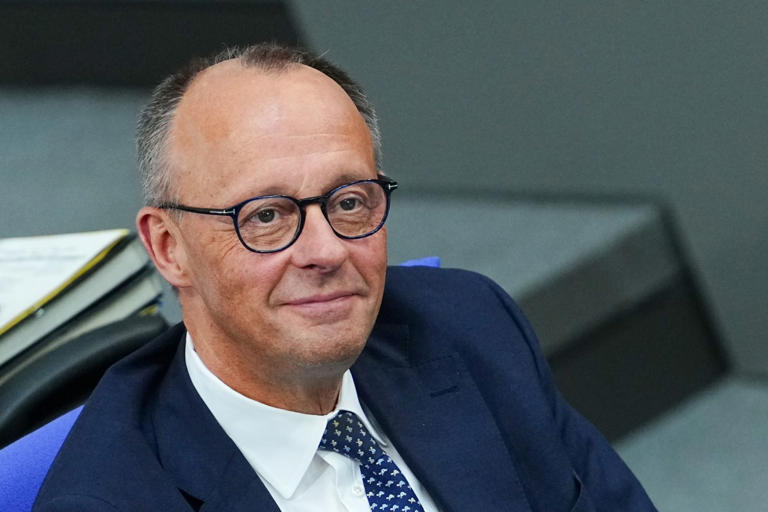
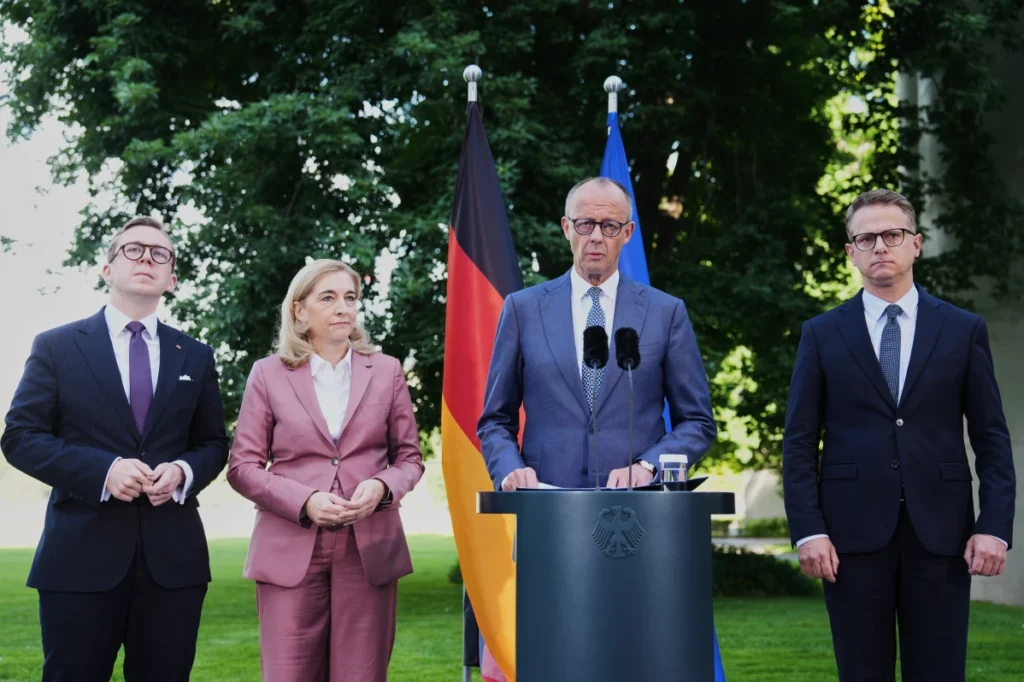
    German Chancellor Friedrich Merz has reshuffled top posts in his cabinet.

    Merz took the opportunity to make a series of changes after a senior ally quit as the leader of his bloc’s parliamentary group over personal conduct that undermined his credibility.

    Jens Spahn quit as leader of the Union’s parliamentary group, one of the most powerful positions in the coalition, after it emerged that he and his husband had used the services of a surrogate mother in the U.S. to have a baby.

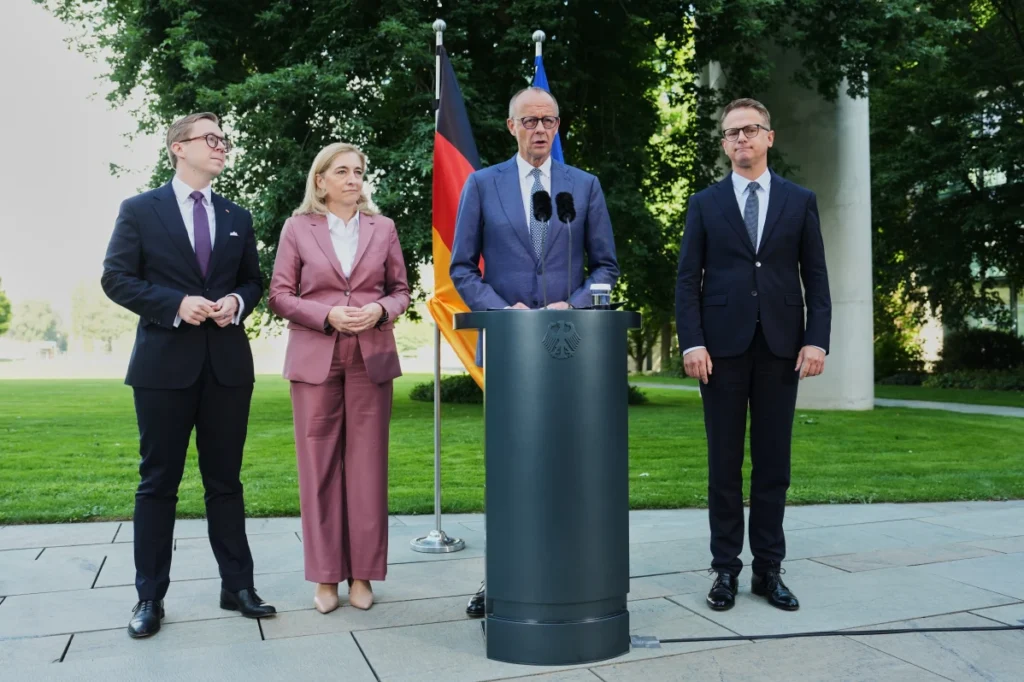
    German Chancellor Friedrich Merz announces cabinet reshuffle.

    Surrogacy isn’t allowed in Germany. Merz’s party opposes allowing it, a position that it reaffirmed at a convention in February, and Spahn himself had spoken out against it in the past. As such, his action prompted accusations of double standards.

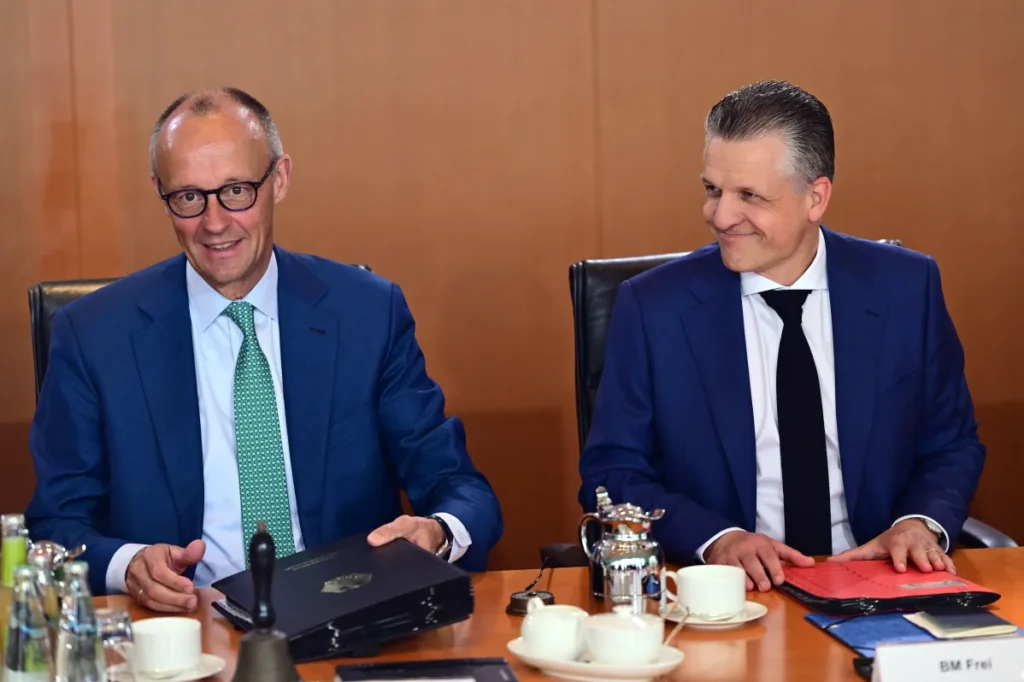
    Merz put his chief of staff, Thorsten Frei, in Spahn’s job, a position he’s widely considered better suited to than coordinating the chancellery. Frei was the Union’s parliamentary chief whip under Merz when the center-right was in opposition.

    The German leader announced that Health Minister Nina Warken will take Frei’s place at the chancellery, a post that is key to the smooth functioning of the government. She will be the first woman to take that job. Warken takes his place at the chancellery after shepherding the first of the government’s reforms, meant to curb rising costs in the German health insurance system, through parliament earlier this month.

    German Chancellor Friedrich Merz and Thorsten Frei.

    Merz said that she has showed that “she can push through reforms against resistance,” praised her as a tough negotiator and said that “she is also at home with the security policy issues” that are important at the chancellery.

    Another close ally, Carsten Linnemann, the General Secretary of Merz’s Christian Democratic Union party, will become Health Minister, taking Warken’s place at the Health Ministry. Merz said that “we must maintain the course of reform” in health policy and that requires a “steadfast” Minister.

    “The personnel changes follow a clear line. We want a government that works with great vigor and pleasure and also represents the personal diversity of our society and politics. We are a reform government and want to continue showing that.”

    Frederick Merz

    Merz said that there will be further Cabinet changes, but didn’t offer details. He said those decisions will take “a few days yet, and perhaps more time.”

    German Chancellor Friedrich Merz announces cabinet reshuffle.

    AfD Co-leader Criticises Merz’s Cabinet Reshuffle

    AfD Co-leader Alice Weidel argued that Merz had caused “yet more chaos” with his reshuffle and said in a post on X that the government being preoccupied with itself doesn’t do justice to Germany’s “many-faceted” problems.

    She added that Germany needs new elections. The next national election isn’t due until early 2029.

    The reshuffle comes amid the German Chancellor’s efforts to boost the fortunes of his deeply unpopular government ahead of regional elections in which a far-right party could get its first state Governor.

    Merz took office less than 15 months ago with pledges to reform and turn around Germany’s economy, Europe’s biggest, after years of stagnation. However, that economic turnaround has been slow to start and the middle-of-the-road coalition of Merz’s center-right Union bloc and the center-left Social Democrats, two traditional rivals, has yet to persuade voters that it can produce results.

    That has resulted in Merz’s popularity sinking to rock-bottom levels, while the far-right Alternative for Germany, or AfD, has gained support on the back of widespread discontent.

    The governing parties face three difficult regional elections in September. In the eastern region of Saxony-Anhalt on Sept. 6, AfD is hopeful of winning a majority that would give it control of a state government for the first time. After months in which voters were turned off by squabbling in the coalition, Merz’s government recently embarked on big plans for potentially painful change — including a proposed reform of the creaking pension system that would include raising the retirement age gradually, income tax cuts for low- and middle-income earners and an effort to slash red tape.

    Alice Weidel, the co-leader of the far-right Alternative for Germany party, which placed second in national elections last year, derided the reform package. She called the measures an “even more left-wing redistribution, and minimal compromises that don’t deserve to be called ‘reforms’.”

    She added that the “fact that this is being sold as a ‘breakthrough’ shows only one thing: this government’s complete inability to reform.”

    Nonetheless, Merz appealed to all Germans to support the package.

  • Court Halts Impeachment Process Against South African President

    Court Halts Impeachment Process Against South African President

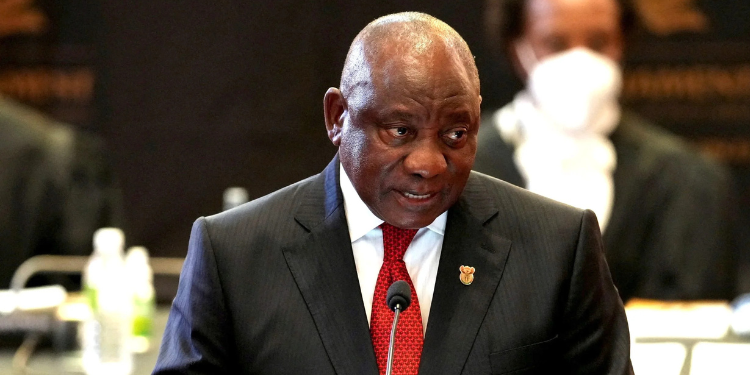
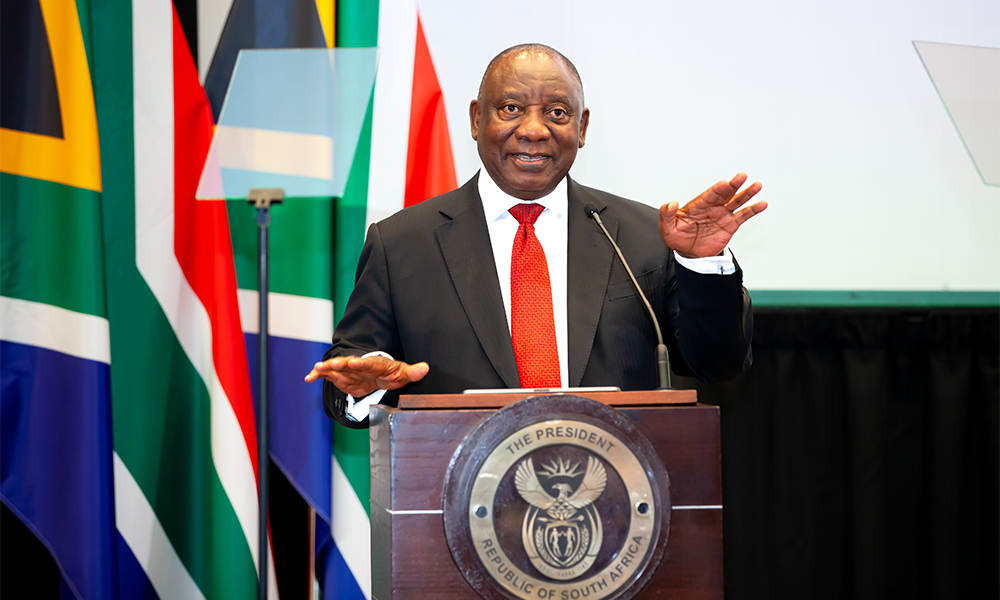
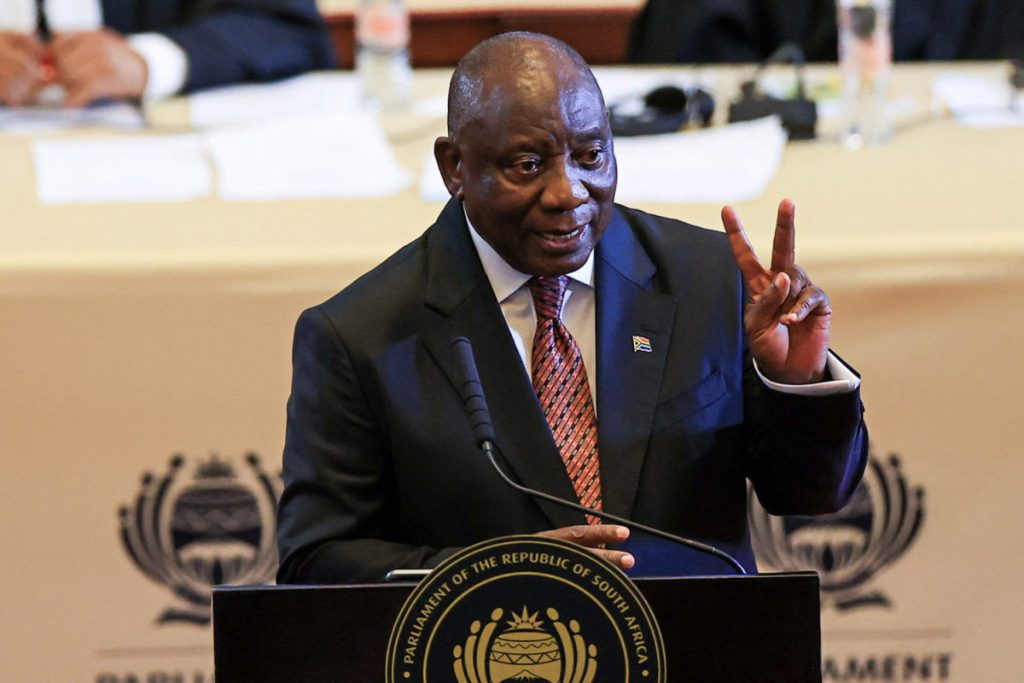
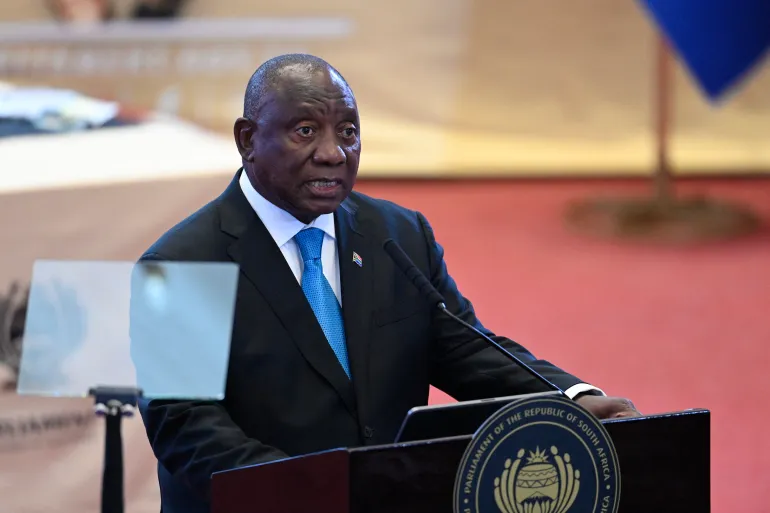
    South African President, Cyril Ramaphosa’s impeachment case has been temporarily halted after a South African court blocked a parliamentary process seeking to investigate misconduct allegations against the president over the controversial farmgate” scandal.

    The Western Cape High Court granted Ramaphosa an interim interdict preventing Parliament from continuing with the impeachment process while separate legal proceedings challenging an earlier independent panel report remain unresolved.

    The ruling provides a significant political boost for Ramaphosa, who has faced renewed pressure over allegations linked to the theft of hundreds of thousands of dollars from his private farm in Limpopo province in 2020.

    The President has consistently denied any wrongdoing, insisting that the money reported to be about $580,000 came from the legitimate sale of buffaloes through his livestock business.

    However, the discovery of large amounts of cash hidden inside furniture at his Phala Phala farm created a major political crisis, raising questions about transparency, security and whether legal obligations were followed.

    The Cyril Ramaphosa impeachment case emerged after former Intelligence Chief Arthur Fraser publicly revealed details of the robbery in 2022, accusing the President of concealing the theft from law enforcement authorities and tax officials.

    South African President, Cyril Ramaphosa

    Fraser, who is closely associated with former President Jacob Zuma, submitted a dossier to police alleging that Ramaphosa had failed to properly report the incident and may have violated financial regulations.

    Ramaphosa rejected the allegations, indicating that there was no evidence of criminal behaviour.

    At the time, the South African President stated that the money involved was proceeds from the sale of buffaloes and not linked to any illegal activity. He also challenged claims that the amount stolen was significantly higher, with Fraser alleging that millions of dollars were involved.

    The controversy intensified because the money was reportedly kept in foreign currency, raising concerns about possible breaches of South Africa’s exchange control regulations.

    However, investigations by key institutions produced different outcomes. The South African Reserve Bank found no violation of exchange control laws, while the Public Protector, which investigates allegations of misconduct by public officials, also found no wrongdoing by the President.

    Despite those findings, Parliament continued with its own process and established an independent panel to assess whether there were grounds for impeachment.

    The panel reached a controversial conclusion, finding that Ramaphosa had a case to answer over allegations of possible misconduct and constitutional violations.

    It stated there was “substantial doubt about the legitimacy of the source of the currency that was stolen” and concluded that Ramaphosa “has a case to answer.

    This findings triggered political pressure on the President, with opposition parties calling for accountability and demanding that Parliament proceed with impeachment proceedings.

    Cyril Ramaphosa Faces Pressure, But Removal Looks Difficult

    South African President, Cyril Ramaphosa

    Although the Cyril Ramaphosa impeachment case has created one of the biggest political challenges of his presidency, analysts believe the President remains in a strong position due to continued support from the African National Congress (ANC).

    The ANC, South Africa’s largest political party, remains the biggest force in the country’s coalition government and continues to back Ramaphosa despite the controversy.

    Political observers argue that even if the impeachment process eventually resumes and reaches a parliamentary vote, removing Ramaphosa would be extremely difficult.

    Under South Africa’s Constitution, a President can only be removed through impeachment for serious misconduct, violation of the Constitution or law, or an inability to perform presidential duties.

    For removal to succeed, at least two-thirds of Members of Parliament must vote in favour of impeachment.

    The ANC’s parliamentary strength means Ramaphosa is unlikely to face removal unless significant numbers of lawmakers from his own party and coalition partners break ranks.

    However, uncertainty remains over how coalition partners would vote if the process continues.

    The parliamentary impeachment procedure requires an independent panel report to be considered before a committee of MPs examines the allegations and makes recommendations.

    If the committee recommends impeachment, Parliament must hold a vote.

    Ramaphosa has continued to fight the findings, arguing that the independent panel exceeded its authority and incorrectly interpreted the allegations against him.

    South African President, Cyril Ramaphosa

    In response to the report, the President Cyril Ramaphosa previously filed a legal challenge seeking to have the findings overturned, arguing that the panel “misconceived its mandate, misjudged the information placed before it and misinterpreted the four charges advanced against me.

    The Cyril Ramaphosa impeachment case is the first major impeachment process launched against a South African President under new parliamentary rules introduced in 2018.

    Those reforms created the independent panel system and impeachment committee process designed to strengthen accountability mechanisms.

    The country has previously witnessed presidential impeachment attempts, although none resulted in removal.

    In 2016, former President Jacob Zuma survived an impeachment vote after the Constitutional Court ruled that he had violated the Constitution by failing to repay public funds used for upgrades at his private residence in KwaZulu-Natal.

    Zuma remained in office because the ANC used its parliamentary majority to defeat the motion.

    For Ramaphosa, the latest court victory offers temporary relief but does not completely remove the political pressure surrounding the “farmgate” controversy.

    The final outcome will depend on the pending legal challenges, Parliament’s next steps and whether political support for the President remains strong.

  • UK Takes Command of Multinational Force for Post-War Ukraine

    UK Takes Command of Multinational Force for Post-War Ukraine

    UK has taken command of the multinational force that would deploy to Ukraine after hostilities end, as Britain strengthens its role in preparing long-term security arrangements for Kyiv following Russia’s ongoing aggression.

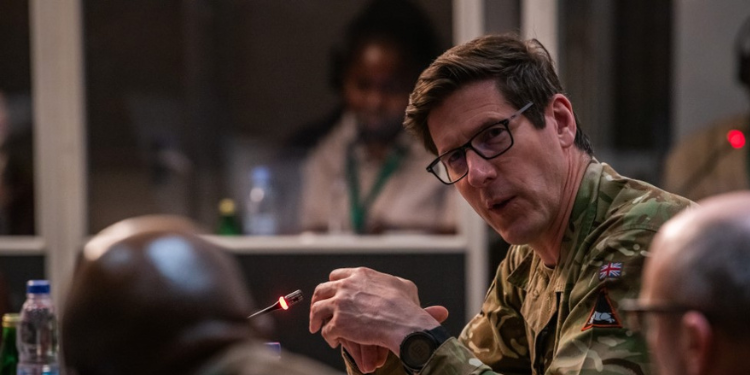
    At a formal ceremony in Paris, a senior British Officer, Lieutenant General Tom Bateman assumed leadership of the Multinational Force Ukraine (MNF-U), taking over from his French counterpart.

    The transfer of command comes as Britain reaffirms its commitment to Ukraine and its leadership role within the Coalition of the Willing, a group of international partners working to establish credible security guarantees for Ukraine once active fighting comes to an end.

    The MNF-U is designed to operate in a post-conflict environment, supporting Ukraine’s ability to defend its sovereignty while helping rebuild its armed forces and restore confidence among citizens, investors and international partners.

    According to Lieutenant General Tom Bateman, assuming leadership of the MNF-U at its Paris-based Operational Headquarters is “a privilege.”

     “Building on the excellent work of my predecessor and his multinational team, we will continue to work closely with our Ukrainian and international partners to prepare a force that will help support a just and lasting peace in Ukraine.”

    Lieutenant General Tom Bateman

    The appointment follows commitments made by leaders of the Coalition of the Willing, who confirmed that the MNF-U would conduct exercises in the coming months to demonstrate its readiness to operate once hostilities cease.

    British officials noted that the force represents a major part of efforts to ensure that any future peace agreement is supported by practical security measures rather than relying solely on diplomatic commitments.

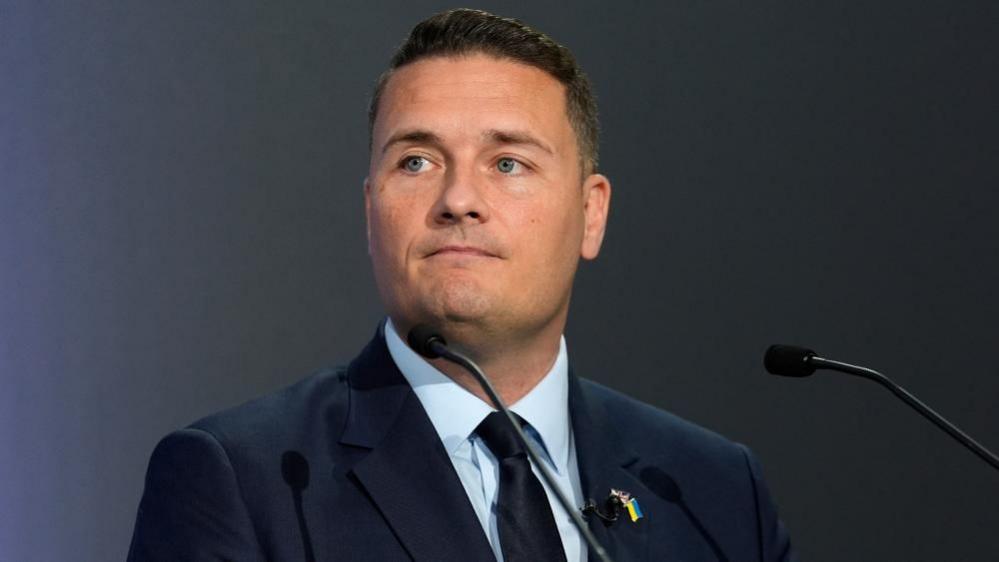
    According to Defence Secretary Wes Streeting, Britain’s support for Ukraine would continue both during the conflict and in preparations for a future peace.

    UK Defence Secretary, Wes Streeting

    “The frontline in Ukraine is the frontline for our freedom and democracy. Our commitment to supporting Ukraine both in the fight now, and in preparation to secure the peace we want to see remains steadfast and will not waver.”

    Wes Streeting

    He added, we are proud to take command of this multinational force, which demonstrates the leading role we will continue to play in supporting our Ukrainian friends.”

    The two primary goals of the MNF-U are regeneration and assurance.

    By promoting safer skies and seas, the force would contribute to Ukraine’s security under the reassurance mission, enabling the nation to resume commercial aviation, revive its economy, and draw in foreign investment.

    The regeneration element focuses on bolstering Ukraine’s armed forces through training, equipment support, and initiatives to restore military capabilities following years of conflict.

    UK and France Advance Security Plans for Post-War Ukraine

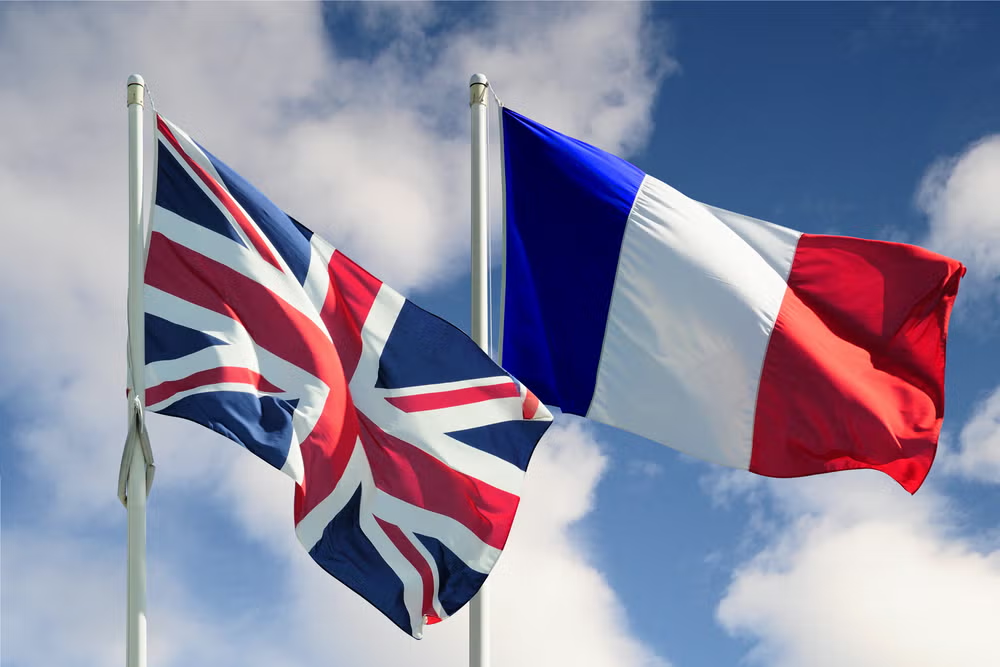
    United Kingdom & France

    Lieutenant General Bateman’s appointment is indicative of Britain and France’s ongoing collaboration in defining Ukraine’s future defence strategy.

    If deployed, the MNF-U would set up a headquarters in Kyiv so that foreign soldiers could collaborate closely with Ukrainian officials and military leaders.

    According to officials, the force would help Ukraine’s military forces heal and strengthen their capacity to fend off future aggression rather than replace them.

    Lieutenant General Bateman indicated that, at time of continued Russian aggression against Ukraine, our work demonstrates the enduring commitment of participating nations to Ukraine’s long-term security, sovereignty and stability.

    “I am honoured to work side by side with the new French Deputy Commander to provide continued British and French leadership to this important Multinational Force which has been declared ‘Ready to Operate’ at the recent Coalition of the Willing summit.”

    Lieutenant General Tom Bateman

    According to the British Ministry of Defence, the change in leadership was a component of the agreement reached between London and Paris, which reflects the shared accountability of both nations for directing the global endeavour.

    The action comes as Ukraine is under increasing pressure from its foreign allies to get ready for a peace deal that can withstand future threats due to the ongoing Russian missile and drone attacks.

    Members of the Coalition of the Willing have emphasised that any resolution to the crisis must assure Ukraine’s long-term security and stop future aggression.

    The Multinational Force for Post-War Ukraine (MNF-U) is anticipated to be a key player in those agreements by upholding an international presence, assisting with military recuperation, and bolstering Ukraine’s capacity for self-defence.

    The force, according to British officials, builds on the results of recent coalition talks in which leaders reiterated their dedication to reaching a long-lasting peace that ensures Ukraine’s future within the framework of European security.

    With Lieutenant General Bateman taking over, Britain is putting itself at the forefront of initiatives to influence Ukraine’s post-war destiny, with the MNF-U anticipated to play a significant role in international assistance if hostilities inevitably cease.

  • Trump Imposes Forced-labour Tariffs On 60 Trading Partners

    Trump Imposes Forced-labour Tariffs On 60 Trading Partners

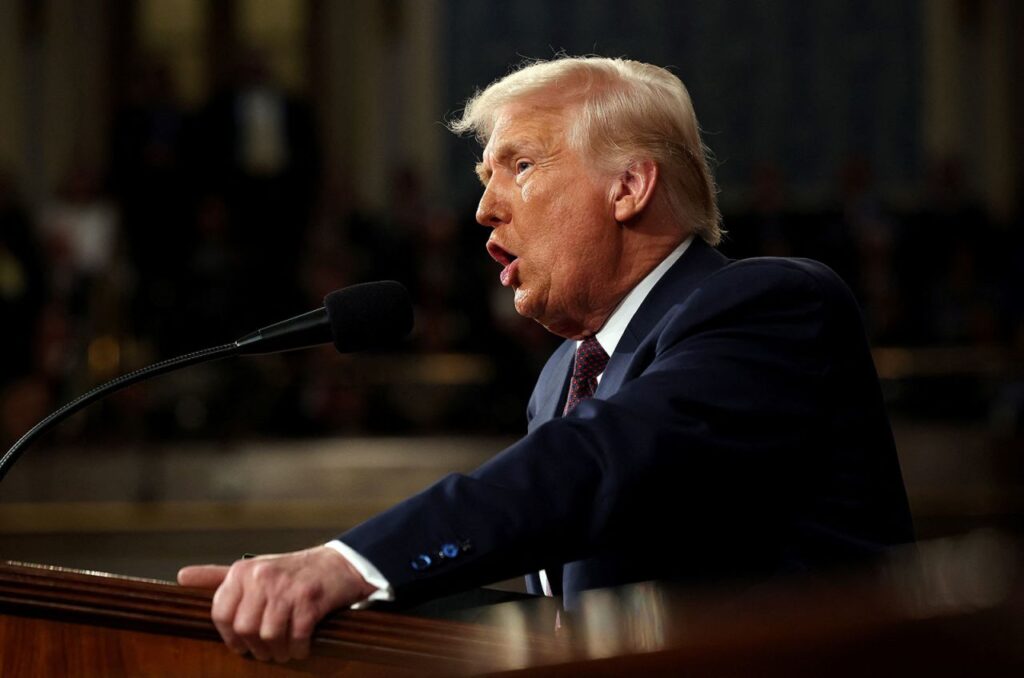
    President Donald Trump has imposed tariffs on imports from 60 trading partners, charging that they have inadequately enforced bans on goods produced by forced labor.

    The tariffs of 10% to 12.5% on trading partners accounting for 99.4% of U.S. imports, went into effect Friday morning. The timing coincides with the lapse of a 10% near-blanket duty President Donald Trump imposed earlier this year that was deemed unlawful by the Supreme Court.

    The new tariffs take effect just as temporary 10% worldwide tariffs expire at 12:01 a.m. Friday. Trump had turned to those temporary levies after the Supreme Court struck down his biggest and boldest tariffs in February.

    Trump Rebuffs Putin’s Offer To Aid Israel-Iran Conflict Mediation
    US President, Donald Trump.

    Administration officials said that the timing of the rollout was intended to “avoid complexity” that would come from layering the new levies on top of the existing 10% duties. They added that business leaders have been seeking more continuity and predictability around tariffs.

    Some products, including oil and gas and fertilizer, are exempted from the new tariffs. Also being spared are products that qualify for duty-free status under the US-Mexico-Canada Agreement, the North American trade pact Trump negotiated in his first term.

    The latest action follows a monthslong investigation by the US Trade Representative into the alleged use of forced labor to produce goods exported to the US and the failure by various countries to address the practice.

    U.S. Trade Representative Jamieson Greer asserted that the United States “has had a forced labor import ban for nearly a century, and rigorously enforces it; it’s well past time for our trading partners to do the same.”

    After the Supreme Court struck down his biggest and boldest tariffs in February, Trump has turned to imposing tariffs under Section 301 of the Trade Act of 1974, which permits the President to impose import taxes and other sanctions against countries found to engage in “unjustifiable,” “unreasonable” or “discriminatory” trade practices.

    Tariffs Draw Immediate Criticism

    The European Union questioned the new tariff, with its foreign policy chief Kaja Kallas calling it a “negative surprise” and rejecting the forced labor claims as unfounded. Switzerland also opposed the allegations, while Norway said it does not plan to retaliate by imposing tariffs on American goods.

    EU Seeks To Lower Price Cap On Russian Oil In Latest Sanctions Proposal
    In this picture, European Commission President Ursula von der Leyen and EU Foreign Policy Chief, Kaja Kallas address media at EU headquaters.

    Brazil rejected the 12.5% tariff on its goods, calling the U.S. move “arbitrary and unjustified” in a statement. It plans to trigger its reciprocity law, which could call for retaliatory tariffs on the United States, and take a complaint to the World Trade Organization. The Brazilian government said that the United States “chose to manipulate an issue of great importance to human rights and the struggles of workers worldwide in order to accuse 59 countries and the European Union of unfair practices.”

    Australia, subject to a 12.5% tariff, also voiced opposition to the new tariffs. Trade Minister Don Farrell told reporters that Washington’s move is “completely unjustified,” adding that Canberra would continue to lobby the US to remove all tariffs on Australian goods.

    Chile’s Undersecretary for International Economic Relations Paula Estévez said that the country has “solid labor institutions, a robust regulatory framework and a firm commitment to the prevention and eradication of forced labor.” Chile faces a 12.5% rate. “The Government of Chile considers that the application of this measure to our country is inconsistent with these standards, as well as with the technical, political, and legal background presented throughout the investigation process,” she said.

    Meanwhile, more Section 301 tariffs are likely to be imposed. There are several other pending investigations that rely on the same trade law, Section 301 of the Trade Act of 1974, being used to enact the new rates.

    One focuses on allegations that major trading partners — including China, Mexico and the European Union — are contributing to global manufacturing overcapacity. The U.S. Trade Representative’s office launched a probe into whether 16 countries, accounting for 70% of U.S. imports, have overproduced goods, pushing down prices and putting U.S. companies at a disadvantage in global markets. The administration has yet to complete that investigation.

    Section 301 tariffs are viewed by trade experts as a more legally durable option because they have survived previous court challenges, unlike the emergency authority Trump last April used for his “Liberation Day” broader tariff regime. They can also remain in place indefinitely.

    The administration is exploring additional ways to raise border taxes. Earlier this week the White House announced a 50% tariff on certain Canadian goods set to take effect next month under a never-before-used provision of the Smoot-Hawley Trade Act.

  • ICC Set for Crucial Vote on Chief Prosecutor’s Future

    ICC Set for Crucial Vote on Chief Prosecutor’s Future

    One of the International Criminal Court’s most consequential decisions is set to unfold as member states prepare to vote on the future of Chief Prosecutor Karim Khan, whose tenure has been overshadowed by allegations of sexual misconduct that he strongly denies.

    The vote comes as the Hague-based court finds itself under intense international scrutiny, balancing an internal leadership crisis against mounting geopolitical pressure following its high-profile investigations into conflicts around the world.

    Karim Khan, the Chief Prosecutor of the ICC, has strongly denied the accusations levelled against him. Additionally, his legal team contends that the procedure leading up to the vote was unfair, illegal, and unsupported by facts.

    Nevertheless, member states of the International Criminal Court (ICC) will decide whether he should remain in office or be removed, potentially triggering a leadership transition at a time when the institution is already facing significant political challenges.

    The outcome is being closely watched by governments, legal experts and human rights organisations because of its potential impact on the credibility and independence of the ICC, which was established in 2002 to prosecute individuals accused of genocide, crimes against humanity, war crimes and the crime of aggression when national courts are unable or unwilling to act.

    Khan has been suspended from his duties since June after taking voluntary leave in May 2025 while an internal investigation into the allegations proceeded. His accuser, a junior ICC staff member, publicly repeated claims in a recent interview that the prosecutor had engaged in a non-consensual sexual relationship with her.

    However, lawyers representing Khan have firmly rejected those allegations.

    The dismissal vote also comes against the backdrop of renewed criticism of the International Criminal Court from the United States, which has long opposed the court’s jurisdiction over American nationals and maintains that the tribunal threatens U.S. sovereignty.

    Supporters of Khan argue that attempts to remove him cannot be viewed in isolation from the ICC’s recent investigations, particularly after the prosecutor sought arrest warrants against senior Israeli officials over alleged war crimes committed during the conflict in Gaza.

    Israel, which is not a member of the International Criminal Court, has rejected the allegations and dismissed the warrants as politically motivated and without legal basis.

    Although the misconduct allegations are separate from the court’s investigations, Khan’s supporters fear that his removal would be interpreted by many as evidence that political pressure can influence one of the world’s most important international judicial institutions.

    Even if member states decide not to dismiss him, analysts claim that the controversy has already weakened his authority and could continue to affect the court’s public standing.

    ICC at Crossroads as Member States Decide Karim Khan’s Fate

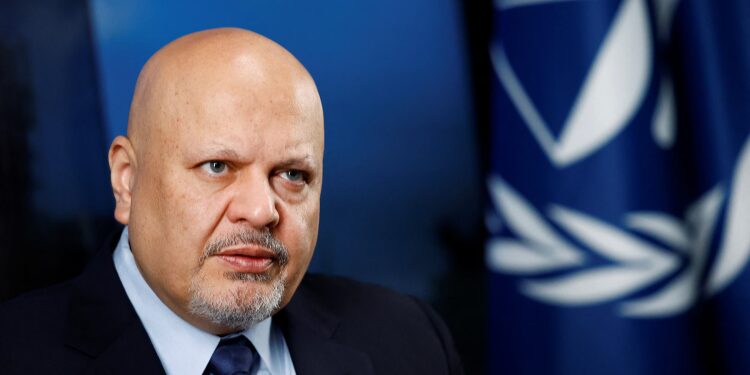
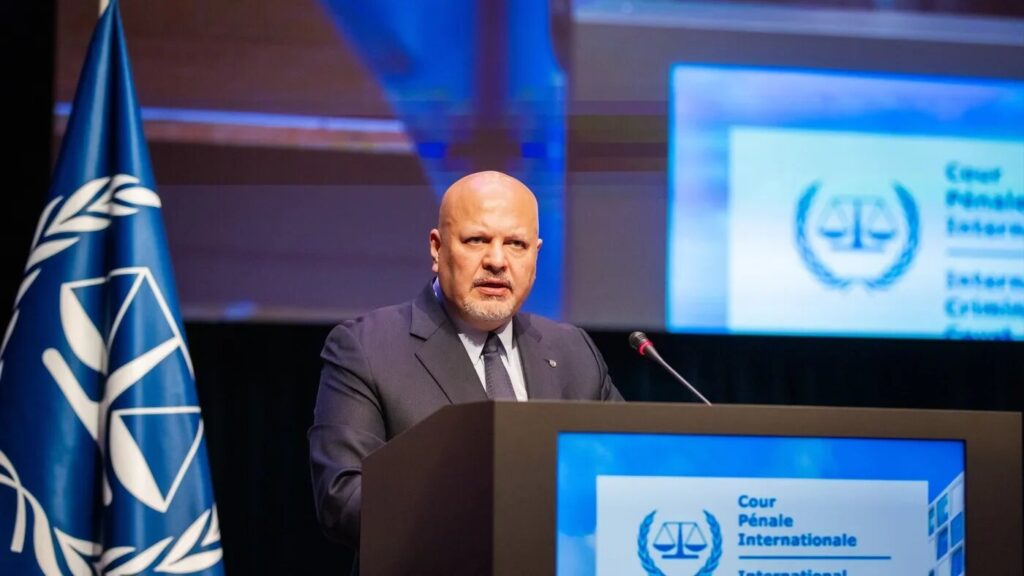
    Chief Prosecutor of the International Criminal Court (ICC), Karim Khan

    A number of ICC member states have made their voting intentions public ahead of the vote, exposing disagreements about the court’s future leadership.

    The Netherlands, the host nation of the International Criminal Court in The Hague, affirmed that it will vote to remove the prosecutor, while France have equally indicated that it would back Khan’s dismissal.

    The stances taken by two of the court’s powerful members have heightened rumours that Khan may lose the support of enough nations to be removed from office.

    The International Criminal Court will start the process of choosing a new top prosecutor right away if member states choose to remove him.

    However, selecting a successor is expected to take several months, with a final appointment unlikely before next year.

    During that transition period, the court’s existing investigations and arrest warrants would remain legally valid because only ICC judges not the prosecutor have the authority to withdraw or cancel warrants once they have been issued.

    Meanwhile, criticism of the court from Washington has continued. Speaking during a visit to the Philippines, U.S. Secretary of State Marco Rubio launched an attack on the tribunal.

    “There were lunatics and crazies involved in the ICC,” Rubio stated, insisting there was no scenario in which U.S. political or military officials would ever stand trial before the court.

    The International Criminal Court has frequently found itself at the centre of geopolitical disputes involving major powers, particularly when investigating conflicts involving influential states or their allies.

    The vote is seen by many legal experts as more than just a choice about a single person. It is also viewed as a test of the court’s accountability systems, governance, and capacity to maintain public trust while addressing accusations involving its top officials.

    Regardless of a person’s status, human rights advocates have maintained that accusations of misbehaviour should be thoroughly and openly examined. They have also emphasised that due process must be upheld during disciplinary processes.

    The vote is anticipated to be a pivotal point in the history of the ICC, regardless of the result.