Category: Europe

  • Wildfires Force Mass Evacuations Across Spain and France

    Wildfires Force Mass Evacuations Across Spain and France

    More than 80,000 people have fled huge wildfires in Spain and France.

    French authorities ordered the total evacuation, by land and sea, of one of the country’s best-known holiday spots.

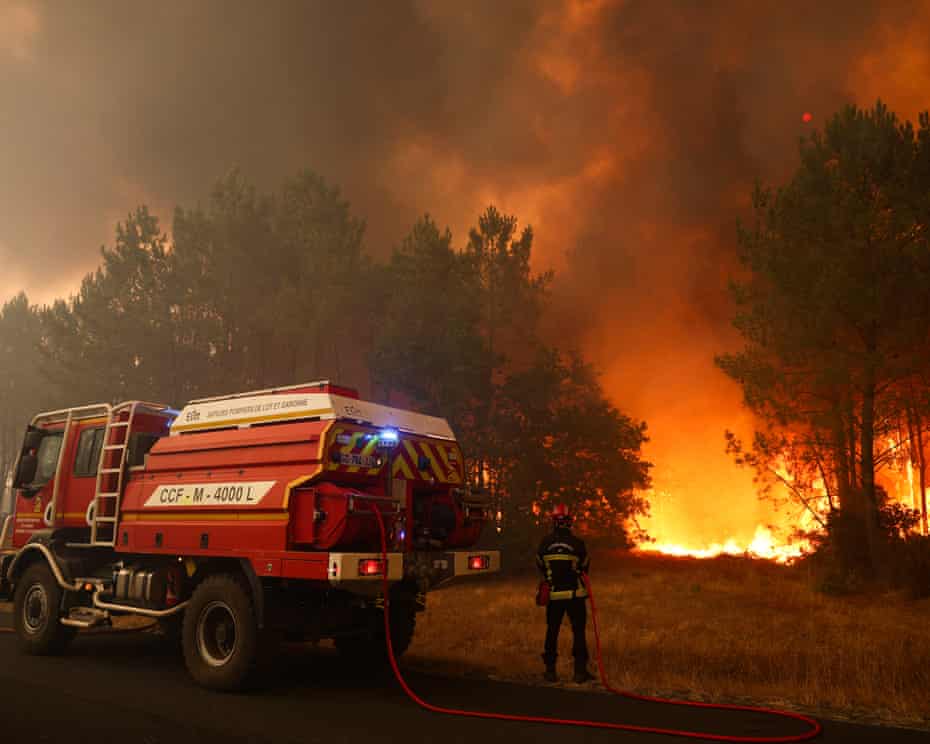
    Authorities in south-west France ordered the Cap Ferret peninsula on the Atlantic coast evacuated “village by village” in the face of an “intense, highly unpredictable” wildfire that has burned through more than 12,500 hectares (30,900 acres) of forest.

    A firefighter battles flames in Cap Ferret.

    More than 44,000 people had been evacuated in two days to escape the Cap Ferret fire, the Gironde prefecture said, including thousands of holidaymakers in campsites and rental homes. Boats ferried hundreds off piers on the peninsula on Friday as the blaze threatened to cut off the only road to it.

    About 800 firefighters and four water-bombing planes were battling the Gironde blaze north of Arcachon Bay, but the fire, which began on Wednesday near the village of Saumos 25 miles (40km) west of Bordeaux, was not yet stabilised.

    Numerous roads in the area, including those leading to Cap Ferret, popular with French and international holidaymakers, and home to the villas of many celebrities and millionaires, were closed to all but essential traffic. Eighty houses had burned.
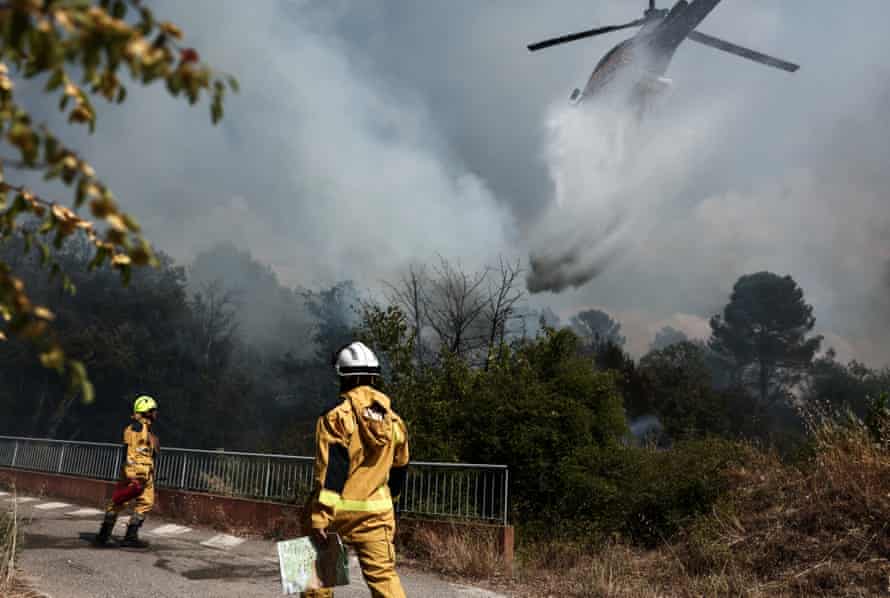
    A helicopter drops water over a burning area as a wildfire flares up again in Pontevès, south-east France.

    A second fire raging in the region, farther south near the popular holiday resort of Biscarrosse, had also burned through more than 2,500 hectares, the Landes prefect, Gilles Clavreul, said, and led to the evacuation of about 25,000 people. Clavreul stated that more than 600 firefighters were struggling to contain that blaze.

    “The fire front looks very bad. There are a great many new fire starts ahead of the main blaze. The situation is highly dynamic and unfavourable.”

    Gilles Clavreul,

    France’s Interior Minister, Laurent Nuñez, said that 32 wildfires of varying size and intensity were burning across France, with 50,000 hectares scorched already so far this year.

    Spain’s government declared its first national emergency for a wildfire as two major blazes merged into one outside Madrid and a third was on the verge of joining them, amid searing heat and tinder-dry conditions across much of southern Europe.

    Madrid’s regional leader, Isabel Diaz Ayuso, said, “This is the worst wildfire in our region’s history,” describing “an unprecedented situation: a perfect storm of extremely high temperatures and relentless winds.”

    Spain’s government declared a national emergency on Thursday evening after wildfires ⁠threatened communities near the capital and in the neighbouring province of Ávila, forcing more than 19,000 people to evacuate overnight and on Friday.

    The interior ministry said the decision was taken because of the simultaneous outbreak of several fires, adverse weather conditions and ⁠the need to mobilise extensive resources from several public administrations

    The regional government of Madrid requested assistance, describing the situation as one of “extreme gravity.” It said that at least four active fires could advance “beyond current extinguishing capacity.”

    Spain’s Prime Minister, Pedro Sánchez, chaired an emergency response meeting at the Moncloa palace this morning as the state meteorological office warned that the danger of more fires remained very high or extreme across much of the country.

    “We’re living through a dramatic situation, not just in various Spanish provinces but also in regions of neighbouring countries. Forest fires are devastating thousands of hectares and affecting numerous communities.”

    Pedro Sánchez

    He promised the government had deployed “all available resources. It will be by your side during the emergency and the recovery.” The Prime Minister also thanked “all the emergency services that are fighting day and night.”

    In an update issued today, Spain’s environment ministry said 29 big forest fires had been recorded so far in 2026, compared to an annual average of nine between January and the end of July per year over the past decade. Forest fires had burned about 114,796 hectares, compared with 25,133 by the same time last year.

    France, Spain Seek EU Help Amid Wildfires

    Both countries sought EU help. France’s President, Emmanuel Macron, said that he had activated the EU’s civil protection mechanism as the country, which has endured three almost back-to-back heatwaves since May, battled numerous wildfires mainly in the south-west and south-east.

    Macron, who described the situation as “extremely intense,” said, “We will soon be able to count ‌on reinforcements from two Croatian aircraft, two Portuguese planes, as well as two heavy helicopters from the Czech Republic and Slovakia.”

    Spain’s interior ministry has also requested fire-fighting aircraft through the EU’s civil protection mechanism, which aims to strengthen civil protection cooperation between EU countries and 10 additional participating states.

    The severity of fires in the EU has broken records for the time of year, data from the European Forest Fire Information System shows, with about twice as much land burned by 22 July than the average for that date over the past two decades.

  • Merz Announces Cabinet Reshuffle

    Merz Announces Cabinet Reshuffle

    German Chancellor Friedrich Merz has reshuffled top posts in his cabinet.

    Merz took the opportunity to make a series of changes after a senior ally quit as the leader of his bloc’s parliamentary group over personal conduct that undermined his credibility.

    Jens Spahn quit as leader of the Union’s parliamentary group, one of the most powerful positions in the coalition, after it emerged that he and his husband had used the services of a surrogate mother in the U.S. to have a baby.

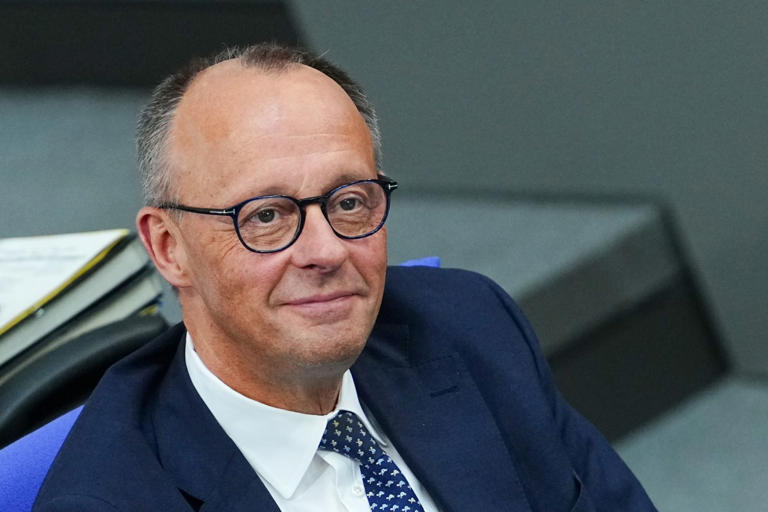
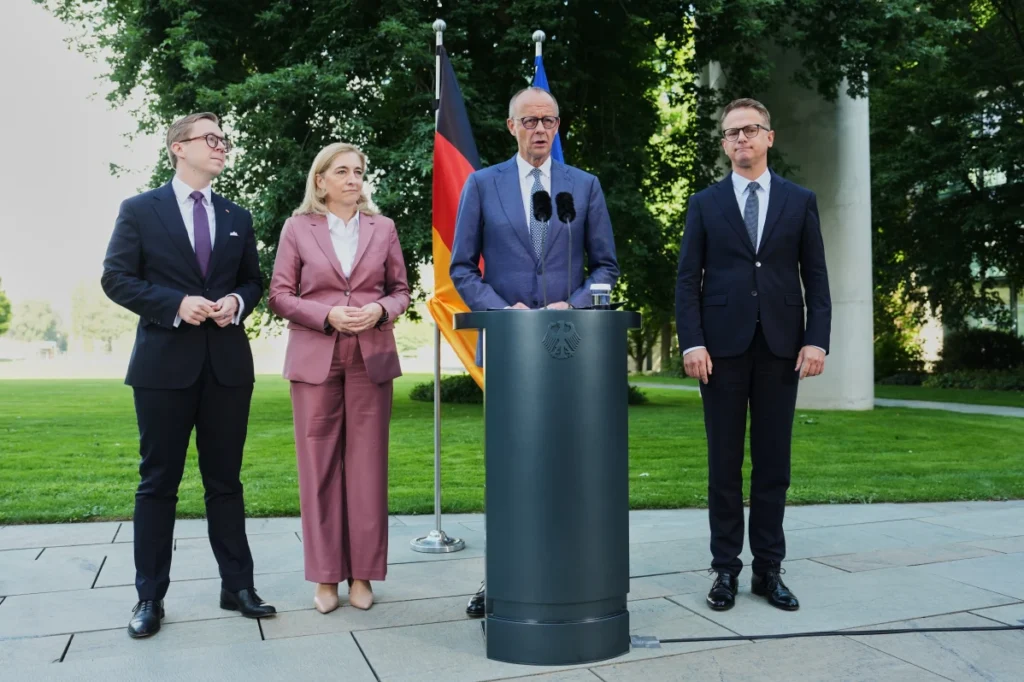
    German Chancellor Friedrich Merz announces cabinet reshuffle.

    Surrogacy isn’t allowed in Germany. Merz’s party opposes allowing it, a position that it reaffirmed at a convention in February, and Spahn himself had spoken out against it in the past. As such, his action prompted accusations of double standards.

    Merz put his chief of staff, Thorsten Frei, in Spahn’s job, a position he’s widely considered better suited to than coordinating the chancellery. Frei was the Union’s parliamentary chief whip under Merz when the center-right was in opposition.

    The German leader announced that Health Minister Nina Warken will take Frei’s place at the chancellery, a post that is key to the smooth functioning of the government. She will be the first woman to take that job. Warken takes his place at the chancellery after shepherding the first of the government’s reforms, meant to curb rising costs in the German health insurance system, through parliament earlier this month.

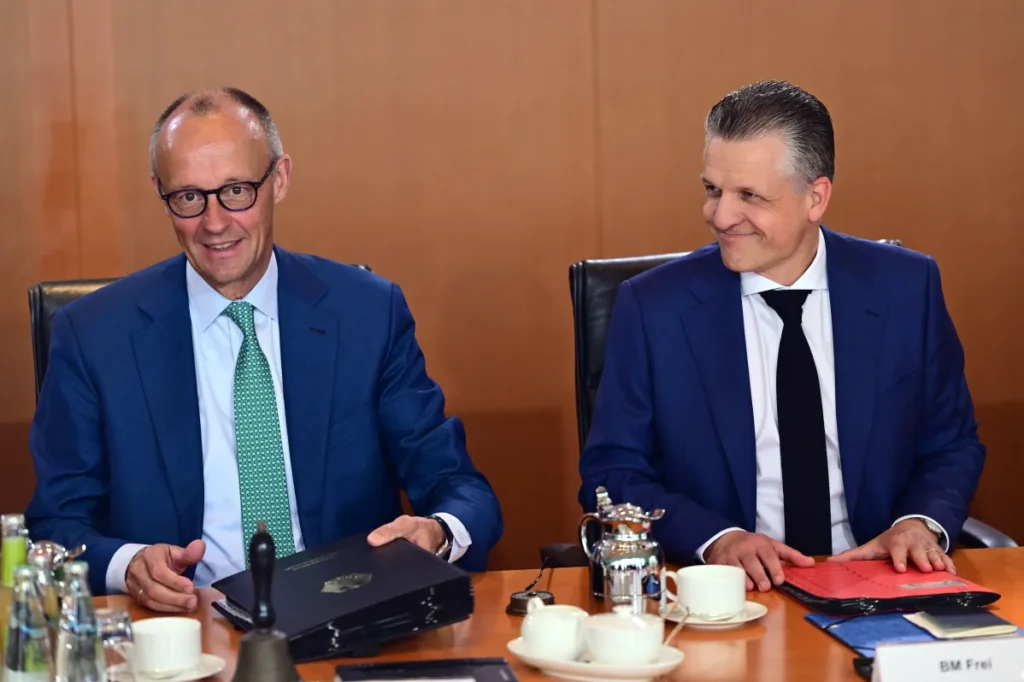
    German Chancellor Friedrich Merz and Thorsten Frei.

    Merz said that she has showed that “she can push through reforms against resistance,” praised her as a tough negotiator and said that “she is also at home with the security policy issues” that are important at the chancellery.

    Another close ally, Carsten Linnemann, the General Secretary of Merz’s Christian Democratic Union party, will become Health Minister, taking Warken’s place at the Health Ministry. Merz said that “we must maintain the course of reform” in health policy and that requires a “steadfast” Minister.

    “The personnel changes follow a clear line. We want a government that works with great vigor and pleasure and also represents the personal diversity of our society and politics. We are a reform government and want to continue showing that.”

    Frederick Merz

    Merz said that there will be further Cabinet changes, but didn’t offer details. He said those decisions will take “a few days yet, and perhaps more time.”

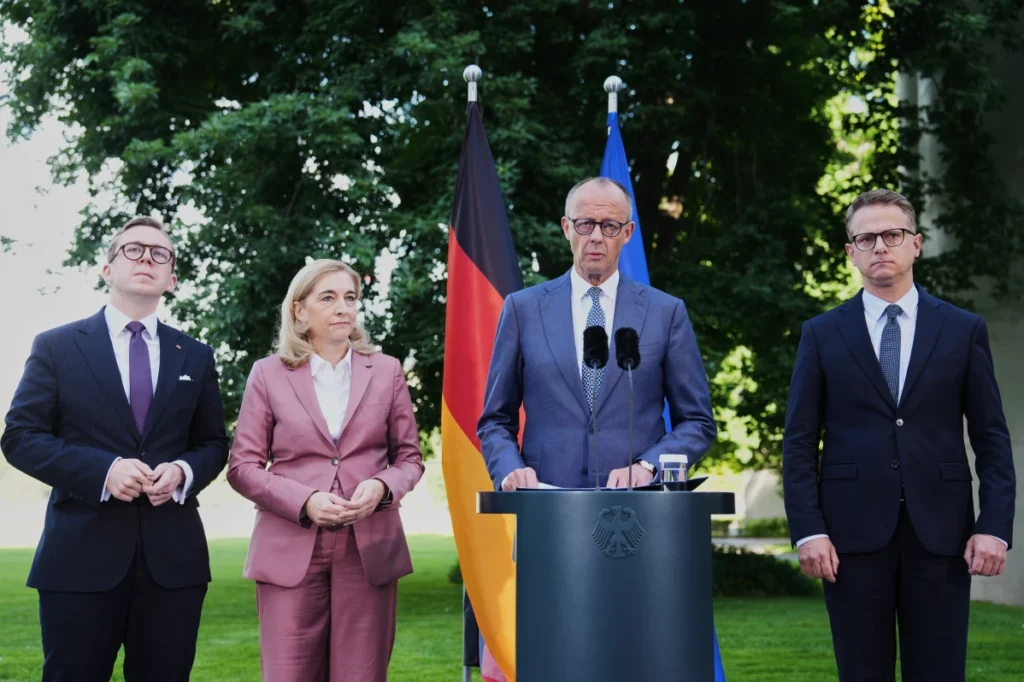
    German Chancellor Friedrich Merz announces cabinet reshuffle.

    AfD Co-leader Criticises Merz’s Cabinet Reshuffle

    AfD Co-leader Alice Weidel argued that Merz had caused “yet more chaos” with his reshuffle and said in a post on X that the government being preoccupied with itself doesn’t do justice to Germany’s “many-faceted” problems.

    She added that Germany needs new elections. The next national election isn’t due until early 2029.

    The reshuffle comes amid the German Chancellor’s efforts to boost the fortunes of his deeply unpopular government ahead of regional elections in which a far-right party could get its first state Governor.

    Merz took office less than 15 months ago with pledges to reform and turn around Germany’s economy, Europe’s biggest, after years of stagnation. However, that economic turnaround has been slow to start and the middle-of-the-road coalition of Merz’s center-right Union bloc and the center-left Social Democrats, two traditional rivals, has yet to persuade voters that it can produce results.

    That has resulted in Merz’s popularity sinking to rock-bottom levels, while the far-right Alternative for Germany, or AfD, has gained support on the back of widespread discontent.

    The governing parties face three difficult regional elections in September. In the eastern region of Saxony-Anhalt on Sept. 6, AfD is hopeful of winning a majority that would give it control of a state government for the first time. After months in which voters were turned off by squabbling in the coalition, Merz’s government recently embarked on big plans for potentially painful change — including a proposed reform of the creaking pension system that would include raising the retirement age gradually, income tax cuts for low- and middle-income earners and an effort to slash red tape.

    Alice Weidel, the co-leader of the far-right Alternative for Germany party, which placed second in national elections last year, derided the reform package. She called the measures an “even more left-wing redistribution, and minimal compromises that don’t deserve to be called ‘reforms’.”

    She added that the “fact that this is being sold as a ‘breakthrough’ shows only one thing: this government’s complete inability to reform.”

    Nonetheless, Merz appealed to all Germans to support the package.

  • EU Hits Google with Another Antitrust Fine

    EU Hits Google with Another Antitrust Fine

    The European Union has fined Google 890 million euros ($1bn), saying the technology giant broke digital antitrust rules by steering users of Google Play and its search engine towards its own services and apps at the expense of rivals.

    It comes a week after the European Union issued two new rules for Google to force it to share search data and open up its Android operating system to rival AI companies, a move it said will support innovation and diversity in the field by enabling fair access to AI features on Android devices and search engines.

    Today’s fine is the latest in Brussels’ crackdown on Big Tech, which has seen the bloc lead the world in reining in the largest firms from Silicon Valley to Beijing.

    Google had recently lost its appeal against a $4.5bn antitrust fine imposed for throttling competition and reducing consumer choice through the dominance of its mobile Android operating system.

    The fines are the biggest in total against one company under the competition law known as the Digital Markets Act (DMA), after the EU slapped penalties of 200 million and 500 million euros ($228m and $570m) against Meta and Apple respectively in 2025.

    The DMA came into effect in 2024 and seeks to rein in what the EU views as Big Tech’s excesses in a bid to ensure fair competition in the digital realm. The fines against Google have been expected for months as part of a probe that began in 2024, but Brussels has faced claims of delaying the move over fears of hurting ties with Washington.

    The EU can slap fines of up to 10 percent of a company’s total global turnover for breaching the DMA. An EU official said that the fines were worth 0.22 percent of Google’s turnover.

    The European Commission’s Executive Vice President for clean, just and competitive transition, Teresa Ribera said that it was acting in the interest of consumers.

    European Commission logo as EU To Implement ‘Trade Countermeasures’ Against US
    European Commission logo

    “The best products should succeed because they’re better, not because they’re owned by the company running the search engine. And European consumers have a right to be told by app developers where to sign up to the best offers, even when the app store owner does not get a cut.”

    Teresa Ribera

    The EU, however, appeared sanguine about any United States retaliation, with Ribera telling reporters that the EU’s duty is to “ensure that the regulation that is being adopted by our sovereign institutions is fully enforced and respected.” She said that there were similar cases in the US and American authorities were “dealing with very similar approaches.”

    European Commission Spokesperson Thomas Regnier also said that in the EU, businesses have the right to compete fairly. “Gatekeepers have the obligation to ensure a level playing field and consumers the right to choose for cheaper alternative offers,” Regnier added.

    The fines could rise further if Google fails to comply within 60 days, the commission said, threatening it with “periodic penalty payments.”

    Google Bemoans EU’s Fine

    Google’s Head of global affairs, Kent Walker, said that the company was being forced to “strip away real-time Search features Europeans love – like instant pricing and direct availability for hotels, flights, and restaurants – and dismantle safety protections on Google Play.” “This isn’t fair competition,” he added

    Google is no stranger to EU fines. Between 2017 and 2019, the EU hit the company with fines worth a total of 8.2 billion euros ($9.3bn). Brussels imposed a 2.95-billion-euro ($3.4bn) fine in a separate case under different antitrust rules in September last year, after which Trump threatened to retaliate against the EU.

    The EU and the US agreed this year to address frictions linked to the bloc’s digital rules through talks, but they have yet to begin. About 25 US lawmakers belonging to Trump’s Republican Party in a letter on Tuesday urged the president to use tools against the EU’s “discriminatory” digital rules, such as trade investigations that could lead to higher levies.

  • Rubio Reasserts US Commitment To Ending Ukraine War

    Rubio Reasserts US Commitment To Ending Ukraine War

    U.S. Secretary of State Marco Rubio has said that the Trump administration is poised to help end the war in Ukraine.

    However, he acknowledged that there is no quick path to a deal, saying diplomacy will require sustained effort and new ideas.

    This comes after Rubio held talks with his Russian counterpart Sergey Lavrov in the Philippine capital on the sidelines of an annual gathering by Foreign Ministers of the Association of Southeast Asian Nations (ASEAN).

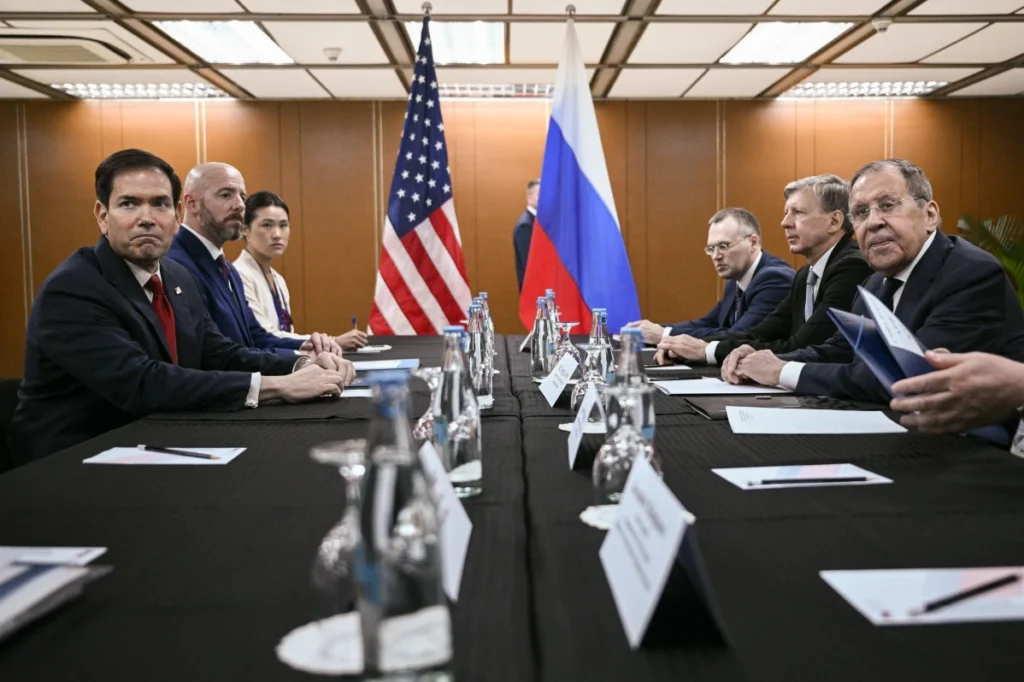
    U.S Secretary of State Marco Rubio holds talks with his Russian counterpart Sergey Lavrov in the Philippine capital on the sidelines of an annual gathering by Foreign Ministers of the Association of Southeast Asian Nations (ASEAN).

    Rubio said of his meeting with his Russian counterpart, “We had a good conversation, a frank conversation,” adding that he would not go into specifics about what was discussed.

    “The United States, the President’s been clear that … we are prepared to play a constructive role in bringing about an end to a senseless war, and we’re ready to do that.”

    Marco Rubio

    He alluded to how U.S.-mediated talks have stalled. He called them “unsuccessful or at least unfruitful” in the past but insisted that President Donald Trump was committed to the work “if conditions and factors have changed to make that possible.”

    “That’s been the challenge — an end that both sides can accept. We’ve tried and we’ll continue to try to see if we can, you know, find a middle ground that brings this about. And we’re prepared to play that role if the opportunity presents itself.”

    Marco Rubio

    However, Rubio said “we’ll have to find new suggestions and new ideas” that are acceptable to both sides. He stated that there has been no change to Washington’s military support for Ukraine, with weapons being purchased by NATO allies and transferred to the war-ravaged country.

    After meeting with Rubio, Lavrov largely ignored questions from reporters. The Russian Foreign Ministry in Moscow said that he emphasized to Rubio “the unacceptability of further arming” Ukraine and accused European countries of pursuing Russia’s “strategic defeat.”

    The Russian ministry said that Lavrov reiterated Russia’s readiness for “a political and diplomatic resolution of the conflict” and commitment to agreements reached at a summit between Russian President Vladimir Putin and U.S President Donald Trump in Alaska last year.

    U.S. efforts to broker an end to the Russia-Ukraine war have been overshadowed by the outbreak of the Iran war earlier this year. Renewed strikes by Washington and Tehran have been intensifying after an interim ceasefire deal collapsed.

    Rubio Warns Of Outsized Military Response To Iran’s Strikes

    Moreover, Rubio warned that Trump is prepared to direct an outsized military response to Iranian aggression as the two sides continue to exchange fire nearly five months into the conflict. “The price will continue to get higher every single night until they come to their senses,” Rubio said.

    He insisted that Tehran is “begging” for talks but Trump does not see the use in responding because “Iran is clearly not ready to make a deal, at least not one they’re willing to live by.”

    Trump has warned Iran that the U.S. will destroy one Iranian bridge or power plant each time Iran shoots at a ship in the Strait of Hormuz. Iranian Foreign Minister, Abbas Araghchi responded by saying that the country’s defense doctrine was an “eye for an eye.”

    In a seeming response to Araghchi’s comment, Rubio said, “The President’s policy is a head for an eye,” adding, “They will pay a very heavy price for the things they’re doing.”

    These threats follow a brief period of optimism last month that the war could soon reach a resolution after the U.S. and Iran signed a memorandum of understanding that initiated a halt in fighting and renewed peace deal talks. However, both Tehran and Washington have alleged that the other side violated the terms of this ceasefire deal and launched attacks in response.

    A rising death toll among U.S. troops and Iranian citizens has increased pressure on the Trump administration to wind down these military operations, with several Republican lawmakers expressing dissatisfaction with the way the President has handled this conflict. “There’s got to be an off-ramp, that’s all there is to it,” Senator Jim Justice told reporters on Wednesday. On Wednesday, Trump attended a dignified transfer of four American service members who were recently killed in Jordan and Iraq amid the war. Rubio told reporters on Wednesday that Tehran is “probably not ready” to make a deal but that its leaders “will be soon.”

    Rubio also admitted that there’s “always going to be a concern that America is so focused on one place that it can’t focus on another,” but he noted that the U.S. remains “engaged in Asia every single day,” citing strong partnerships and economic ties across the region.

  • Spanish Prime Minister Visits Fire-ravaged Area

    Spanish Prime Minister Visits Fire-ravaged Area

    Spanish Prime Minister, Pedro Sánchez has visited the fire-ravaged area in Guadalajara, as firefighters fought one of the country’s largest blazes on record.

    Firefighters in central Spain battled the wildfire that has burned over 32,000 hectares (79,000 acres). The fire in rural Guadalajara comes less than two weeks after a deadly blaze devastated a small expat community in southern Spain. That fire killed 13 people, including several foreigners, in one of the southern European country’s deadliest wildfires.

    Speaking in the village of Tamajón, located less than two hours by car northeast of Madrid, Sánchez called for a pact between political parties to fight climate change.

    Spanish Prime Minister Pedro Sánchez, right, arrives at Tamajón, Guadalajara province, Spain, Wednesday, July 22, 2026, after a wildfire scorched tens of thousands of hectares in one of Spain’s largest wildfires in recent years.

    “Year after year we clearly see how climate change kills and destroys wealth in our communities. This isn’t politics. It is science, it’s about facts.”

    Pedro Sánchez

    This year, Spain has already suffered 22 major forest fires, defined as a fire that burns over 500 hectares (1,235 acres.) Sánchez, the Socialist leader, disclosed that over 100,000 hectares (247,000 acres) had already been scorched through the first half of the year, matching the total yearly average for Spain over the last decade.

    Spain’s Minister for Ecological Transition, Sara Aagesen, described the Guadalajara fire as “one of the largest in the recent history of our country” and the largest ever for the region of Castilla La Mancha.

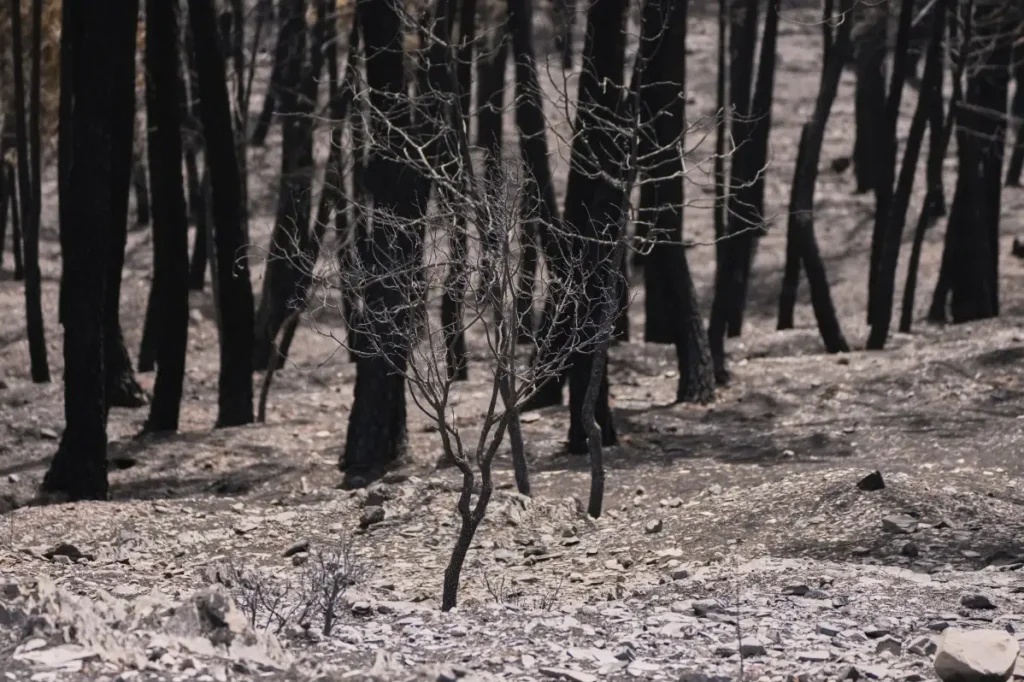
    View of the burned area in Muriel, Guadalajara province, Spain, Wednesday, July 22, 2026, after a wildfire scorched tens of thousands of hectares in one of Spain’s largest wildfires in recent years.

    According to data from the ecological transition ministry, the Guadalajara blaze is the second-largest on record in Spain’s history after some 37,000 hectares (91,000 acres) were burned last year in the northwest of the country.

    About 34 villages have been evacuated in the area but there are no reported serious injuries or deaths. Over 200 firefighters were supported by land vehicles and aircraft today.

    Regional authorities said firefighters supported by water-dumping aircraft had so far protected homes in all 40 villages in the burned area, 90% of which belongs to a national park. Emiliano García-Page, Regional President of Castilla La Mancha said that firefighters hope to have the nearly week-old fire under control by Friday.

    Wildfire Amid Heatwave

    The fire comes amid a heatwave in Spain. Spain’s weather agency said that a heat wave that began on Tuesday was expected to reach its peak between today and Thursday, with temperatures pushing 40 degrees Celsius (104 Fahrenheit) in several inland areas and crossing 42 Celsius (108 Fahrenheit) in parts of Andalusia in southern Spain. Guadalajara and large areas of Spain were under alert for high temperatures.

    Like many other European countries, Spain is experiencing extreme heat, which is combining with wind and limited rainfall to create ideal conditions for small wildfires to grow unchecked.

    In Italy, several fires burned across Sicily today, prompting scattered evacuations. For days, Italy’s Civil Protection agency has declared all of Sicily at the highest risk for wildfires. Winds and temperatures near or above 40 C (100 F) have fueled blazes from near Palermo on the northern coast to Catania in the east and now Agrigento in the west.

    Greece was also sweltering under what was forecast to be the last of a four-day heat wave. Temperatures were predicted to top 42 C (107 F), while several regions in southern and central Greece, including the wider Athens area, were on the highest alert level for wildfire danger. Cyprus, meanwhile, issued a warning for high temperatures expected to reach 43 C (109 F).

    In Britain, it hasn’t rained in more than a month in some areas, and much of the southern half of England is in a state of “prolonged dry weather,” one step before a drought. Thames Water, the country’s biggest water company, has banned its 10 million customers from using hoses to water lawns or wash cars starting Thursday.

    According to the European Union’s Copernicus Climate Change Service, Europe is the world’s fastest-warming continent, with temperatures increasing twice as quickly as the global average since the 1980s. Globally, 2025 was the third-hottest year on record, bringing severe heat waves across Europe.

    Scientists warn that climate change is exacerbating the frequency and intensity of heat and dryness especially in southeastern Europe, making the region more vulnerable to health impacts and wildfires.

  • EU’s Google Restrictions Fuel Global AI Data Battle

    EU’s Google Restrictions Fuel Global AI Data Battle

    The European Union’s latest push to curb Google’s dominance in artificial intelligence and online search is being viewed as far more than another antitrust dispute but rather, it is emerging as a defining battle over who controls the data that will shape the future of artificial intelligence.

    According to digital security and AI governance expert, Dr. Rebecca Y. Akatue, the new restrictions could redefine the global AI landscape, but it also raises complex questions about privacy, security and data ownership.

    Speaking in an interview with The Vaultz News, Dr. Akatue said that the European Commission’s new measures are about far more than competition within Europe. Instead, she described them as part of a broader global contest over who will control the data that powers the next generation of artificial intelligence. “This EU-Google case isn’t about Europe alone. It is about who will own data and AI in Africa over the next decades,” she said.

    The EU recently introduced two measures targeting Google. The first requires Google to make Android more interoperable by allowing rival AI assistants to access voice activation and perform background tasks alongside Google’s Gemini AI. The second requires Google to begin sharing anonymized search data with selected competitors by January 2027 to encourage greater competition in AI development and search services.

    European regulators argue the changes will create a more competitive digital ecosystem by reducing barriers for rival AI developers. Google, however, has warned that the rules could expose sensitive data, undermine user privacy and create national security risks if third-party systems lack adequate safeguards.

    Dr. Akatue said the dispute reflects a long-running antitrust battle that has evolved with the rapid rise of artificial intelligence. “This EU-Google case started more than 10 years ago,” she explained, adding, “The AI issue is a new case because AI is emerging and Google needs to do something about it.”

    According to her, the central issue is Google’s extensive control over search data, which has become one of the most valuable resources for training advanced AI models. “It’s all about data monopolies,” she said. “When you want to train AI, you need data, and Google has all the data,” she added. She noted that the EU believes Google’s dominance in search data has given it a significant competitive advantage, prompting regulators to require greater access for competitors.

    However, Dr. Akatue stressed that expanding access to such data is not without risk.

    “The core issue is who even owns the data. If you open the floodgate and there is no security in place, how are you going to check the privacy risk?”

    Dr. Rebecca Y. Akatue

    While acknowledging that the EU has proposed safeguards to reduce those risks, she said that concerns surrounding privacy and cybersecurity remain legitimate. To illustrate the potential dangers of opening Android’s AI ecosystem to multiple providers, Dr. Akatue pointed to the possibility of malicious or poorly governed AI systems distributing false information. She warned that without effective oversight, malicious AI systems could spread misinformation capable of triggering widespread public panic.

    At the same time, Dr. Akatue acknowledged that Google’s dominant market position has made it difficult for competitors to develop comparable AI systems.

    “If Google doesn’t agree to share data or open the AI platform to rival companies, it means it will be very difficult for others to innovate. They need this data to innovate.”

    Dr. Rebecca Y. Akatue

    Nonetheless, she asserted that her expertise leads her to prioritise the protection of individuals’ personal information and national interests.

    “I’m not against innovation, but I’m a privacy scholar. I care about sharing of data and the risks it can impose on individuals and nation states.”

    Dr. Rebecca Y. Akatue

    She described the situation as a difficult balancing act between encouraging competition and protecting sensitive data.

    “Google has monopolised the system for a very long time because they started and collected all the raw data. Now you want them to give you the data. It’s not for free—they will be paid—but Google also wants to protect its image.”

    Dr. Rebecca Y. Akatuee

    According to Dr. Akatue, Google is concerned that if competitors fail to adequately protect shared data, the resulting privacy breaches could still damage Google’s reputation.The dispute also highlights broader questions about how future AI innovation should be supported.

    She suggested that enormous investment will be required for countries and companies to develop their own data resources. “It’s not easy to build data from scratch,” she said, adding “Collecting the data and then training it into AI is a very herculean task.”

    A Signal Of Commitment To Stricter Digital Regulation

    Looking ahead, Dr. Akatue believes the EU’s actions signal a continued commitment to stricter digital regulation and stronger antitrust enforcement.

    She pointed to the bloc’s AI Act as evidence that Europe intends to play a leading role in setting global standards for AI governance.

    “EU has a very strong AI Act. Antitrust literally means fair play rules. The EU thinks Google has taken all the market, making it difficult for others.”

    Dr. Rebecca Y. Akatue

    Without greater access to data, she warned, AI integration across sectors ranging from healthcare and agriculture to public services could progress much more slowly.

    The implications extend well beyond Europe, she added, as governments and technology companies around the world closely watch the outcome. “African countries, EU countries, China—they have all taken positions,” Dr. Akatue said. “Some are waiting to see,” she added.

    She noted that countries including Nigeria, India and Brazil have begun developing their own positions on AI governance, while major technology companies are also weighing the implications of the EU’s approach.

    Even companies that compete directly with Google share some of its concerns, she observed. “Apple is supporting Google’s stand with the privacy and data-sharing risks,” she said.

    “As soon as you open the market in the EU, interested parties elsewhere will also ask for access. That is the impasse between Google and the EU.”

    Dr. Rebecca Y. Akatue

    For Dr. Akatue, the outcome of the EU-Google dispute will likely influence global discussions on cross-border data flows, AI governance and digital competition for years to come.

  • Fidesz Party’s Data Center Raided In Embezzlement Probe

    Fidesz Party’s Data Center Raided In Embezzlement Probe

    Offices housing data servers used by former Prime Minister Viktor Orbán’s Fidesz party have been raided by prosecutors and investigators with Hungary’s tax authority.

    According to Marianna Bodó, a Spokesperson for the Bács-Kiskun County chief prosecutor’s office, the raid is part of a probe into suspected embezzlement and other crimes.

    The Spokesperson disclosed in an email that the raid was part of an investigation into the suspected misuse of grant money through Hungary’s National Cultural Fund while Orbán’s government was in office. The county lies south of the capital, Budapest.

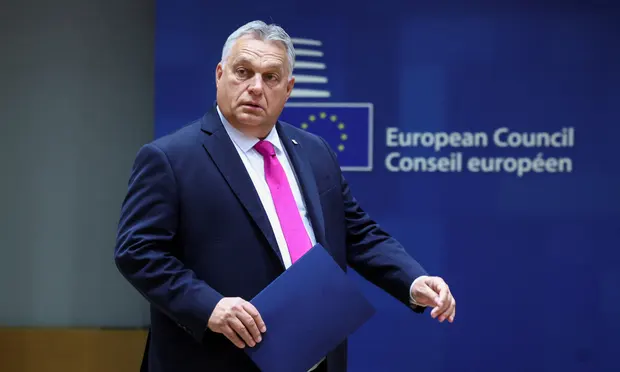
    Victor Orban
    Hungarian Prime Minister, Viktor Orban.

    Six current and former officials have been charged in connection with the misuse of some 17 billion forints ($53.5 million) through the fund. They have denied wrongdoing. The officials have been accused of distributing the money in an opaque manner to artists and performers linked to Fidesz. Some of them actively campaigned for the party leading up April’s national election.

    Bodó noted that a regional criminal directorate of the National Tax and Customs Administration assisted in the raid, adding that no further information could be provided “in the interests of the investigation.”

    Orbán and Fidesz governed Hungary for 16 years until their blowout election loss in April. While in office, they were routinely accused of overseeing unchecked corruption, seizing control of Hungary’s institutions and undermining democracy and the rule of law.

    After taking office in May, Prime Minister Péter Magyar has taken action to dismantle what he calls Orbán’s “mafia” by removing numerous political appointees — including the President — and Heads of institutions viewed as having facilitated Orbán’s autocratic government.

    Since ending Orban’s hardline 16-year-long rule, Magyar’s new pro-European conservative government has rushed to loosen the self-styled “illiberal” leader’s lingering grip on the central European country.

    Magyar has also vowed to pursue figures who enabled corruption, which watchdogs believe became endemic under his predecessor, and recover public assets from those who “illegally acquired” them

    Since their election defeat, Fidesz has accused Magyar and Tisza of “tyranny” in their steps to dismantle Orbán’s political and economic system. Tisza argues that it is using its overwhelming electoral mandate to fulfill campaign promises.

    Separately, Hungary’s government announced an investigation yesterday into a large foreign investment by Chinese automaker BYD negotiated by a former Foreign Minister Péter Szijjártó who last week resigned from Parliament to take an executive position at the company.

    Hungary's Minister of Foreign Affairs and Trade, Peter Szijjarto.
    Hungary’s former Minister of Foreign Affairs and Trade, Peter Szijjarto.

    Szijjártó noted in the announcement made last Wednesday that he would take the job at the world’s top electric carmaker prompted accusations of a conflict of interest and criticism over his role in facilitating substantial government subsidies to the company while in office.

    Magyar told lawmakers that Szijjártó, a close ally of former Prime Minister Viktor Orbán, had helped BYD while he was in office “with hundreds of billions (of forints) in public money, diplomatic support and state infrastructure.” “We will examine all the decisions, negotiations and state commitments made by Péter Szijjártó that were related to the BYD Hungary investment,” Magyar said.

    He added that the investigation would look into all subsidies, tax breaks, permits, environmental exemptions and publicly-funded investments given to large multinational firms during Orbán’s tenure.

    “We will investigate who made these decisions, who prepared them, what professional warnings were ignored, and how much burden they left on Hungarian taxpayers, workers, local communities and the environment.”

    Péter Magyar

    Neither Szijjártó nor BYD have responded to Magyar’s allegations of conflict of interest while Szijjártó was in office. The former Foreign Minister has posed his new job as a “prestigious” opportunity to work for one the “greatest success stories” in the automotive industry.

    Fidesz Criticises Raid

    Fidesz accused the governing Tisza party, led by pro-European Prime Minister Péter Magyar, of seeking to use legal means to destroy its offices housing data servers.

    Fidesz said in a statement on Facebook that investigators had launched the raid “without prior notice” and “with the intention of seizing the party’s entire communications system and databases.” “There has been no precedent for this in Hungary since the end of Communism in 1990!” Fidesz asserted.

    Meanwhile, Magyar noted on Facebook on that he was awaiting further information on the raid from prosecutors.

  • AliExpress Fined €550m By EU

    AliExpress Fined €550m By EU

    The European Commission has fined Chinese online retail platform AliExpress 550 million euros ($629 million) for failing to stop the sale of unsafe and counterfeit products on its site.

    The fine, the biggest ever imposed for breaches of the 27-nation European Union’s Digital Services Act, comes just months after another online retailer, Temu, was fined 200 million euros for similar breaches. Last year, Brussels issued a $120 million penalty for Elon Musk’s social media site X.

    The Digital Services Act is designed to keep users safe online and stop the spread of harmful content that’s either illegal or violates a platform’s terms of service, such as promotion of genocide or anorexia. It also looks to protect Europeans’ fundamental rights like privacy and free speech.

    The newly imposed fine on AliExpress was for conduct by the company until at least June 2025, when the commission issued a preliminary ruling that found AliExpress was not doing enough to tackle the sale of illegal products under the DSA, and when it accepted commitments by AliExpress to improve its systems. The commission said that that AliExpress now has until Oct. 20 to submit an action plan setting out measures to “remedy the breach of its obligations to assess and mitigate systemic risks.”

    The European Commission found that AliExpress did not have enough staff to assess the legality of products, sometimes giving them just “tens of seconds” to judge whether a product met EU standards.It also found many illegal products were being promoted under AliExpress’ recommendation systems and that the company’s internal risk assessments failed. “Many illegal products, from counterfeit products to unsafe toys and dangerous cosmetics, circulated on the platform and, even if detected, remained online for multiple weeks,” the commission said.

    European Commission logo as EU To Implement ‘Trade Countermeasures’ Against US
    European Commission logo.

    Henna Virkkunen, the Commission’s Executive Vice President for tech sovereignty, security and democracy, said in a statement, “The spread of counterfeit counterfeit clothing, unsafe toys, dangerous cosmetics and other illegal and harmful products is not an unavoidable cost of shopping online — it is a failure by AliExpress to comply with its obligations under the Digital Services Act.”

    “Scale is not an excuse; risks must be identified and addressed systematically to ensure consumers can safely shop online. Today, we are holding AliExpress to this standard and request it to take action.”

    Henna Virkkunen

    While the fine was much larger than those previously issued under the DSA to Temu (€200m) and X (€120m), it represented less than 1% of the €122bn that AliExpress’s parent company, Alibaba, generated in revenue last year. It could have been fined a maximum of 6% of global annual revenue.

    Temu was fined in May for failing to stop the sale of illegal and dangerous products, while X was fined for breaches including what the EU said was a “deceptive” blue tick verification badge given to users and the lack of transparency of the platform’s advertising. Temu is still under EU investigation on other issues and may yet face another fine.

    Previous investigations by the EU of a sample of products sold on large retail platforms including Shein found that 65% of cosmetics, 63% of food supplements and 60% of personal protection equipment, such as hard hats and steel toe cap boots for building sites, were non-compliant.

    Officials asserted that the fine was not a result of the discovery of illegal products on AliExpress but its failure to put in place barriers or mitigations that would have protected consumers from “illegal, non-compliant and counterfeit goods” which is illegal under EU law.

    The European Commission said that after an investigation process lasting more than two years, the company was given the opportunity to rectify its compliance and risk procedures but failed to do so.

    AliExpress Criticises EU Fine

    AliExpress condemned the fine as “disproportionate.”

    “We disagree with today’s decision and the disproportionate fine, which ‌does not adequately reflect our established framework and the significant, proactive enhancements we ⁠have made. We are carefully reviewing the ‌decision and considering all available options.”

    AliExpress

    AliExpress is the largest online retail operator in the EU with 193 million users, making it significantly bigger than Shein with 156 million and Temu with 130 million.

    Today’s announcement in Brussels also comes less than three weeks after AliExpress’ operator, Chinese tech giant Alibaba, said it will pay $600 million to resolve a dispute with the U.S. government over allegations that the Hangzhou-based firm sold and imported illegal pharmaceuticals, controlled substances, regulated chemicals and pill-making equipment into the U.S.

  • Germany Agrees To Nuclear Cooperation With France

    Germany Agrees To Nuclear Cooperation With France

    Germany’s Chancellor Friedrich Merz and French President Emmanuel Macron have announced that the German military would participate in a nuclear exercise under a French initiative to deepen European nuclear cooperation.

    The move by both countries to deepen nuclear cooperation underscores growing European defense self-reliance amid concerns about the future of U.S. security commitments to the continent.

    Chancellor Friedrich Merz announced after talks with French President Emmanuel Macron at Norvenich air base near Cologne in western Germany, “We will have German conventional forces participate in a nuclear exercise conducted by the French armed forces before the end of this year.”

    France To Vote on Legalising Assisted Dying
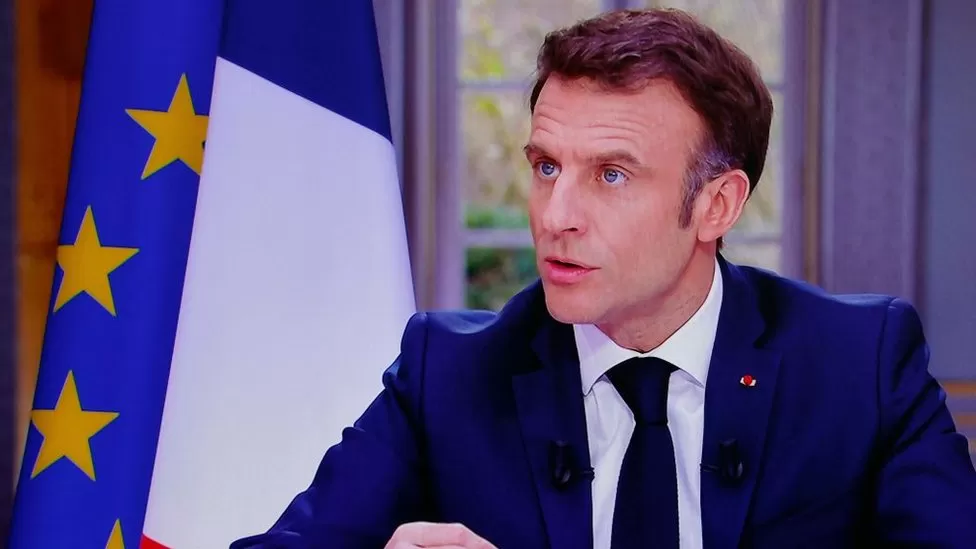
    Emmanuel Macron, President of France.

    He said that the cooperation with France “complements” the NATO nuclear sharing agreement, to which Germany remains committed. U.S. nuclear bombs are stationed in Germany as part of NATO’s nuclear deterrent, and German fighter jets have been certified to potentially carry the weapons in case of an emergency.

    Previous German leaders have refused offers of nuclear cooperation with France, Merz said, but “the world we live in today requires new answers.”

    He added that Germany’s participation in the nuclear exercise will be with conventional means for now. “We are proceeding step by step, it may be that this will result in a new doctrine, but it is far too early to say that today,” he said.

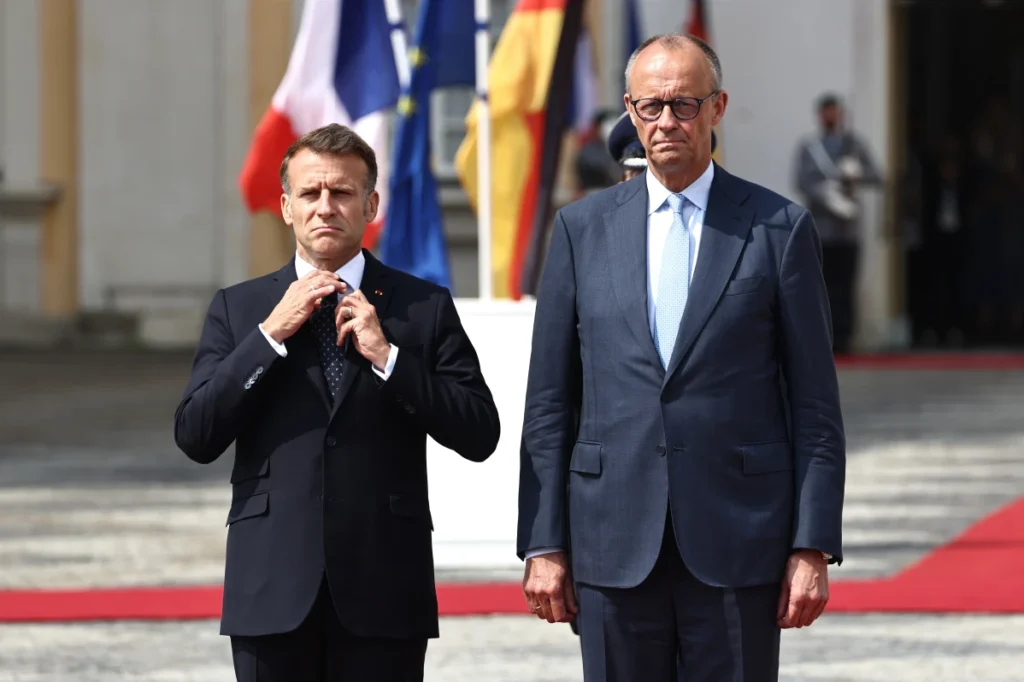
    French President Emmanuel Macron and German Chancellor Friedrich Merz.

    Yesterday, French Rafale and German Eurofighter jets participated in a joint in-flight refueling exercise, a symbolic kickoff to the cooperation. The Rafale jets are designed to deliver nuclear weapons.

    In early March, Macron announced that his country would increase its nuclear arsenal, and he invited European partners to strengthen cooperation on nuclear deterrence. France’s initiative came amid doubts across Europe about U.S. reliability when it comes to the continent’s defense.

    France has been the only nuclear power in the 27-nation European Union since Brexit. Several countries announced their interest in the French initiative, including the United Kingdom, Germany, Poland, the Netherlands, Belgium, Greece, Sweden, Denmark and Norway.

    The participation of Germany, which is implementing a major rearmament plan to build Europe’s strongest conventional military by 2039, boosts the program.The German and French leaders also sought to reinvigorate bilateral ties after a planned $100 billion joint fighter jet program collapsed in June. The project had aimed to replace Rafales and Eurofighters used by Germany and Spain by 2040.

    Macron Lauds Initiative

    On his part, French President Emmanuel Macron said that advanced deterrence is very important for European collective security, “because it creates strategic doubt among our adversaries.”

    The French President said that Germany would have a “vanguard role” in deterrence efforts and that “diluting the presence of the nuclear deterrent” is what confuses enemies.

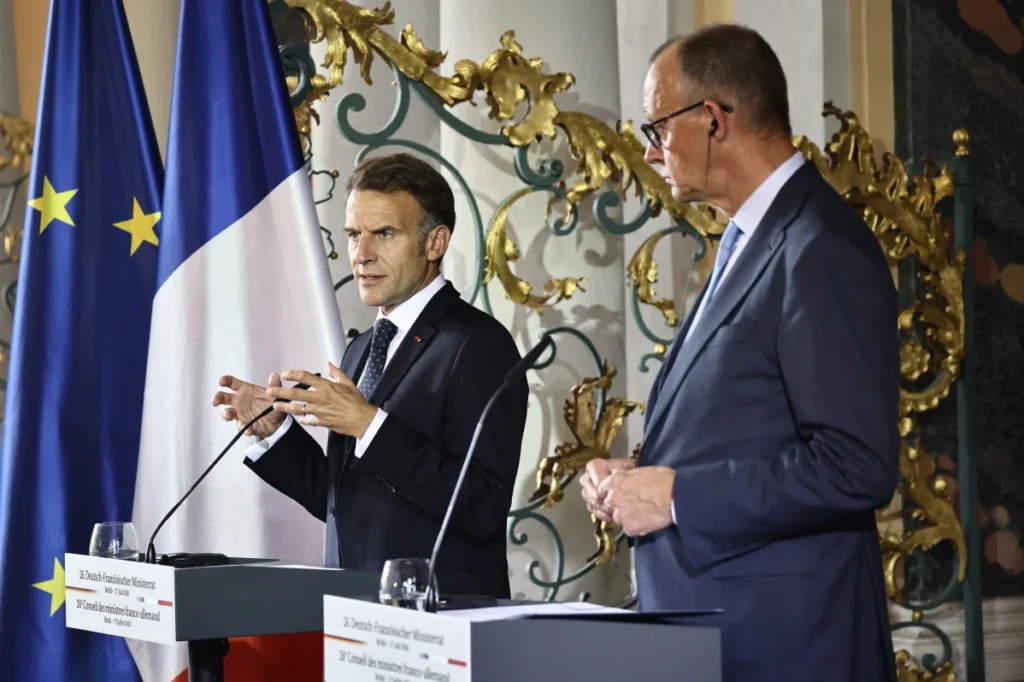
    French President Emmanuel Macron and German Chancellor Friedrich Merz.

    Macron said that cooperation would translate into “explaining some aspects of how we operate, sharing certain closely held practices, offering joint exercises, developing joint initiatives and partnerships, and fostering greater … trust among our teams, experts and military personnel.”

    He noted that complete and absolute transparency is “not necessarily the most effective strategy when dealing with adversaries on European soil.” He added that enhanced nuclear deterrence won’t involve financing from Germany.

    The two leaders are eager to lock in advances over the coming months, as Macron approaches the end of his presidency, and uncertainty grows over whether his successor will share his commitment to deeper European cooperation.

  • EU Issues Two New Rules For Google

    EU Issues Two New Rules For Google

    The European Union has issued two new rules for Google to force it to share search data and open up its Android operating system to rival AI companies.

    In its latest move, the EU said that it will support innovation and diversity in the field by enabling fair access to AI features on Android devices and search engines.

    In issuing the two new rules, the commission stated that it found that AI agents not made by Google were unable to function on Android phones at the same level as Google’s Gemini. Google must now allow voice-activation of these alternative AI agents and enable them to run background tasks like booking restaurants via third-party apps.

    By January 2027, Google must also begin sharing anonymized search data with some rivals. The commission said that the move is meant to level the playing field since Google controls a vast trove of user data that no competitor can match.

    The measure is the latest advancement of Brussels’ growing rules and regulations that have given the 27-nation bloc a global leadership position in checking the power of tech juggernauts or “gatekeepers” like TikTok, which are largely based in China and the U.S. Recently, Brussels has pushed through efforts to ensure Google gives access to Gemini AI services to rival AI companies and search engines; forced Apple to add interoperability features to its devices to connect to non-Apple products; and demanded Meta dismantle “key addictive features” like infinite scrolling.

    Early this month, judges at the European Union’s top court dismissed an appeal by Google over a landmark, 4.1 billion euro ($4.5 billion) antitrust fine imposed for throttling competition and reducing consumer choice through the dominance of its mobile Android operating system.

    The case has been tangled up in courts since the European Commission announced the fine in 2018. However, the European Court of Justice dismissal marked the end of that process. “The appeal brought by Google and its parent company Alphabet against the judgment of the General Court is dismissed, thereby confirming the penalty imposed for Google Search’s abuse of a dominant position in the context of the Android operating system,” the Luxembourg-based judges wrote in their ruling.

    Google previously argued free and open-source Android has resulted in low-cost phones and driven competition with its chief rival, Apple. Android is the most popular mobile operating system, beating even Apple’s iOS.

    The fine is one of three antitrust penalties totaling more than $8 billion that the European Commission slapped on Google between 2017 and 2019, putting the 27-nation bloc at the forefront of the global push to rein in tech giants.

    Since then, the commission has widened its crackdown on digital giants with more antitrust investigations targeting Amazon, Apple and Facebook and sweeping new rules aimed at clamping down on the biggest digital companies.

    EU Official Hails New Rules For Google

    Henna Virkkunen, an Executive Vice President at the European Commission overseeing tech, welcomed the new rules, saying, “Thanks to these measures, we hope to see emerging alternatives to Google Search and Google’s AI services, such as Gemini, and that users in the EU can enjoy greater choice of services.”

    However, Kent Walker, President of global affairs for both Google and its parent company Alphabet, said that the new rules could backfire by removing safeguards that the company had built to protect user privacy like the vetting of third-party AI assistants.

    “Europeans’ private searches would be exposed to unfamiliar companies, without adequate anonymization of the data and without user knowledge or consent. This would weaken citizens’ privacy, risk business trade secrets, and endanger national security.”

    Kent Walker

    Google Likely To Be Held Liable For Commercial Partners’ Content On YouTube

    Also today, the European Court of Justice ruled that Google may be held legally liable for content on Youtube when it is made by a commercial partner.

    The case follows Google decision to challenge a €750,000 fine imposed by an Italian court in 2022 in relation to content that promoted online gambling, in breach of Italian law. The administrative court in Italy had ordered Google to remove the videos from the YouTube which the US tech firm owns.

    The ECJ found that the legal premise for the fine did fall within EU law on electronic commerce. In addition, it rejected arguments Google could be exempt from regulations concerning content in this case because the YouTube video did not arrive on the platform through “automated and passive activity excluding any knowledge or control over the information which is transmitted or stored.”

    “That is not the case where an operator reviews, for the purpose of concluding a commercial partnership contract, the main theme of a video channel, that channel’s most viewed videos or newest videos and the associated metadata. The operator thus acquires specific knowledge of the essential content of a set of videos and cannot therefore claim to act as an intermediary service provider.”

    ECJ judges