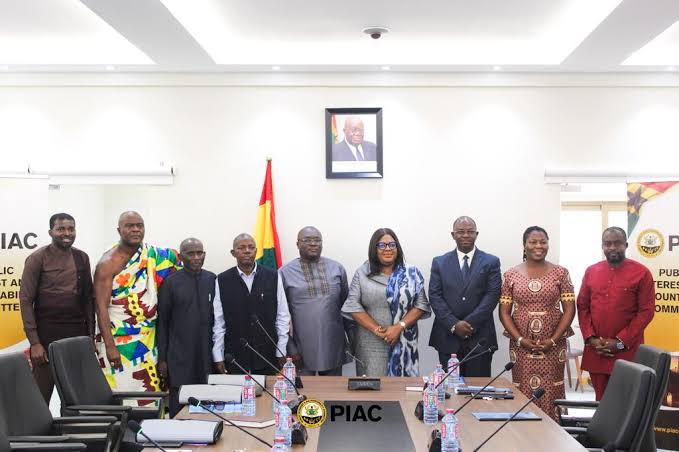
Ghana’s petroleum revenue collections increased sharply in the first half of 2026, but the latest report from the Public Interest and Accountability Committee (PIAC) raises questions about whether the information needed to scrutinise the use of those revenues is keeping pace with the money flowing through the system.
The Committee’s 2026 Semi-Annual Report records US$561.41 million in petroleum receipts between January and June, a 52 per cent increase from the US$370.34 million recorded during the same period in 2025.
Yet the report also identifies outstanding surface rental liabilities, information gaps affecting oversight and the absence of data needed to complete its assessment of the utilisation of the Annual Budget Funding Amount (ABFA).
These issues expose a distinction at the centre of petroleum revenue governance: collecting and allocating public revenue is only part of accountability.
Effective oversight also requires timely disclosure, a clear account of expenditure and the ability to establish whether the money has been used for its authorised purpose.
PIAC states that it was unable to include findings and recommendations on ABFA and Ghana National Petroleum Corporation (GNPC) allocation utilisation because relevant information had not been received by the time the report was finalised.
Although the report presents validated figures on GNPC receipts and expenditure, the limitation means readers should not assume that it provides a complete assessment of how all petroleum revenue allocations were used.
The Committee’s report states:
“The Semi-Annual Report does not contain findings and recommendations on the utilisation of the ABFA or GNPC allocations because the relevant information was not received at the time of finalising the report.”
The qualification is important. The absence of findings is not, by itself, evidence that funds were misused. It does, however, identify a gap in the information available for independent scrutiny and limits the conclusions that can be drawn about expenditure.
Missing ABFA Data Weakens Public Scrutiny
PIAC says it requested petroleum revenue allocation and utilisation information from the Ministry of Finance in July 2026. The Ministry supplied allocation data but did not provide the ABFA expenditure component required for the Committee’s review.
The report says PIAC followed up through several official and unofficial reminders. On 14 September 2026, the Committee invited the Ministry to a meeting to validate the draft semi-annual report and again requested ABFA utilisation data for January to June. According to PIAC, the request was not honoured, and the Ministry was not represented at the meeting.
The Committee consequently proceeded to publish the report without the missing expenditure information, expressing the expectation that the Ministry would provide the data for analysis in its 2026 Annual Report.
The significance goes beyond an incomplete chapter. Without timely expenditure information, the public cannot readily compare the amount allocated with the amount spent, examine the purposes for which the funds were used or assess whether spending aligns with the priorities set under the petroleum revenue management framework.
The issue also affects Parliament and other accountability institutions that depend on complete reporting to evaluate the management of public resources.
Transparency is not secured simply because allocation figures are published; expenditure information must be available in a form that permits meaningful scrutiny.
PIAC’s position is therefore a call for more complete reporting, not a finding of wrongdoing. The practical test is whether the outstanding data are provided, assessed and incorporated into the Committee’s subsequent reporting.
GNPC Receives US$85.98 Million as Scrutiny Remains Essential
GNPC received US$85.98 million in petroleum revenue allocations during the first half of 2026, up from US$65.26 million in the corresponding period of 2025. The increase was approximately 31.75 per cent.
The report identifies the allocation as relating to the Jubilee and TEN fields, with no receipts from SGN. Including cash brought forward, the amount available for spending was approximately US$89.07 million.
The report’s breakdown shows that GNPC received US$63.14 million in Level A equity financing and US$22.83 million in Level B operational funding.
These categories serve different purposes. Level A supports the State’s equity financing obligations in upstream petroleum projects, while Level B supports GNPC’s operational and investment activities.
The expenditure table records approximately US$23.45 million for Jubilee equity financing and US$23 million for TEN equity financing. It also lists staff costs of about US$11.06 million, capital projects of US$9.74 million, general operational expenditure of US$3.75 million and other spending categories.
These figures provide useful visibility into the scale and composition of GNPC’s expenditure. They also underline why public reporting needs to go beyond aggregate totals.
Equity financing, operational costs and capital expenditure serve different purposes and should be assessed against their respective funding conditions and expected outcomes.
The report does not justify a conclusion that the listed expenditure was unlawful. Instead, the accountability question is whether reporting is sufficiently complete and timely to allow the public and oversight institutions to evaluate spending against the rules governing each allocation.
That distinction is particularly important for a national oil company expected to support upstream investment while progressively strengthening its operational capacity and financial sustainability.
Outstanding Surface Rentals Leave Revenue Uncollected
A separate concern is the continued existence of unpaid surface rental liabilities. PIAC reports that arrears stood at approximately US$2.41 million at the end of June 2026, excluding a further US$1.73 million owed under terminated petroleum agreements.
Surface rentals are payments associated with petroleum contract areas. Outstanding liabilities therefore represent revenue that has not been collected despite the existence of contractual obligations.
The amounts are not proof that every outstanding balance is irrecoverable, but they show that revenue assurance requires more than assessing and recording what companies owe.
The report acknowledges efforts by the Ghana Revenue Authority to recover outstanding liabilities. Nevertheless, the remaining balances indicate that collection and enforcement still require attention.
PIAC recommends that the relevant authorities strengthen recovery efforts and ensure that arrears are addressed in decisions concerning contract renewals, renegotiations or the reallocation of petroleum areas. Such measures would connect enforcement with the future commercial opportunities available to operators.
The policy objective is straightforward: contractual payment obligations should be enforceable, and outstanding balances should not be allowed to remain peripheral to decisions that determine continued access to petroleum acreage.
Accountability Must Cover the Entire Revenue Chain
The report’s findings point to several different stages at which oversight matters: the collection of revenue, the allocation of funds, the recording of expenditure and the recovery of unpaid liabilities. Weakness at any one stage can limit the public value obtained from petroleum resources.
PIAC’s wider assessment emphasises that effective oversight depends on complete, timely and reliable information. Where data are missing, independent scrutiny becomes less comprehensive and it becomes harder to assess whether petroleum wealth is being managed in line with the country’s development objectives.
The Committee’s report also makes clear that the absence of information should not be confused with proof of misconduct.
That restraint is essential, but it does not reduce the importance of obtaining the missing records. Rather, it identifies the information required before firm conclusions can be reached.
The next step is for the Ministry of Finance to provide the outstanding ABFA utilisation data and for the relevant institutions to ensure that future reporting deadlines are met.
GNPC expenditure should remain open to scrutiny within the distinct rules governing its funding categories, while the recovery of surface rental arrears requires sustained enforcement.
Ghana’s petroleum revenue rebound has strengthened the immediate fiscal position. But public confidence depends not only on how much the country collects.
It also depends on whether the institutions responsible for managing that income can provide a complete account of where it goes, what it finances and whether outstanding obligations are recovered.
Without that information, the country may know how much petroleum revenue has entered the system while still lacking a complete picture of how effectively that resource is being used.