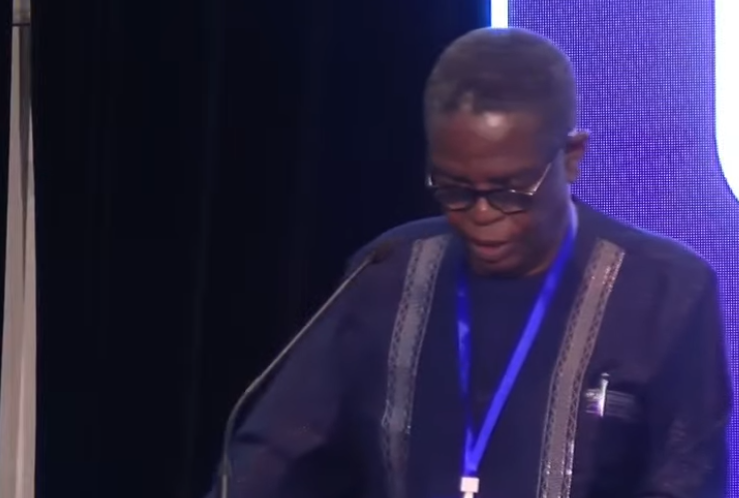
The Managing Editor of Insight Newspaper, Kwesi Pratt Jnr, has urged journalists to recognise the historical responsibility of the media as Ghana marks the 77th anniversary of the Ghana Journalists Association. Speaking at the GJA 77th Symposium and Lecture, he argued that journalism has always played a significant role in shaping the country’s political consciousness and public life.
Mr Pratt Jnr traced the origins of the association to August 15, 1949, when the Africa Press Association emerged as an indigenous alternative to the colonial press. He noted that journalists such as Osagyefo Dr Kwame Nkrumah were among the nationalist figures who understood the influence of journalism in mobilising citizens and shaping political thought.

Discussing the history of the profession, the Managing Editor explained that journalism developed during a period when Ghanaian society was debating political authority, national identity and the right of citizens to participate in determining the country’s future. Therefore, he urged journalists to view the profession as part of Ghana’s democratic development and not simply as a platform for recounting events.
According to Mr Pratt Jnr, the history of journalism demonstrates that the press has consistently operated within important political and social transformations. He added that the GJA anniversary therefore provided an opportunity for journalists to examine the direction of the profession and the responsibilities that accompany its influence.
Referencing the association’s long history, he urged the current generation of journalists to treat its legacy as an obligation that requires continuous renewal. The Managing Editor explained that inheriting the achievements of earlier journalists should lead to fresh efforts to strengthen the profession and improve its contribution to public life.
“A legacy is not something we inherit merely to admire. It is something we inherit to extend.”
Kwesi Pratt Jnr
The call for renewal also placed emphasis on the changing nature of the media environment. Ghana’s media landscape has moved from a system dominated by newspapers to one involving radio, television, online platforms, social media and emerging technologies such as artificial intelligence.
This transformation has created new opportunities for citizens to access and share information. At the same time, the expansion of publishing platforms has increased the responsibility of professional journalists to verify information before placing it before the public.
The Managing Editor linked the evolution of journalism to the constitutional framework governing the media. He pointed to the 1992 Constitution’s guarantees on media freedom and independence while drawing attention to the responsibility assigned to the media to promote accountability in governance.
In his view, the constitutional provision establishes a balance between freedom and responsibility. Press freedom gives journalists the space to investigate and publish while professional responsibility requires accuracy, fairness and respect for evidence.
Digital Media Raises New Test For Journalism And Public Trust
The rapid expansion of digital platforms has created a new challenge for journalism by increasing the volume of information available to the public. Mr Pratt Jnr argued that the central task for journalists now extends beyond finding information to establishing what can be verified and trusted.
Addressing the changing media environment, he observed that social media allows virtually anyone to publish information to a large audience. Consequently, professional journalism faces greater pressure to distinguish verified facts from claims that circulate rapidly across digital platforms.
The Managing Editor noted that the abundance of information does not automatically translate into greater public knowledge. In his view, journalism retains a distinctive role because trained practitioners are expected to investigate claims, establish evidence and provide context before information reaches the public.
Moreover, he linked the changing media environment to the question of public trust. Mr Pratt Jnr argued that journalists cannot demand trust from citizens because credibility must be earned through consistent accuracy, verification and fairness.
The discipline of journalism, he explained, requires practitioners to separate allegations from established facts. It also requires the courage to investigate powerful individuals and institutions while giving adequate consideration to people who lack direct access to influence.
This responsibility becomes particularly important when unverified information attracts significant public attention. Mr Pratt Jnr urged journalists to resist the temptation to publish material simply because it can generate immediate interest or widespread engagement.
The challenge also extends to the relationship between journalism and political influence. From his perspective, the media has a duty to scrutinise power while recognising that media organisations themselves operate within economic and institutional structures that can shape editorial decisions.
Questions surrounding ownership and financing therefore form an important part of the discussion about media independence. Consideration must also be given to who determines editorial priorities and the extent to which financial relationships can influence the working environment of journalists.
Furthermore, the Managing Editor drew attention to the pressures created by media ownership and commercial interests. Such pressures can affect the ability of newsrooms to pursue stories that require extensive investigation or challenge influential interests.
The issue of journalism’s relationship with power therefore remains central to the profession’s future. Mr Pratt Jnr urged practitioners to preserve the independence required to examine decisions made by governments, businesses and other institutions that exercise influence over public affairs.
The constitutional protection of media freedom, he noted, provides an important foundation for this work. That protection also carries a responsibility for journalists to use their freedom in ways that strengthen public accountability and democratic participation.
READ ALSO: Akuapem South Tightens Building Rules To Protect Green Zones