

The Chairperson of the African Union Advisory Board Against Corruption, Honourable Kwami Edem Senanu, has proposed a five-question framework for measuring the African Union’s actual performance, arguing that continental institutions should be judged by a chain of results rather than by the number of treaties ratified or meetings convened.
Mr Senanu unveiled the framework during his address at SYPALA 2026, telling participants at the Students and Young Professionals African Liberty Academy that a credible measurement system for the AU needs to trace a single thread from initial commitment through to what citizens actually experience on the ground.
Five Questions, One Chain of Results
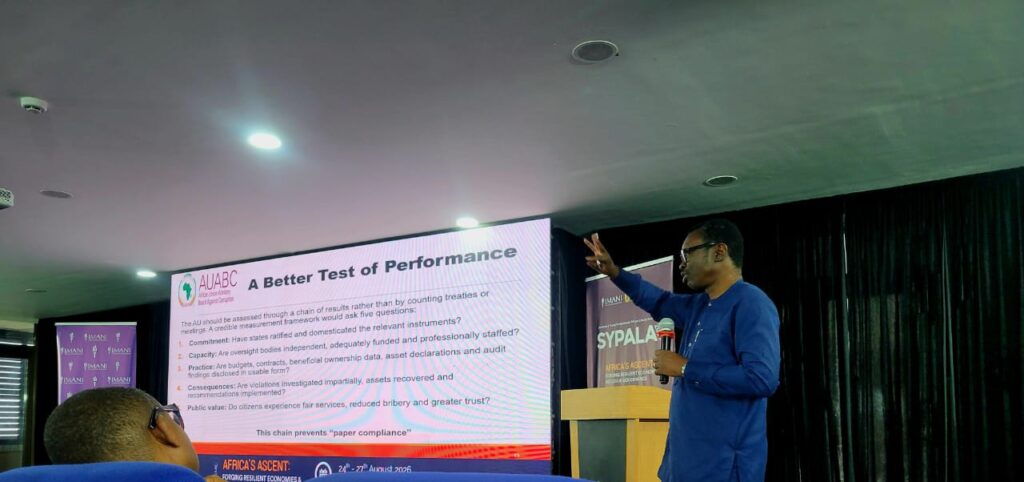
Mr Senanu set out the framework as a sequence rather than a checklist, arguing that each question only matters in relation to the ones before it. The first, which he termed commitment, asks whether states have ratified and domesticated the relevant AU instruments.
The second, capacity, asks whether the oversight bodies responsible for enforcement are independent, adequately funded and professionally staffed.
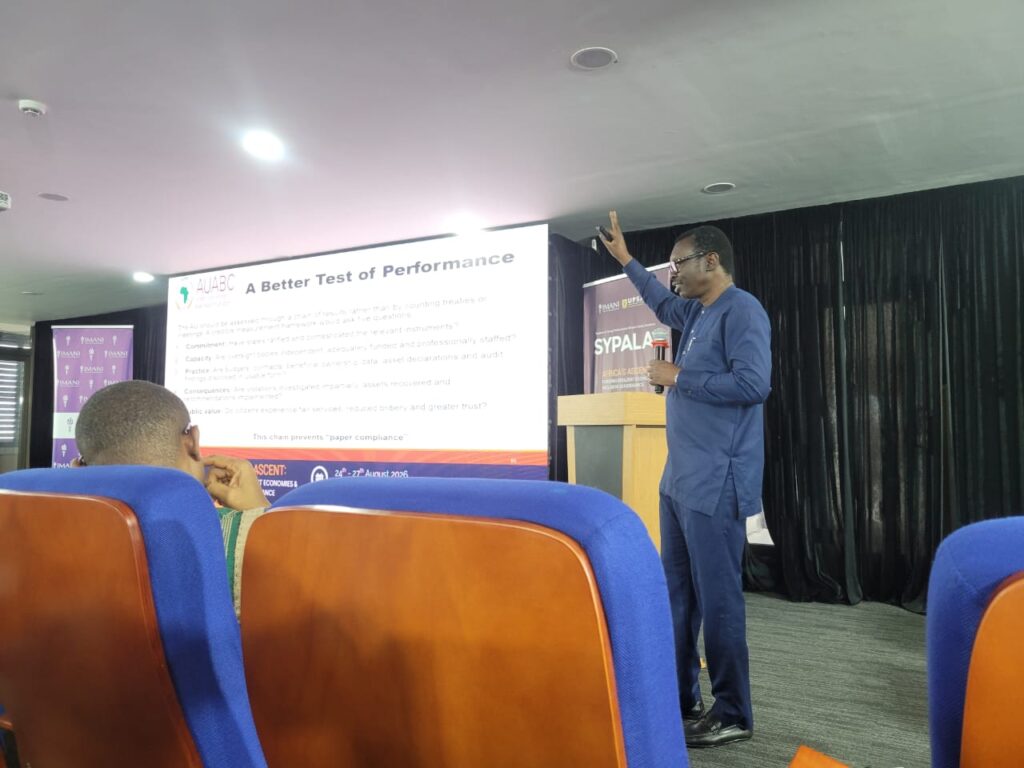
The third question, practice, moves from institutional design to institutional behaviour, asking whether budgets, contracts, beneficial ownership data, asset declarations and audit findings are actually disclosed in a form the public can use.
The fourth, consequences, asks whether violations are investigated impartially, whether stolen or misappropriated assets are recovered, and whether the recommendations that follow are implemented rather than shelved.
The fifth and final question, which Mr Senanu framed as the ultimate test of whether any of the preceding four matters, asks whether citizens experience fairer services, reduced bribery and greater trust as a direct result.
“Do citizens experience fair services, reduced bribery and greater trust?” the framework asks, closing the loop from paper commitment to lived experience.
Preventing “Paper Compliance”
Mr Senanu argued that the value of the five-question chain lies specifically in what it rules out. A country or institution can ratify a convention, hold the required meetings and technically satisfy the first stage of the framework while nothing changes for the citizens the framework is ultimately meant to serve.
He said the sequential structure is designed to prevent exactly that outcome, describing it as a safeguard against what he called “paper compliance.”
By requiring evidence at each stage, from ratification through funded oversight, usable disclosure, real consequences and finally measurable public benefit, the framework denies institutions credit for commitments that never progress beyond formal adoption.
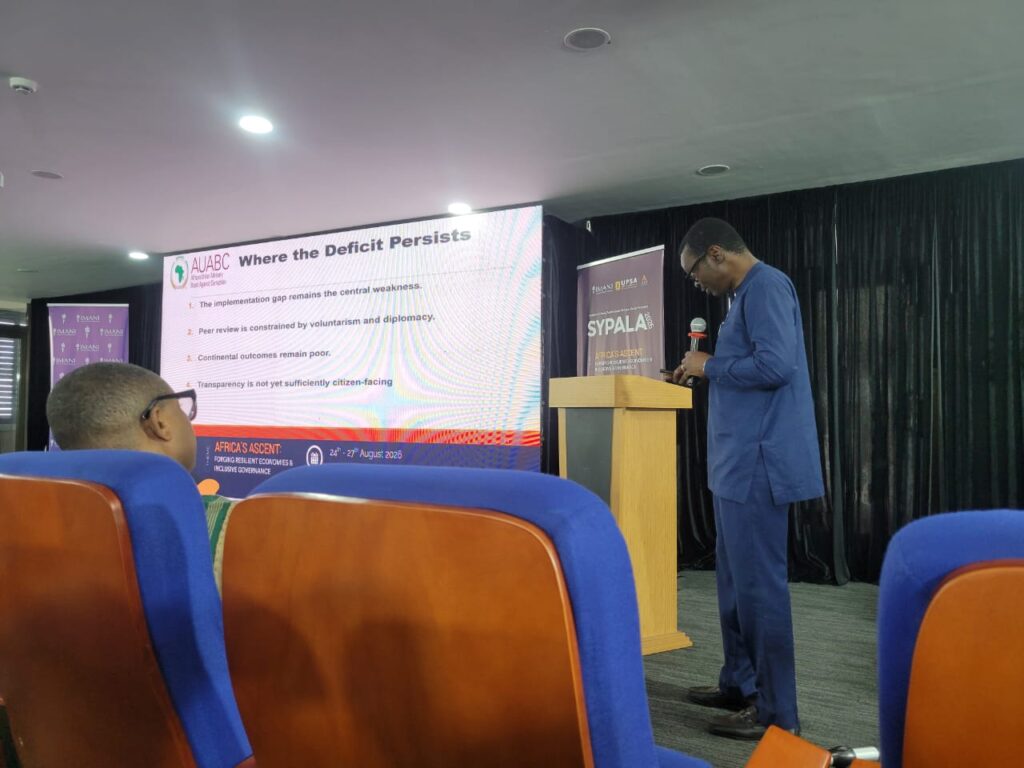
Mr Senanu paired the five-question test with a separate diagnostic slide identifying where he believes the continent’s deficit currently sits.
He named the implementation gap as the central weakness running through Africa’s governance architecture, and said peer review among African states remains constrained by voluntarism and diplomacy, meaning states largely control whether and how rigorously they submit to review by their peers rather than facing a binding external standard.
He said continental outcomes remain poor by his own assessment, and that transparency across AU institutions is not yet sufficiently citizen-facing, a shortfall that maps directly onto the fifth and final question of his proposed framework.
Applying the Test in Practice
Mr Senanu’s broader remarks at SYPALA 2026 offered a live illustration of how the framework might be applied.
He pointed to the African Continental Free Trade Area as an instrument that has cleared the earlier stages of his chain, ratification and institutional design, while still falling short on the practice and consequence stages, since intra-African trade volumes have not moved the way effective implementation should have produced.
READ ALSO: World Bank Raises Red Flag Over Ghana’s Economic Stability