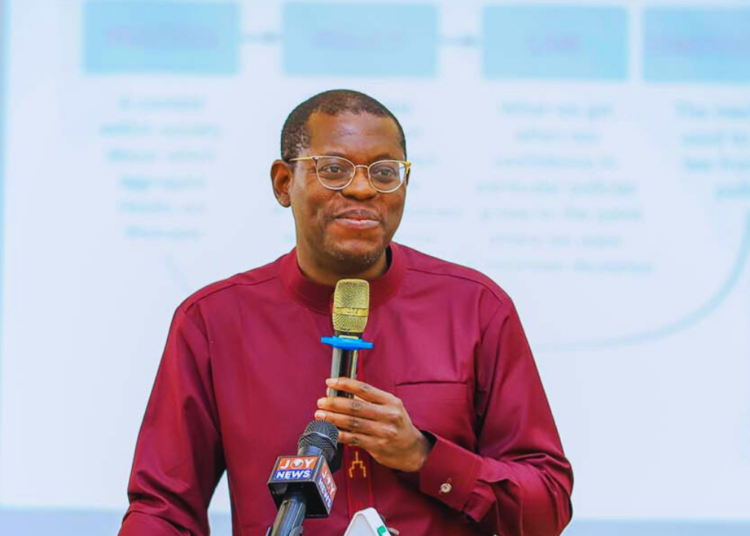
Bright Simons, Honorary Vice President of the IMANI Centre for Policy and Education, has warned that Ghana’s push to retain greater control over its gold sector risks repeating decades of policy failure unless it is grounded in rigorous economic analysis rather than the political appeal of resource nationalism alone.
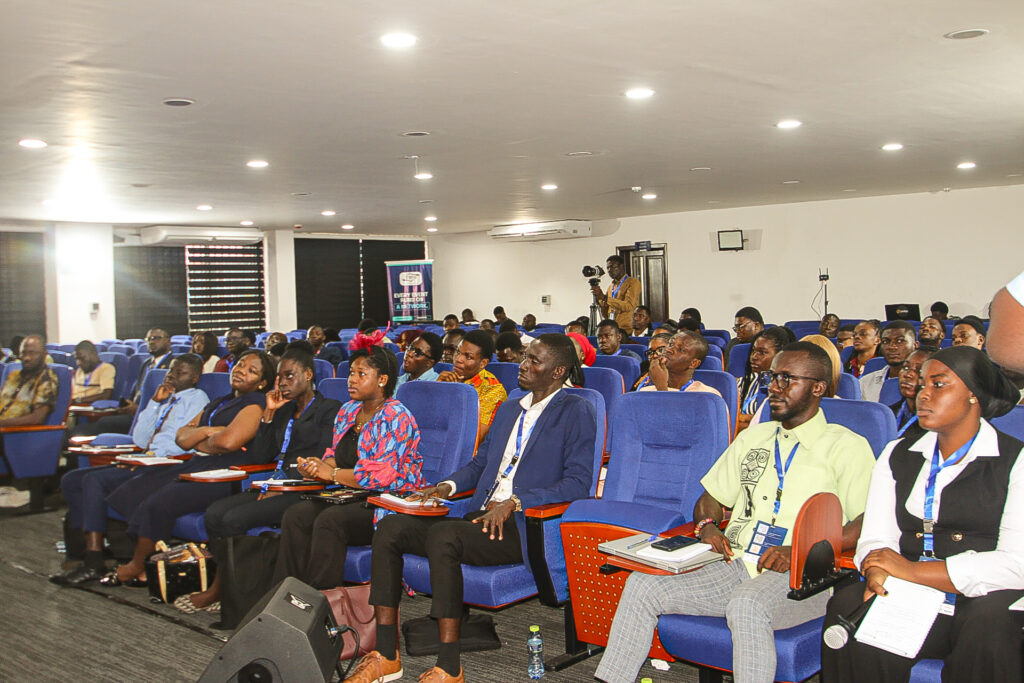
Speaking at the Students and Young Professionals African Liberty Academy in Accra on Wednesday, August 26, Mr Simons used Ghana’s gold sector to illustrate what he calls Katanomics, a framework describing how political slogans and technical policy analysis pull in opposite directions, often leaving popular ideas poorly executed because the difficult work of implementation gets lost once the political message has already won public support.
A Popular Idea With a Difficult History
Mr Simons said the call to refine Ghana’s gold domestically, rather than exporting it raw, is close to politically unanimous. “If you went to the markets and randomly pulled people, 99% of people would say that’s the greatest idea I’ve ever heard,” he said.
But he argued most Ghanaians are unaware the country has already built and lost several gold refineries, and that gold refining itself is a low-margin business whose profitability depends on assembling complex financing arrangements that have repeatedly failed to materialise.

He said the pattern repeats because Ghana has never properly reckoned with its own history. He recalled the nationalisation of most Ghanaian mines through the late 1960s, 1970s and much of the 1980s, a period he said crashed production and turned some mines into hazards, eventually forcing an IMF-driven reversal back toward privatisation.
“We went donkomi on the assets,” he said, arguing that because the failure was never properly analysed, Ghana returned decades later to similar nationalist proposals without any new insight into what would make them work.
The State Gold Mining Corporation and GNPC’s Greek Mine
Mr Simons pointed to more recent examples of the same pattern. The State Gold Mining Corporation, he said, remains troubled, and the Ghana National Petroleum Corporation’s acquisition of a gold mine, Prestea Sankofa Gold Limited, has never turned a profit.
He argued that if the government is genuinely committed to resource nationalism, it must first demonstrate it can fix these existing state-linked ventures before assuming it will succeed where established international operators have not.
He extended the same critique to GoldBod, the state’s gold export control mechanism, describing what he called a policy created without a proper postmortem of the system it replaced.
He questioned why private-sector gold trading was deemed inadequate without a clear diagnosis of whether the underlying problem was corruption or something else, and traced the resulting funding confusion through the Bank of Ghana, which he said suffered negative equity partly as a result, to the Finance Ministry, which has since struggled with delayed payments to gold buyers.
He drew a parallel to the earlier state-run Ghana Manganese Company, describing it as a comparable disaster whose failures pushed the country’s manganese tax revenues toward zero for years.
The Value of the Goal Versus the Difficulty of the Method
Mr Simons was careful to separate his critique of implementation from the underlying goal. “It’s sensible that we keep a lot of our gold mining in Ghana,” he said, arguing that most politically popular ends, including resource nationalism, are good in principle.
His argument, he stressed, concerns method rather than intention. “How you do it is much, much, much, much harder,” he said, warning that anyone who defends a policy purely because it is politically appealing does not understand where such policies actually succeed or fail.
He said the value chain running from raw gold ore to a finished product like a watch can multiply value roughly 300 times, but argued Ghana does not need to capture the entire chain to benefit.
If refining itself yields limited returns, he suggested the country could instead pursue adjacent opportunities such as gold jewellery manufacturing or the electronics gold trade, framing this as evidence that a narrow focus on refining alone overlooks more profitable segments of the same chain.

Mr Simons closed his argument on resource nationalism by proposing a standard for evaluating future proposals rather than abandoning the underlying ambition. He said Ghana should track its policy failures explicitly, so that when similar resource nationalist ideas resurface, officials are forced to explain what has changed since the last attempt failed.
Without that discipline, he argued, the country will continue relitigating the same debates from a standing start, unable to learn from its own history even as it keeps pursuing an end goal he agrees is worth pursuing.
READ ALSO: World Bank Warns COCOBOD as Major Risk to Ghana’s Economy Recovery