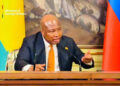
Hon. Abena Asare, MP for Atewa East and Chairperson of the Public Accounts Committee (PAC), has raised critical questions regarding GoldBod’s financial management following her detailed review of the state entity’s 2025 financial statements.
The parliamentary probe focuses on GoldBod’s decision to recognize GH¢4.5477 billion in government funds as grant revenue, which directly inflated its reported surplus to approximately GH¢5.44 billion for the financial year.
According to the PAC Chairperson, counting operational trade capital as earned revenue distorts GoldBod’s actual financial performance and masks its underlying fiscal health.
“How did GH¢4.5477 billion provided as revolving trade capital, and still unutilised at year-end, come to be recognised as revenue contributing to a reported surplus of about GH¢5.44 billion? Public money of this magnitude should not be described as revolving capital in one part of the accounts, unutilised in another, and revenue in another without a clear reconciliation.”
Hon. Abena Asare, MP for Atewa East and Chairperson of the Public Accounts Committee (PAC)
The PAC Chair highlighted severe internal contradictions within GoldBod’s official annual report regarding the characterization and deployment of the public funds.

While GoldBod’s Business Review defines the GH¢4.5477 billion allocation as revolving trade capital intended for gold purchasing, trading, and export operations, other sections describe the amount as an unutilised government subvention that remained dormant at the Bank of Ghana at year-end.
This fundamental accounting conflict classifying unspent trading capital as recognized revenue raises urgent questions regarding compliance with national public financial management laws and international accounting standards governing state enterprises.
Accounting Standard Deviations and Legal Compliance
The demand for immediate accounting clarification stems from potential non-compliance with statutory standards governing public funds and international reporting frameworks.
Under International Public Sector Accounting Standard (IPSAS) 1, financial statements must reflect the true economic substance of transactions rather than their legal framing, ensuring a fair, objective, and consistent presentation of performance.
Furthermore, IPSAS 23 stipulates that government transfers cannot automatically be recognized as revenue; recognition depends strictly on whether funds carry binding conditions or represent capital contributions.

Absorbing revolving trade capital meant for continuous operational rollover into grant revenue artificially inflates reported surpluses while obscuring actual commercial earnings from gold operations.
This reporting approach also directly impacts statutory compliance under the Public Financial Management Act, 2016 (Act 921). Sections 79, 82, and 93 of Act 921 require public sector financial statements to be meticulously prepared, consistently classified, and capable of presenting a true and fair view of state resources.
When capital intended for liquidity support in the extractive sector is categorized inconsistently across financial schedules, it weakens statutory oversight, undermines fiscal accountability, and exposes public enterprises to governance risks.
Internal Financial Inconsistencies and Resource Governance
Beyond the central subvention dispute, Hon. Abena Asare identified pervasive numerical contradictions across multiple line items within GoldBod’s 2025 audited accounts.
The PAC Chairperson noted that different parts of the same signed report present conflicting figures for total expenditure, reported surplus, total assets, and net assets.
Discrepancies were also highlighted in GoldBod’s recorded share of profit in its commercial subsidiary, GoldBod Jewellery Limited, creating confusion regarding downstream earnings and asset valuations.

In extractive sector financial management, internal reporting discrepancies compromise institutional integrity and public accountability. IPSAS 1 mandates strict consistency across all components of an annual statement to prevent information asymmetry and misrepresentation.
As Hon. Asare emphasized, “a signed and audited annual report dealing with billions of cedis of public resources should not leave readers choosing between different figures for the same line item.”
In a critical sector handling substantial foreign exchange, numerical variances undermine public trust and impede effective parliamentary oversight.
Calls for Audit Transparency and Board Accountability
Resolving these fiscal anomalies requires direct administrative action and total transparency from GoldBod’s leadership and state auditors.
The PAC Chairperson has formally requested the Directors of GoldBod to state the exact accounting basis for recognizing unspent trade capital as revenue and to reconcile all conflicting figures appearing in the annual report.

Hon. Abena Asare noted that while “GoldBod may well have generated income from its operations,” commercial revenues must remain clearly distinguished from government subventions to evaluate operational viability accurately.
To establish complete public trust, Hon. Asare also urged the Auditor-General to make available the official Management Letter arising from the 2025 audit cycle.
Publishing this document will clarify whether external auditors identified these classification errors during audit fieldwork and reveal what explanations were provided by management.
READ ALSO: Growing Indiscipline in Schools Reflects Wider Societal Decline – Rt. Rev Kwakye