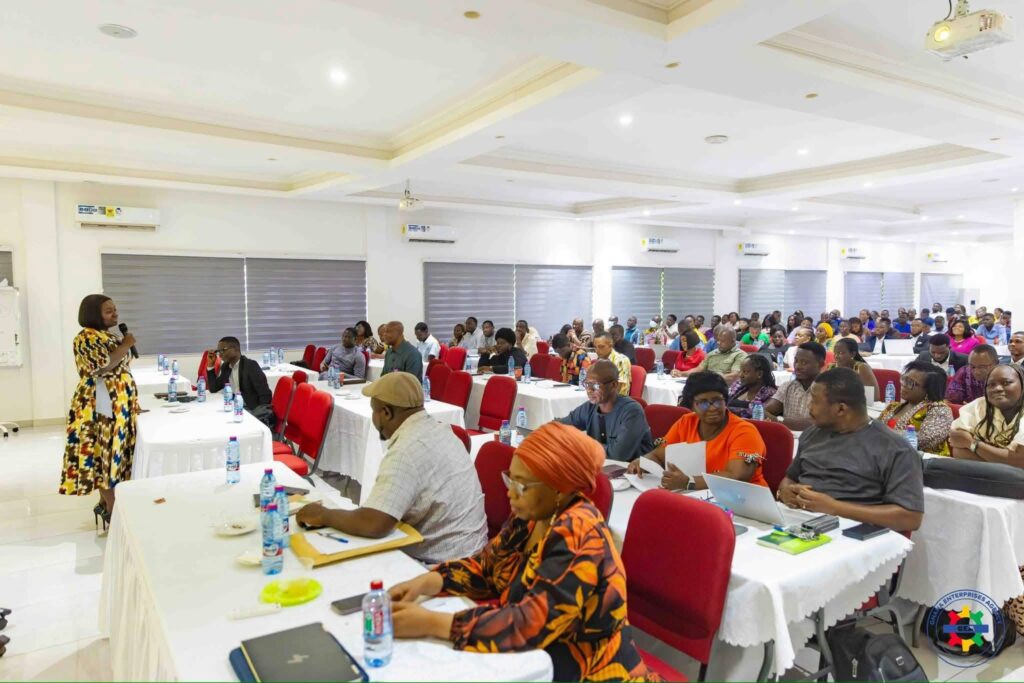
The Ghana Enterprises Agency convenes a comprehensive review meeting for the Southern Sector at Abokobi to assess progress, address implementation challenges, and chart a clearer path for the next phase of the BizBox Project.
The meeting Led by the Chief Executive Officer of Ghana Enterprise Agency, brings together directors, project coordinators, field officers and technical teams from across the Southern Sector in what is described as one of the most critical reflections since the rollout of the project.
As the BizBox Project closes its second year, the review provides a platform to move from isolated field reports to a consolidated national picture of what is working, what is stalling, and what must change.
Discussions at Abokobi centre on three main priorities: strengthening coordination among the various working teams, addressing operational gaps identified during implementation, and consolidating hard-won lessons from two years of delivery.
For many participants, the meeting marks the first time teams from different districts sit together to compare experiences directly. The format is deliberately practical. Instead of formal presentations alone, the sessions focus on problem solving, peer learning and joint planning.
Coordination Takes Centre Stage
A recurring theme throughout the review is coordination. While each district team implements the BizBox Project according to a common framework, field realities differ significantly. Teams share how local economic conditions, enterprise density, and access to business development services shape implementation.
Project managers note that where coordination among business development service providers, financial institution partners, and community level mobilizers is strong, beneficiary on boarding and business support are faster and more effective. Where coordination is weak, duplication, delays and gaps in follow-up support emerge.
‘’The review explores practical mechanisms to tighten collaboration. These include harmonizing reporting timelines, improving information flow between district teams and the head office, aligning training calendars with local market seasons, and ensuring that youth and women entrepreneurs receive continuous support beyond initial training.’’
Miss Ansei
The Agency emphasizes that the BizBox Project is not just about numbers trained or businesses supported, but about building a system that delivers support efficiently and consistently across all participating districts.
Confronting Operational Gaps
The review also provides a candid assessment of operational gaps that have surfaced during the second year. Teams point to challenges in data collection and validation, particularly in areas where network connectivity and high mobility of micro and small enterprises make tracking difficult.
Others raise issues around timely disbursement of support packages, managing expectations among beneficiaries, and ensuring that post-training mentorship translates into measurable business growth.
The discussions do not shy away from these difficulties. Instead, they treat them as valuable lessons that can inform stronger systems. Directors present detailed district-level updates, backed by field data, success stories and areas requiring attention.
These updates give the Agency leadership a clearer, evidence-based picture of progress on the ground. Key among the lessons consolidated is the need to deepen community engagement and strengthen partnerships with local assemblies, trade associations and traditional authorities.
Teams that have invested heavily in local stakeholder engagement report higher retention and greater business formalization rates. Another lesson is the importance of tailoring business development support.
While the core BizBox curriculum remains standard, its application needs to reflect the dominant trades in each district, from agribusiness and agro-processing in peril-urban areas to services, fashion, and small-scale manufacturing in urban centres.
A Pivotal Second Year for the BizBox Project
BizBox Project is widely seen as pivotal. After a first year focused on rollout and system setup, the second year tests the resilience and adaptability of the delivery model. The Abokobi review shows that significant progress has been made in expanding access for young people and women to entrepreneurship training, business advisory services, and pathways to finance.
It also shows that the project is maturing into a more reflective, learning-oriented initiative that values feedback from the field. Participants note that beneficiary attitudes are also shifting. Young entrepreneurs are moving from seeing the project as a one-off support programme to engaging with it as a longer-term growth platform.
This shift, teams observe, requires more sustained mentorship, market linkage support and assistance with business registration and compliance. Commitment to Effective
Delivery The Ghana Enterprises Agency expresses appreciation to all directors, project officers and field teams who participate in the Southern Sector review.
In its closing remarks, the Agency reaffirms its commitment to the effective, transparent and accountable delivery of the BizBox Project. It underscores that regular sector reviews such as the one at Abokobi are not routine administrative exercises, but essential management tools that ensure the project remains responsive, results-driven and aligned with its core objective of empowering young Ghanaians through sustainable enterprise development.
The Agency notes that lessons and recommendations emerging from Abokobi will directly inform planning for the next implementation period, including improved coordination protocols, refined operational guidelines and enhanced support systems for districts.
As the BizBox Project enters its third year, the Abokobi review sends a clear message: progress is being made, challenges are being acknowledged, and the collective resolve to deliver a transformative youth entrepreneurship project across Ghana remains strong.
The BizBox Project is an initiative of the Ghana Enterprises Agency and the MasterCard Foundation, designed to provide entrepreneurship skills, business development support and access to finance for young people and women across Ghana.
READ ALSO :BoG Turns to AI in New Inflation Forecasting Push