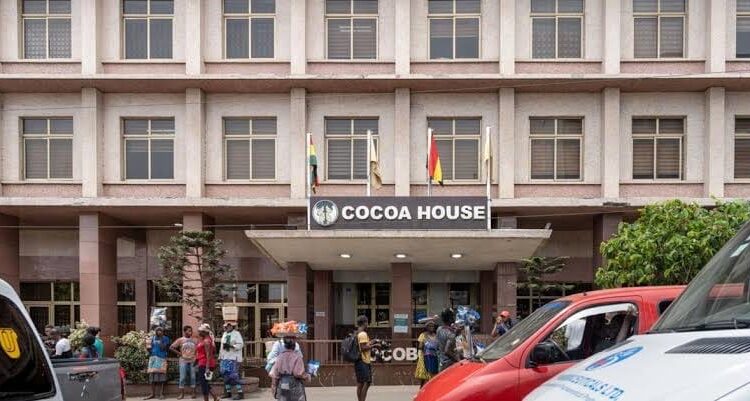
The Ghana Cocoa Board (COCOBOD) has announced the full settlement of its mandatory payment obligations to bondholders affected by the Domestic Debt Exchange Programme (DDEP) for the year 2026, with a total payment of over GH¢2.68 billion.
In a press release dated September 1, 2026, and signed by its Public Affairs Department, COCOBOD disclosed that it has paid an amount of GH¢2,306,202,372.09, representing the final tranche of its 2026 DDEP bond obligations.
The Board said the latest payment completes its scheduled obligations to holders of bonds affected by the DDEP for the year. According to COCOBOD, earlier in March 2026, it had paid a coupon amount of GH¢376,325,910.09 to the same group of bondholders.
With the latest settlement, the total amount paid by the Board to DDEP bondholders in 2026 has reached GH¢2,682,582,282.18.
The Ghana Cocoa Board (COCOBOD) wishes to inform bondholders, investors, cocoa industry stakeholders, and the general public that it has settled an amount of GHS2,306,202,372.09, completing its mandatory payment obligations to holders of bonds affected by the Domestic Debt Exchange Programme (DDEP) for the year 2026.
The Board also announced the closure of another category of its debt obligations. In July 2026, COCOBOD fully settled GH¢162 million owed to holders of Cocoa Bills who did not participate in the DDEP.
COCOBOD explained that the July payment brought its outstanding obligations to the affected non-DDEP Cocoa Bill holders to a close, clearing that segment of its domestic debt portfolio. The two settlements mark a significant milestone in the Board’s debt servicing calendar for 2026, coming at a time when Ghana’s cocoa sector is under close scrutiny from investors, farmers and international partners.
COCOBOD Settlement Bills Mark Major Milestone
COCOBOD stated that the payments demonstrate its commitment to responsible financial management and the systematic settlement of its financial obligations. The Board framed the settlements as part of a broader effort to strengthen the financial sustainability of Ghana’s cocoa sector, under the guidance of the Ministry of Finance.
“Together, these payments demonstrate the Board’s commitment to responsible financial management and the systematic settlement of its financial obligations as part of the broader effort to strengthen the financial sustainability of Ghana’s cocoa sector, under the guidance of the Ministry of Finance.”
COCOBOD
The settlement comes against the background of Ghana’s Domestic Debt Exchange Programme, launched in late 2022 as part of the government’s measures to restore macroeconomic stability and secure an International Monetary Fund (IMF) programme.
Under the DDEP, COCOBOD’s short term Cocoa Bills, which had been a key instrument for financing cocoa purchases, were included in the exchange. Some institutional holders of Cocoa Bills opted to participate in the programme and had their holdings exchanged for longer-dated bonds with revised terms, while others did not participate.
The inclusion of COCOBOD in the DDEP initially raised concerns among investors and in the cocoa value chain about the Board’s liquidity and its ability to meet its operational financing needs, particularly for crop financing and payments to cocoa farmers.
What COCOBOD has done is to show that despite the challenges in the cocoa sector, including production shortfalls in previous seasons, it is prioritizing its debt service commitments. GH¢2.68 billion in one year is significant. It tells the market that the restructuring was not a default but a rescheduling.
Settlement to Bring Relief to Banks, Pension Funds Hit by DDEP
The payment is also expected to provide some relief to local financial institutions, pension funds and individual investors who were affected by the DDEP.Many domestic bondholders, especially banks and fund managers, had expressed liquidity pressures following the exchange.
Timely coupon payments and settlements by issuers like COCOBOD have become critical for restoring liquidity in the domestic financial market. For the cocoa sector, financial sustainability remains a key issue.
COCOBOD has in recent years faced high operational costs, declining production in some seasons due to climate challenges and disease, and the need to ensure prompt payment to cocoa farmers.
Government has maintained that restoring COCOBOD’s balance sheet is central to securing the long-term future of cocoa, which remains Ghana’s leading agricultural export and a major source of foreign exchange and employment.
Under the guidance of the Ministry of Finance, COCOBOD has been implementing measures to improve financial discipline, including rationalizing costs, improving production through rehabilitation programmes and strengthening internal controls.
The Board has also benefited from improved world market prices for cocoa, which reached record highs in 2024 and 2025, helping to improve its revenue position. Industry stakeholders say while the debt settlement is commendable, the Board must continue to focus on boosting production and ensuring that cocoa farmers benefit directly from improved finances.
COCOBOD has assured the public that it remains committed to meeting its obligations as and when they fall due and to maintaining transparency with its stakeholders.
READ ALSO:Mahama Urges Non-Aligned Movement to Resist Global Power Bloc Politics