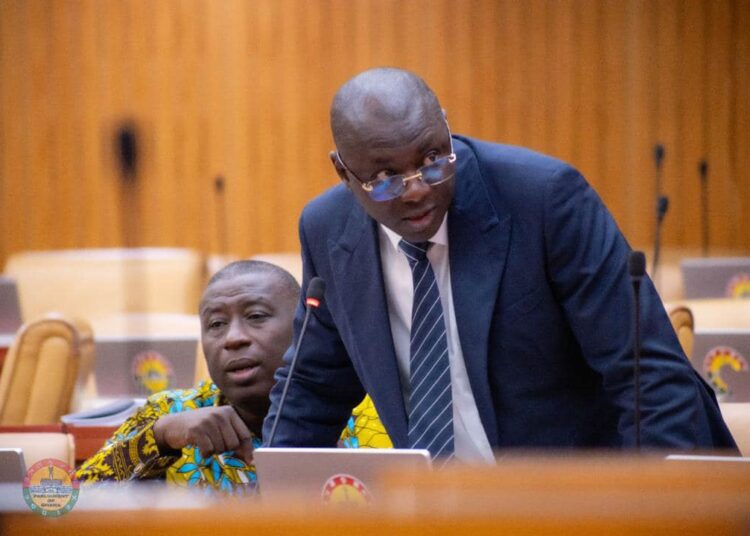
Hon. Dr. Mohammed Amin Adam, the former Minister for Finance and Member of Parliament for Karaga, has called for the immediate removal of the Governor of the Bank of Ghana (BoG), Hon. Johnson Asiama from the Board of Directors of the Ghana Gold Board (GoldBod).
The former Finance Minister asserted that the institutional relationship between the central bank and GoldBod presents a clear conflict of interest that ultimately damages the nation’s financial standing.
According to Dr. Amin Adam, the Bank of Ghana has been continuously funding the operations of GoldBod while its Governor sits on the board, overseeing an arrangement that systematically yields substantial operational losses for the state.
“And if we have such an agreement, then it means that the Bank of Ghana knew that this transaction was a loss-making operation. Because they would have known that they buy gold at a certain rate and then they sell it at a certain rate, and this will amount to willfully causing financial loss to the state. We are also asking for the legislative instrument authorizing Gold Coast fees.”
Hon. Dr. Mohammed Amin Adam

Expanding on the demands, the Karaga lawmaker emphasized that the underlying framework of the transaction makes it evident that the central bank was fully aware of the loss-making nature of the enterprise from its inception.
Because the Bank of Ghana purchased gold at specified rates and subsequently sold it at lower realization rates, the leadership knew beforehand that the structural spread would result in a direct financial strain on public resources.
Beyond calling for the Governor’s exit, Dr. Amin Adam outlined a series of remedial actions aimed at resetting institutional accountability within the national extractive sector.
These measures include demanding the specific legislative instrument authorizing GoldCoast fees, requesting a restatement of the GoldCoast 2025 financial accounts to exclude a 4.54-billion-cedi government capital injection from revenue figures, and seeking the outright removal of GoldCoast from the governance structure.
Governance Conflicts And Institutional Neutrality
The call to separate the central bank’s leadership from GoldBod’s governing board centers on the fundamental principles of regulatory independence and fiscal oversight.
When the regulator of the monetary system simultaneously functions as a commercial participant and board member of a state gold aggregator, the dual role erodes the objective checks and balances required to protect public assets.
By providing cedi liquidity and financing mechanisms to back local gold procurement while holding a seat on the corporate board, the central bank effectively acts as both the financier and the supervisor of a commercial venture.

Dr. Amin Adam argues that this governance arrangement creates a structural hazard where institutional oversight is compromised by direct operational involvement.
In standard financial corporate governance, the entity providing capital and absorbing transaction risk cannot objectively evaluate the performance or pricing structures of the operational agent.
The dual mandate creates a scenario where policy interventions to defend national foreign exchange reserves absorb commercial discount losses, blurring the line between statutory central banking duties and corporate mismanagement.
Financial Losses And Valuation Mechanics
The financial mechanics behind the opposition’s demands highlight significant variances between local acquisition costs and international off-take realizations.
Under the existing Domestic Gold Purchase Programme framework, gold is acquired locally from artisanal and small-scale miners at prevailing foreign exchange market rates to stay competitive against informal channels.

However, these transactions are subsequently logged and settled through central bank accounting frameworks at fixed or official reference exchange rates, creating a wide valuation gap that translates into balance-sheet losses.
Furthermore, international sales executed through off-take agreements have frequently involved substantial price discounts to secure rapid cash settlement in foreign destinations like Dubai and India.
The combination of buying gold at a premium on the local market, paying fixed service and assay charges, and selling at discounted international spot rates guarantees a net financial drain.
For the opposition, allowing the Governor of the central bank to remain on the board while approving agreements that lock in these negative margins constitutes a failure of fiduciary responsibility that warrants urgent structural reform.
Accounting Discrepancies And Capital Injection Restatement
The debate over GoldBod’s solvency is further complicated by controversy surrounding the classification of state financial interventions within its annual statements.

Dr. Amin Adam pointed out that the reported profitability or surplus figures presented by the entity rely on the improper accounting treatment of state equity.
Specifically, the opposition contends that a 4.54-billion-cedi capital injection provided by the central government was classified as operational revenue rather than balance-sheet equity or capital support.
READ ALSO: NPP Needs Stronger Party Structure To Win 2028, Antwi Warns