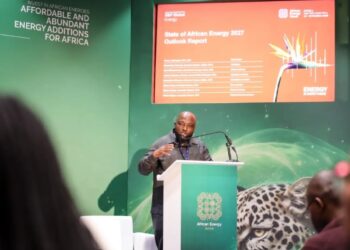
Energy and critical mineral advocate Pauline Anaman has called on African nations to independently establish their own list of critical minerals to drive the continent’s industrialization and economic transformation agenda.
Delivering a statement at the Bled Strategic Forum, she argued that the current classification of critical resources such as lithium, cobalt, and rare earth elements is a construct of the Global North designed to secure foreign supply chains and power Western energy security.
According to her, Africa must move away from serving merely as an extractive resource base for external powers and instead control the narrative, supply chains, and economic value generated from its vast mineral wealth.
While on her call during the forum, Anaman asserted that the global race for energy transition materials has transformed climate action into a high-stakes geopolitical contest. She stressed that while the world looks to Africa to supply the essential raw materials required to power low-carbon technologies, the continent faces severe energy deficits that cannot be overlooked in the rush toward global decarbonization goals.
She emphasized that African leaders must intentionally align resource extraction with domestic energy demands and local manufacturing capabilities, ensuring that the continent actively shapes international economic policy as an architect rather than remaining a passive observer in global negotiations.
“While Africa is in the position to supply these ‘critical minerals’, this great continent must deliberately define what minerals are critical to its industrialization agenda and economic transformation. The global green transition is no longer just a climate conversation. It is a geopolitical contest.”
Pauline Anaman
Shift Away From Foreign Nomenclature
This urgent call is crucial for Africa because accepting external definitions of resource criticality forces the continent into a subordinate economic role.
When industrial nations in Europe and North America label specific minerals as “critical,” they do so to insulate their advanced manufacturing, defense, and renewable technology sectors from supply disruptions.
Historically, this dynamic has driven raw material export models that leave African nations at the bottom of the global value chain, exposed to price volatility while importing high-cost finished goods.
By establishing a native taxonomy of critical minerals, African economies can prioritize resources required for local infrastructure development, such as iron ore, copper, bauxite, and industrial minerals necessary for local grid expansion, urbanization, and domestic manufacturing.
This strategic realignment allows regional bodies to design resource governance frameworks that favor local value addition, mineral processing, and regional trade integration under mechanisms like the African Continental Free Trade Area (AfCFTA).

Defining criticality through a domestic lens ensures that national mineral policies serve local poverty reduction and structural industrial transformation first, rather than serving solely to feed foreign green energy supply chains.
Navigating Green Transition Geopolitics
Furthermore, assertiveness in defining critical resources provides Africa with necessary leverage in the accelerating global energy transition.
As Western nations, China, and other industrial powers compete aggressively for access to battery metals, African governments face intense pressure to sign bilateral resource deals.
Without a unified, self-defined strategy, individual nations risk entering uncoordinated agreements that yield low mineral royalties, limited technology transfer, and severe environmental degradation.

Anaman highlighted this tension by questioning who will bear the financial and social costs of the low-carbon shift, especially when millions of Africans still lack basic electricity access. A self-determined critical mineral strategy enables the continent to demand equitable partnerships.
Instead of unrefined ore exports, Africa can condition resource access on foreign direct investment in local refining, smelting, and manufacturing hubs.
Reconciling global decarbonization targets with local developmental imperatives requires African leadership to negotiate from a position of strategic clarity, ensuring that global climate goals do not undermine continental energy access.
Architects Of The Global Energy Future
Ultimately, the initiative to redefine critical minerals is about sovereign economic governance and continental self-determination. For decades, international rule-making in extractive governance has sidelined resource-rich African countries, relegating them to compliance roles rather than setting global standards.
Participating in international summits like the Bled Strategic Forum allows African policy advocates to challenge legacy supply chain structures directly at the decision-making table.

Transitioning from an observer to an architect of global trade rules requires a unified continental voice that links mineral extraction directly to industrial policy.
When Africa defines its own critical resources, it asserts control over the technological, industrial, and financial yield of its subsoil wealth.
As the world accelerates its transition toward renewable energy systems, the continent’s ability to set its own strategic priorities will determine whether it remains an exploitation zone or emerges as a global industrial powerhouse.
READ ALSO: GoldBod’s US$1.315bn FX Split Channels Dollars to Market, Reserves