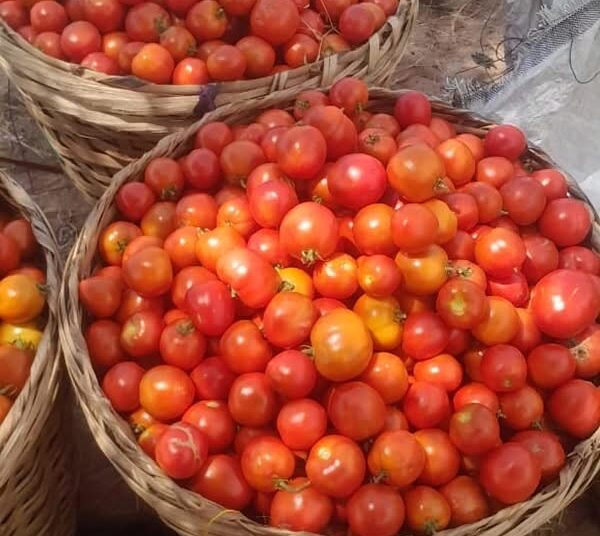
Prices of tomatoes are expected to see a sharp decline in the coming weeks as Ghanaian farmers have begun harvesting, Deputy Minister for Food and Agriculture, Hon. John Dumelo, has disclosed.
According to the Deputy Minister, the anticipated drop is due to increased supply from major tomato growing areas, which will help ease pressure on consumers who have faced high prices in recent months.
He further revealed that the government is actively preparing for large-scale dry season tomato farming scheduled from December to June next year, as part of efforts to ensure all-year-round production and reduce the country’s dependence on imports.
“As part of the preparations, lands have been cleared mostly in the Northern part of Ghana, and nursing and transplanting will start from October,” Hon. Dumelo stated. He added that the Ministry has provided solar powered boreholes and irrigation inputs to farmers to enable them to actively pursue dry season farming and augment shortfalls expected next year.
The intervention forms part of government’s broader strategy to boost local tomato production, stabilize prices, create jobs for farmers in the north, and cut down on tomato imports from neighbouring countries.
Hon. Dumelo assured Ghanaians that with these measures, the country is on course to achieve self-sufficiency in tomato production and ensure price stability throughout the year.
Relief for Consumers After Months of High Prices
For several months, Ghanaian households and food vendors have grappled with soaring tomato prices, with a box of tomatoes in some major markets selling for as high as GH¢2,500 to GH¢3,000.

The price surge, largely attributed to seasonal shortages, poor rains, pest infestations and heavy reliance on imports from Burkina Faso, placed a heavy burden on consumers and significantly increased the cost of prepared food.
Traders at Agbogbloshie, Techiman, and Kumasi Central markets have often cited scarcity and high transportation costs as major drivers of the price hikes. The expected harvest from local farms is therefore set to bring much needed relief, with market watchers projecting that retail prices could drop by over 40 percent by the end of September.
The Deputy Minister noted that the current harvesting season in the middle and southern belts, including areas in the Bono East, Ashanti and Eastern Regions, will increase local supply and stabilize the market ahead of the dry season intervention.
Tackling the Import Dependency Ghana currently imports over $100 million worth of tomatoes annually, mostly from Burkina Faso, despite having vast arable land suitable for tomato cultivation.
This heavy dependence has made the country vulnerable to external supply shocks and price volatility, especially during the lean season between March and July when local production is low.
Governments have attempted to reverse this trend, but challenges including lack of irrigation facilities, post-harvest losses estimated at 30 to 40 percent, limited access to improved seeds, and inadequate storage have hampered progress.
Hon. Dumelo explained that the current government’s approach under the Feed Ghana Programme is different, as it focuses on addressing the structural bottlenecks rather than short term fixes.
The goal is not just to produce tomatoes in the rainy season and face shortages in the dry season. We want to produce tomatoes 12 months in a year. That is why we are investing heavily in irrigation.
A Game Changer for the North
The dry season farming initiative, which will run from December to June next year, is expected to be the largest of its kind in recent years. According to the Ministry, thousands of acres of land have already been cleared in the Northern.
Also at the North East, Upper East and Upper West Regions, areas that have comparative advantage for dry season vegetable farming due to their flat lands and high sunshine hours. Under the programme, farmers are being supported with solar powered boreholes.
Also, with water pumps, drip irrigation kits, improved high yielding tomato seeds, fertilizers and extension services. Nursing of seedlings is expected to begin in October, with transplanting scheduled for November to allow for early harvesting by December.
The Deputy Minister emphasized that the use of solar powered irrigation is critical to reducing the cost of production and ensuring sustainability, as it eliminates the reliance on expensive fuel-powered pumps.
“This initiative will not only ensure availability of tomatoes during the lean season but will also create jobs for the youth and women in the northern part of Ghana, who often migrate to the south during the dry season in search of non-existent jobs.”
Hon. Dumelo
Reducing Post Harvest Losses and Linking Farmers to Markets
Beyond production, the Ministry is also working with the private sector and development partners to address post-harvest losses, which remain a major challenge in the tomato value chain. Plans are underway to establish aggregation centres, cold storage facilities and processing linkages with tomato processing factories, including the revamped Pwalugu and Afariwaa tomato factories.
Farmers under the dry season programme will be linked directly to off-takers, market queens, supermarkets and processing companies through a structured out-grower arrangement to guarantee ready market and fair prices.
With harvesting already underway and the dry season preparations in full gear, consumers can expect some respite at the market in the coming weeks, while farmers look forward to a more profitable and sustainable tomato production system that works all year round.
READ ALSO:Ghana’s Energy Inflation Surges As Disinflation Loses Momentum