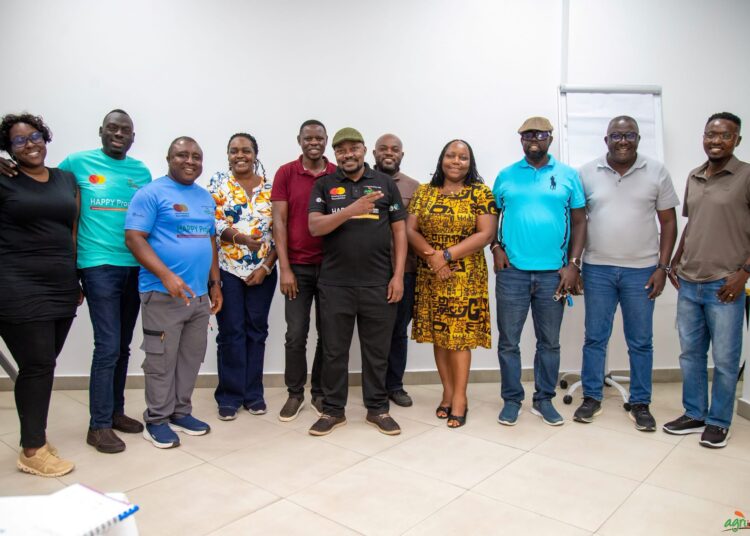
The Mastercard Foundation has undertaken a cross-learning visit to selected sites under the Harnessing Agricultural Productivity and Prosperity for Youth (HAPPY) Programme by the Agri-Impact Limited.
The education took the team from travelling to the Greater Accra Region through the Central Region to the Upper West Region to assess implementation, engage beneficiaries and gather lessons for strengthening youth-focused agricultural interventions.
The field visit formed part of efforts by the Foundation, Agri-Impact Limited and other partners to deepen learning from the implementation of the HAPPY Programme and gain first-hand insight into how interventions are translating into opportunities for young people across different parts of Ghana.
Following the field engagements, the Mastercard Foundation team joined Team Agri-Impact and colleagues from the Mastercard Foundation Ghana at the Ibis Styles Hotel in Accra for a debriefing session.
The session provided an opportunity for participants to reflect on observations from the field, share experiences and identify lessons that could inform the continued implementation and improvement of the programme.
The HAPPY Programme, launched in December 2023 through a partnership between the Mastercard Foundation and Agri-Impact Limited, is designed to make agriculture a more commercially viable and attractive pathway for young people in Ghana.
Focusing on Agricultural Value Chain
The programme focuses on four strategic agricultural value chains: rice, soybean, tomato and poultry and seeks to address challenges across production, productivity, value addition, entrepreneurship and market access.
According to Agri-Impact, HAPPY is being implemented through a consortium involving organisations including the National Service Authority, Ghana CARES/MiDA, NewAge Agric Solutions, the Ghana Enterprises Agency, the Ministry of Food and Agriculture, TechnoServe, Catholic Relief Services and Jobberman.
The programme has set an ambitious target of creating about 326,000 dignified and fulfilling work opportunities for young people, with women expected to account for about 70 per cent of beneficiaries, alongside persons with disabilities.
It also aims to increase food production, strengthen agricultural value chains and contribute to reducing Ghana’s dependence on imports of strategic food commodities. Agri-Impact says the programme targets an additional 190,000 tonnes of food production and annual revenue exceeding US$200 million.
The cross-learning visit is therefore significant because it allows programme stakeholders to move beyond implementation reports and directly observe how young people, farmers and agribusinesses are participating in the initiative at community level.
The Importance of Combining Agricultural Support
Previous field engagements under HAPPY have demonstrated the importance of combining agricultural inputs and technical support with access to land, finance, markets and business development services.
During an earlier visit to HAPPY sites in Greater Accra, Ashanti and Bono regions, for instance, the Mastercard Foundation and Agri-Impact team observed interventions involving rice production, poultry processing, hatcheries and tomato production.
At Kasunya in the Greater Accra Region, Agro Kings demonstrated how support under the programme had helped young farmers access land, inputs and irrigation infrastructure, enabling them to cultivate throughout the year.
Reflecting on the impact of the programme during that visit, Mastercard Foundation’s Head of Entrepreneurship Development, Gottfried Odamtten-Sowah, said the initiative was providing young people with the support needed to move into meaningful agricultural employment.
“I’m blown away, this is an incredible model for providing young people with access to finance, markets, capacity building and other wraparound services.’’
Head of Entrepreneurship Development,Gottfried Odamtten-Sowah
He further observed that the enthusiasm of young people participating in the programme demonstrated the potential of agriculture to provide dignified and fulfilling work opportunities.
The experiences gathered from earlier field engagements also point to the value of reducing the financial and operational barriers confronting young people entering agriculture.
The experiences gathered from earlier field engagements also point to the value of reducing the financial and operational barriers confronting young people entering agriculture.
“The young people I interacted with are excited and they are on the right path, and could produce much more impact as implementation expanded.’’
Head of Entrepreneurship Development, Gottfried Odamtten-Sowah
The Focus on Inclusion is also Central to HAPPY’s Design
The programme specifically prioritises young women and persons with disabilities, recognising that barriers to land, finance, skills and markets can limit their participation in Ghana’s agricultural economy.
Experiences from the Upper West Region have similarly highlighted the role of the programme in supporting rural women through access to agricultural inputs, training and skills development.
Participants have reported that such support can improve their ability to participate independently in farming and reduce their reliance on household members.
Agri-Impact CEO Daniel Fahene Acquaye has previously stressed the broader objective of using the programme to create sustainable economic opportunities for young people while strengthening Ghana’s food production capacity.
“The HAPPY Programme is about Transforming Agriculture into a Viable and Attractive Economic Opportunity for Young People,” the programme’s approach demonstrates, with interventions designed to connect production to value addition, entrepreneurship and markets.
Against this background, the latest cross-learning exercise provides an important platform for stakeholders to compare experiences across regions and identify what is working, what requires improvement and how successful approaches can be replicated.
The debriefing at the Ibis Styles Hotel in Accra consequently served as more than a review of the field visit. It provided a space for the Mastercard Foundation and Team Agri-Impact to translate observations from communities and project sites into practical lessons for programme implementation.
As HAPPY continues to expand its footprint, such cross-learning engagements are expected to remain important to ensuring that investments in agriculture translate into sustainable enterprises, stronger value chains, increased food production and dignified employment opportunities for Ghanaian youth.
The initiative ultimately seeks to position young people not merely as beneficiaries of agricultural programmes, but as entrepreneurs, producers, processors, service providers and value-chain actors capable of contributing to Ghana’s food security and economic transformation.