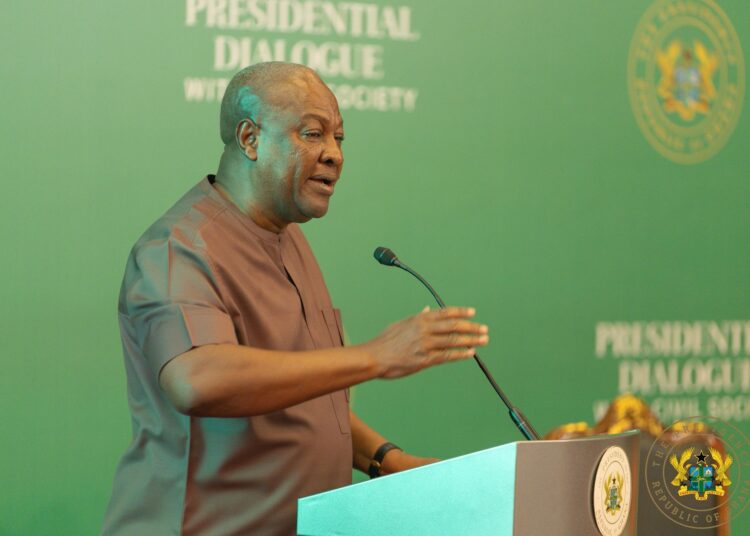
President John Dramani Mahama has commended the Ghana Gold Board (GoldBoard) for achieving a dramatic operational turnaround, while urging the institution to ensure its long-term financial growth relies on core institutional strength rather than temporary economic tailwinds.
Writing as a minerals and extractive industry analyst, the president’s spotlight on the statutory gold regulator highlights a significant surge in profitability, jumping from GH¢178.5 million in 2024 to approximately GH¢896.5 million in net profit.
The Ghanaian leader emphasized that establishing transparent, accountable, and nationally beneficial structures around the country’s precious metals trade remains vital to securing enduring economic value.
“These results deserve commendation. They must, however, be sustained through stronger core operations and cannot depend indefinitely on just a better business environment and the exchange rate movements. A one-year turnaround is encouraging, but sustained performance is the real test.”
President John Dramani Mahama

Expanding on these findings, the government’s latest entity spotlight underscores how structural reforms in Ghana’s extractive sector can rapidly unlock value.
Ghana’s gold trade framework has historically suffered from fragmented oversight, informal leakages, and inadequate revenue capture from small-scale and artisanal mining operations.
By consolidating trade, assaying, and export processes under a centralized, transparent model, the GoldBoard managed to capture higher volume flows and optimize revenue collection within twelve months.
However, sustaining this impressive multi-fold profit surge requires continuous operational refining, strict oversight of licensed buyers, and deeper domestic value addition through local refining and minting.
Navigating the Tailwinds: Macroeconomic Drivers vs. Operational Fundamentals
A critical examination of the GoldBoard’s GH¢896.5 million net profit reveals that external economic factors played a major role in driving these financial gains. Global gold prices hit historic highs across recent trading cycles, creating an exceptionally favorable environment for gold-exporting nations like Ghana.
Concurrently, local currency fluctuations and exchange rate movements significantly augmented foreign exchange conversions when converting dollar-denominated bullion sales back into local currency.

While market conditions provided substantial support, long-term corporate viability cannot depend solely on cyclical commodity booms.
As President Mahama noted in his commentary, “This must, however, be sustained through stronger core operations and cannot depend indefinitely on just a better business environment and the exchange rate movements.“
For the GoldBoard to build resilient operations, its core revenue drivers such as assaying fees, aggregation charges, and export licensing must remain profitable even during market downturns or local currency stabilization periods.
Institutionalizing Transparency and Governance in Ghana’s Extractive Sector
The shift from the former Precious Minerals Marketing Company (PMMC) framework to a modern, empowered GoldBoard represents an effort to eliminate systemic leakages in the extractives value chain.
For decades, illicit gold smuggling and illegal artisanal mining (galamsey) drained billions of dollars from the national treasury, bypassing formal banking channels and foreign exchange reserves.

Establishing rigorous tracking, digital tokenization, and strict buying protocols has channeled a larger share of artisanal gold into legitimate state export pipelines.
To maintain institutional momentum, governance structures must enforce absolute transparency across all purchase, assay, and export operations.
Independent auditing of bullion valuations, public disclosure of off-taker contracts, and strict compliance with global sourcing standards (such as OECD due diligence guidelines) are necessary to safeguard national credibility.
Strengthening internal capacity will ensure that accountability remains an institutional standard rather than a temporary achievement.
Testing Resilience Beyond the First-Year Turnaround
In extractive sector management, a single-year financial recovery provides a promising initial outcome, but it does not guarantee long-term viability.
The extractive industry is subject to sharp price fluctuations, regulatory shifts, and geopolitical pressures. President Mahama highlighted this reality by stating that “A one-year turnaround is encouraging, but sustained performance is the real test.”

To pass this long-term test, the GoldBoard must reinvest its short-term profits into sustainable infrastructure.
Priorities include expanding local assaying laboratories across major mining districts, supporting environmentally responsible small-scale mining cooperatives, and upgrading state-of-the-art gold refineries to process bullion locally prior to export.
Moving up the value chain from raw gold trading to high-grade refined bullion and minting will protect national revenues from global price shocks. Only through disciplined operational management can the GoldBoard anchor Ghana’s economic sovereignty for generations to come.
READ ALSO: Profit Without Dividend Is Not Public Value, SIGA Boss Tells State Boards